
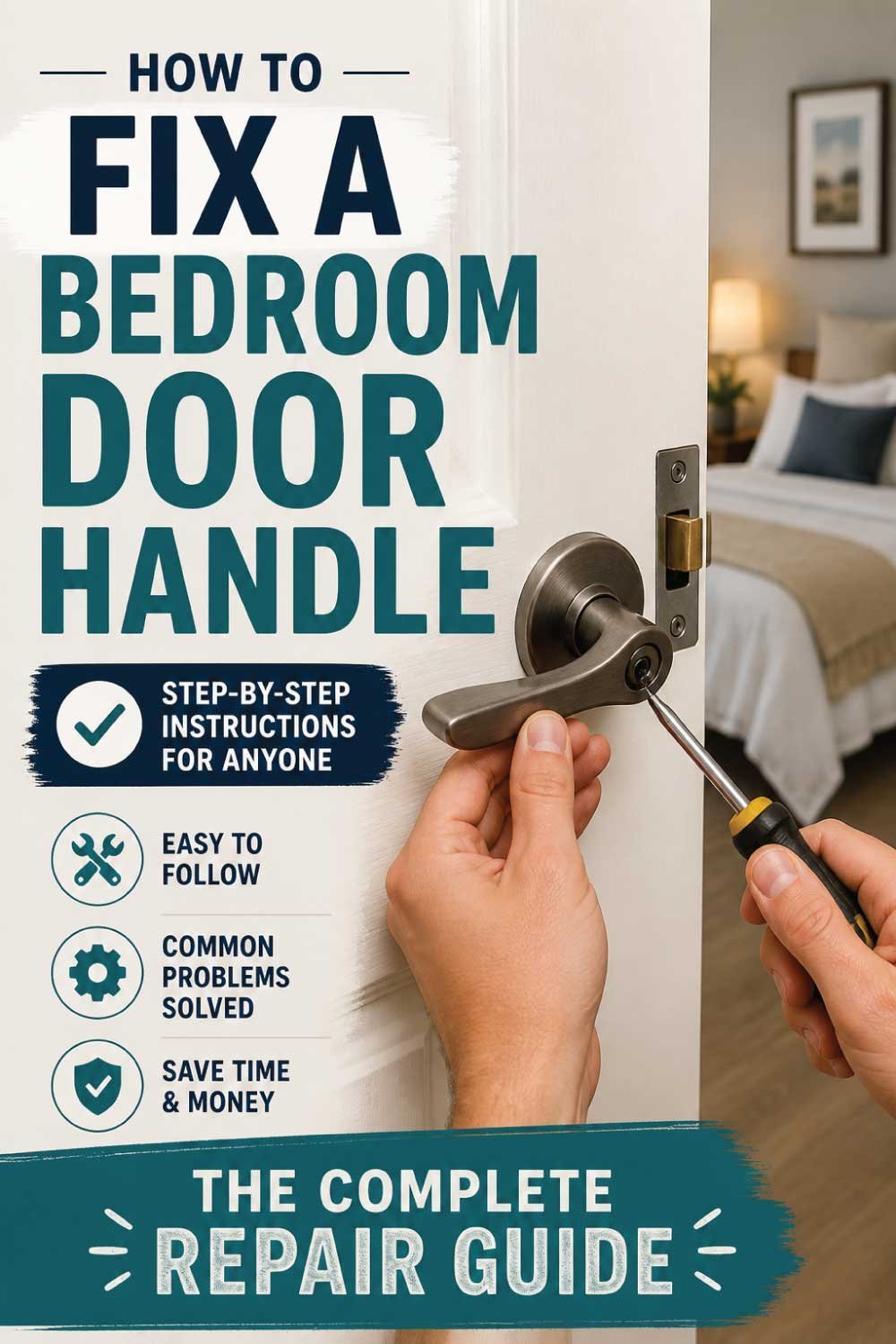
A bedroom door handle that spins uselessly, sticks, won’t latch, feels loose and wobbly, or simply refuses to turn is one of those small problems that becomes a big annoyance fast, especially when it’s your bedroom and privacy matters. The good news is that door handle problems are almost always fixable without a locksmith or a contractor. Most repairs take 20–45 minutes, cost very little, and require nothing beyond basic household tools.
This guide covers every common bedroom door handle problem in detail from loose handles and sticky latches to spinning knobs, broken mechanisms, and full handle replacements so you can diagnose your exact issue and fix it correctly the first time.
Understanding Your Bedroom Door Handle
Before diving into repairs, it helps to know what type of handle you have and how it works. Bedroom door hardware comes in a few main styles, and the internals differ slightly between them.
Door Knobs
The classic round knob is the most common bedroom door handle in homes built before the 1990s. Turning the knob rotates a spindle inside the door that retracts the latch bolt, allowing the door to open. Most interior knobs use a simple privacy lock — a small push-button or twist lock on the interior side with an emergency release slot on the exterior.
Lever Handles
Lever handles are increasingly common in modern homes and are required by building codes in many areas for accessibility reasons. They work on the same latch mechanism as knobs but use a lever that pushes down rather than a twist motion. Levers are easier to operate but more prone to catching on clothing and being accidentally pushed down.
The Latch Mechanism
Regardless of whether your door has a knob or lever, the actual latching hardware inside the door is largely the same. The latch mechanism consists of a spring-loaded latch bolt (the angled metal tongue that pops out from the door edge), a spindle that connects both handles, and a rose plate or escutcheon on each side of the door. When you turn the knob or push the lever, the spindle retracts the latch bolt so the door can open.
Understanding this lets you quickly identify whether the problem is in the handle itself, the spindle connection, the latch mechanism, or the strike plate on the door frame.
Tools You will Need
Most door handle repairs require only:
- Phillips and flathead screwdrivers
- Allen wrench set (hex keys)
- Needle-nose pliers
- Utility knife
- Hammer
- Drill with bits (for replacements)
- Tape measure
- Lubricant (silicone spray or dry PTFE spray)
- Replacement parts as needed
Fix 1: Loose Door Handle or Knob
A handle that wobbles, rattles, or feels sloppy when you grab it is one of the most common door hardware complaints. It almost always means a screw has come loose or the handle has worked free from its mounting.
Finding the Screws
The location of the mounting screws depends on how your handle is assembled:
Visible screws: Some handles have two screws visible on the interior rose plate (the round or rectangular backing plate). These are easy — simply tighten them with a Phillips screwdriver.
Hidden screws with a cover plate: Many modern handles have a decorative cover that snaps or screws over the rose plate, hiding the mounting screws underneath. Look for a small notch or slot on the edge of the rose plate — insert a flathead screwdriver and gently pry to pop the cover off, revealing the screws beneath.
Set screw on the knob neck: Older-style and some decorative knobs use a small set screw on the side or underside of the knob where it meets the rose plate. This is usually a small hex (Allen) screw — look for it while slowly rotating the knob until you feel it under your thumb, or look directly at the neck of the knob in good light. Tighten it with the appropriate Allen wrench.
Tightening the Handle
Once you’ve located the screws, tighten them firmly — but don’t overtighten, as the screws thread into the opposite handle’s tailpiece and excess force can strip the threads. Tighten until snug, test the handle, and check that it operates smoothly before replacing any cover plate.
If the screws tighten but the handle still feels loose, the screws may be stripped. In that case, try slightly longer screws of the same thread diameter, or wrap the screw threads with a small piece of thread-seal tape (plumber’s tape) before reinserting — this adds grip without replacing the full mechanism.
Fix 2: Door Handle That Won’t Turn or Turns Stiffly
A handle that’s stiff, hard to turn, or feels like it’s grinding internally usually has one of three causes: lack of lubrication, a bent or misaligned spindle, or a worn internal mechanism.
Lubricate First
Before assuming a mechanical problem, lubricate the mechanism. This solves stiff handles surprisingly often.
- Spray a small amount of dry silicone lubricant or PTFE spray into the keyhole (if present), around the spindle where it enters the knob, and along the latch bolt at the door edge.
- Work the handle back and forth repeatedly to distribute the lubricant into the mechanism.
- Wipe away any excess from the door surface.
Do not use WD-40 as a primary lubricant for door handles — it’s a solvent and water displacer, not a lasting lubricant. It will feel better briefly but dries out quickly and can leave residue that attracts dust and makes the problem worse over time. Silicone spray is the correct product.
Check the Spindle Alignment
The spindle is the square or round metal bar that passes through the door and connects both handle sides. If this spindle is even slightly bent or has slipped sideways in its channel, it creates friction that makes the handle stiff or prevents it from operating at all.
- Remove one handle (see removal steps in Fix 5 below).
- Inspect the spindle. It should be straight and centered in the latch mechanism hole.
- If bent, attempt to straighten it with pliers, or replace the spindle (these are inexpensive and sold at hardware stores).
- If the spindle has simply slipped to one side, reposition it centrally and reinstall the handle.
Worn Internal Mechanism
If lubrication and spindle inspection don’t solve the problem, the internal mechanism — the spring and cam assembly inside the handle that retracts the latch — is worn out. At this point, replacement of the handle set is the most practical solution (see Fix 5).
Also Read:
How to Fix a Bedroom Door: The Complete Guide to Every Common Problem
Fix 3: Handle That Spins Freely Without Operating the Latch
A knob or lever that spins or moves freely without retracting the latch is a very specific failure — and it means the connection between the handle and the spindle has broken down. You turn the knob, but nothing happens. This is one of the more frustrating handle failures because it can leave you locked in or out of a room.
The Most Common Cause
On knobs, the most common cause is a failed set screw — the small hex screw on the neck of the knob that grips the spindle has come loose. The knob rotates freely around the spindle without gripping it, so no rotational force is transferred to the latch.
Fix: Locate the set screw on the neck of the knob (look for a small hole on the side or underside of the knob shank). Tighten it firmly with an Allen wrench of the correct size. If the set screw is stripped or missing, purchase a matching replacement screw at a hardware store.
On Levers
Lever handles that drop down without operating the latch usually have a broken or disengaged return spring inside the mechanism, or the lever has pulled free of its connection to the spindle. In most cases, replacement of the lever handle set is more practical than attempting to repair the internal spring assembly.
Emergency Exit if Stuck Inside
If the handle has failed and you’re inside the room unable to open the door:
- Try the latch bolt directly — push the door toward the frame while pressing the latch bolt in with a finger or thin tool. Many latches can be manually retracted this way.
- Use a credit card or thin flexible tool along the door edge at latch height to push the angled face of the latch bolt back while pulling the door toward you.
- If the door has a privacy lock engaged, look for the small slot on the exterior knob and insert a thin flathead screwdriver or the provided emergency key to turn the lock.
Fix 4: Sticky or Stuck Latch Bolt
The latch bolt — the spring-loaded angled tongue at the door’s edge — is a mechanical part that can become sticky, slow to retract, or fail to spring back out after being pushed in. This results in a door that won’t latch closed, doesn’t click shut, or requires the handle to be held turned while the door is pulled closed.
Cleaning and Lubricating the Latch
- With the door open, manually push the latch bolt in and out several times. Does it spring back quickly and fully? A healthy latch snaps back firmly. A slow, sluggish, or partial return indicates a weak or dirty spring mechanism.
- Spray silicone lubricant directly onto the latch bolt and into the latch mechanism housing at the door edge. Push and release the latch bolt repeatedly to work the lubricant in.
- If this doesn’t improve the action, the latch mechanism needs replacement.
Replacing Just the Latch
The latch mechanism is the rectangular assembly that sits in the door edge and contains the latch bolt. This can be replaced independently of the full handle set in many cases.
- Unscrew the two screws on the latch face plate (the rectangular metal plate on the door edge).
- Pull the latch mechanism out of the door.
- Take it to a hardware store — match the length (the most common sizes are 2-3/8 inch and 2-3/4 inch backset, measured from the door edge to the center of the handle hole) and the face plate dimensions.
- Slide the new latch into the door, align the face plate, and screw it down.
- Test operation before reassembling the handles.
Latch Not Reaching the Strike Plate
If the latch bolt springs out correctly but doesn’t fully engage the strike plate hole, the door isn’t latching securely. This is a strike plate alignment issue rather than a handle problem — the strike plate on the door frame needs adjustment. Refer to the door frame repair guide for detailed steps on repositioning and adjusting a strike plate.
Also Read:
Fix 5: Replacing a Bedroom Door Handle (Full Replacement)
When a handle is too worn to repair, broken, or you simply want to update the hardware, full replacement is a straightforward project. All interior door handles are designed for easy DIY installation.
Step 1: Measure Before You Buy
Two measurements determine which handle will fit your door:
Backset: The distance from the edge of the door to the center of the handle hole. Standard backsets are 2-3/8 inches (common in older homes) and 2-3/4 inches (common in newer construction). Measure carefully — using the wrong backset means the latch won’t reach the strike plate.
Bore size: The diameter of the large hole through the door face that the handle mechanism passes through. Standard bore is 2-1/8 inches. Most modern handles fit this, but verify before purchasing.
Step 2: Remove the Old Handle
For handles with visible screws:
- Unscrew the two screws on the interior rose plate.
- Pull both handle halves away from the door.
- Unscrew the latch face plate on the door edge and slide the latch mechanism out.
For handles with a cover plate:
- Pop off the decorative cover with a flathead screwdriver at the notch.
- Unscrew the mounting screws beneath.
- Pull both sides free and remove the latch.
For knobs with a set screw:
- Locate and loosen the set screw with an Allen wrench.
- Pull the knob straight off the spindle.
- The rose plate will either unscrew or have a notch for prying.
- Remove the latch from the door edge.
Step 3: Install the New Latch
- Slide the new latch mechanism into the door edge hole, with the angled face of the latch bolt facing the direction the door closes (the angled face should point toward the door frame, so it compresses against the strike plate as the door closes).
- Align the face plate and drive the two screws to secure it.
Step 4: Install the New Handles
- Thread the exterior handle spindle through the latch mechanism hole in the door.
- Fit the interior handle onto the spindle from the other side, aligning the mounting holes.
- Drive the mounting screws through the interior rose plate, through the door, and into the threaded posts of the exterior handle. Tighten firmly but not so hard as to strip.
- For knobs with set screws, tighten the set screw against the spindle flat.
- Snap on any decorative cover plates.
Step 5: Test Thoroughly
Before considering the job done, test all operations:
- Does the latch retract smoothly when you turn the handle?
- Does the latch spring back out fully and quickly when released?
- Does the door latch click closed properly?
- Does the privacy lock engage and release correctly?
- Does the exterior emergency release work?
Adjust the strike plate on the door frame if the latch isn’t engaging cleanly.
Fix 6: Privacy Lock Not Working
Bedroom doors typically have a simple privacy lock — a push-button or twist knob on the interior side that locks the door without a key. When this lock fails (won’t engage, won’t release, or is accidentally locked with no one inside), it’s a specific and fixable issue.
Lock Won’t Engage
If pushing or twisting the privacy button does nothing, the locking mechanism inside the handle has failed. In most cases this means replacing the handle set. Before doing so, try removing the handle and checking that the locking cam inside the mechanism isn’t dislodged — sometimes it can be repositioned without full replacement.
Lock Accidentally Engaged (Locked Out)
All privacy lock handles include an emergency release on the exterior side — a small slot or hole in the center of the exterior knob or on the trim plate. Insert a thin flathead screwdriver, a coin, or the dedicated privacy pin that came with the handle set, and turn or push to release the lock. This works on virtually every residential privacy handle regardless of brand.
If the emergency release is broken or missing, a thin stiff wire or bobby pin can often reach the internal release mechanism through the hole.
Upgrading Privacy Lock Security
Standard bedroom privacy locks offer minimal actual security — they’re designed for privacy, not security, and can be opened easily from outside. If you want more security on a bedroom door, consider replacing the standard privacy handle set with a keyed entry handle or adding a secondary surface-mount bolt lock or chain lock higher on the door.
Common Mistakes to Avoid
Using WD-40 as a lubricant: It works briefly but dries out and creates sticky residue. Always use silicone or dry PTFE spray for door hardware.
Overtightening mounting screws: The interior and exterior handles are connected through the door, and over-tightening compresses the mechanism, causing stiffness. Tighten until snug, then test the action.
Buying the wrong backset: Always measure your backset before purchasing a replacement. A 2-3/8 inch backset handle in a 2-3/4 inch door will leave the latch too short to reach the strike plate.
Installing the latch backwards: The angled face of the latch bolt must face toward the door frame (so it deflects off the strike plate when closing). An upside-down or reversed latch won’t function and may damage the frame.
Ignoring strike plate alignment after replacement: A new latch mechanism may sit at a very slightly different position than the old one. Always check that the latch aligns with the strike plate hole and adjust if needed.
Maintenance Tips to Keep Handles Working Smoothly
Lubricate annually. A light application of silicone spray to the latch bolt and handle mechanism once a year prevents the stiffness and wear that leads to failures.
Tighten screws every year. Handle screws work loose through daily use. A quick check and tightening takes two minutes and prevents the wobbling that leads to spindle damage.
Don’t hang things on lever handles. Bags, belts, and clothing hung on lever handles stress the internal spring mechanism and cause premature failure.
Address stiffness early. A handle that’s starting to feel stiff is telling you it needs lubrication or a minor adjustment. Addressing it immediately prevents the problem from progressing to a complete failure.
Final Thoughts
A bedroom door handle is one of the most-used pieces of hardware in your home — touched multiple times every single day. When it fails, it fails noticeably. The reassuring reality is that every common handle problem has a clear solution, and the parts are inexpensive and widely available.
Start with the simplest fix: lubrication solves a surprising percentage of handle problems. Then work through the mechanical checks — set screws, spindle alignment, latch operation — before committing to a full replacement. When replacement is necessary, the process is genuinely simple and the upgrade opportunity is real: new hardware improves both the function and the look of a bedroom door instantly.
Take your time with the diagnosis, match your replacement parts carefully, and test every function before calling the job complete.