
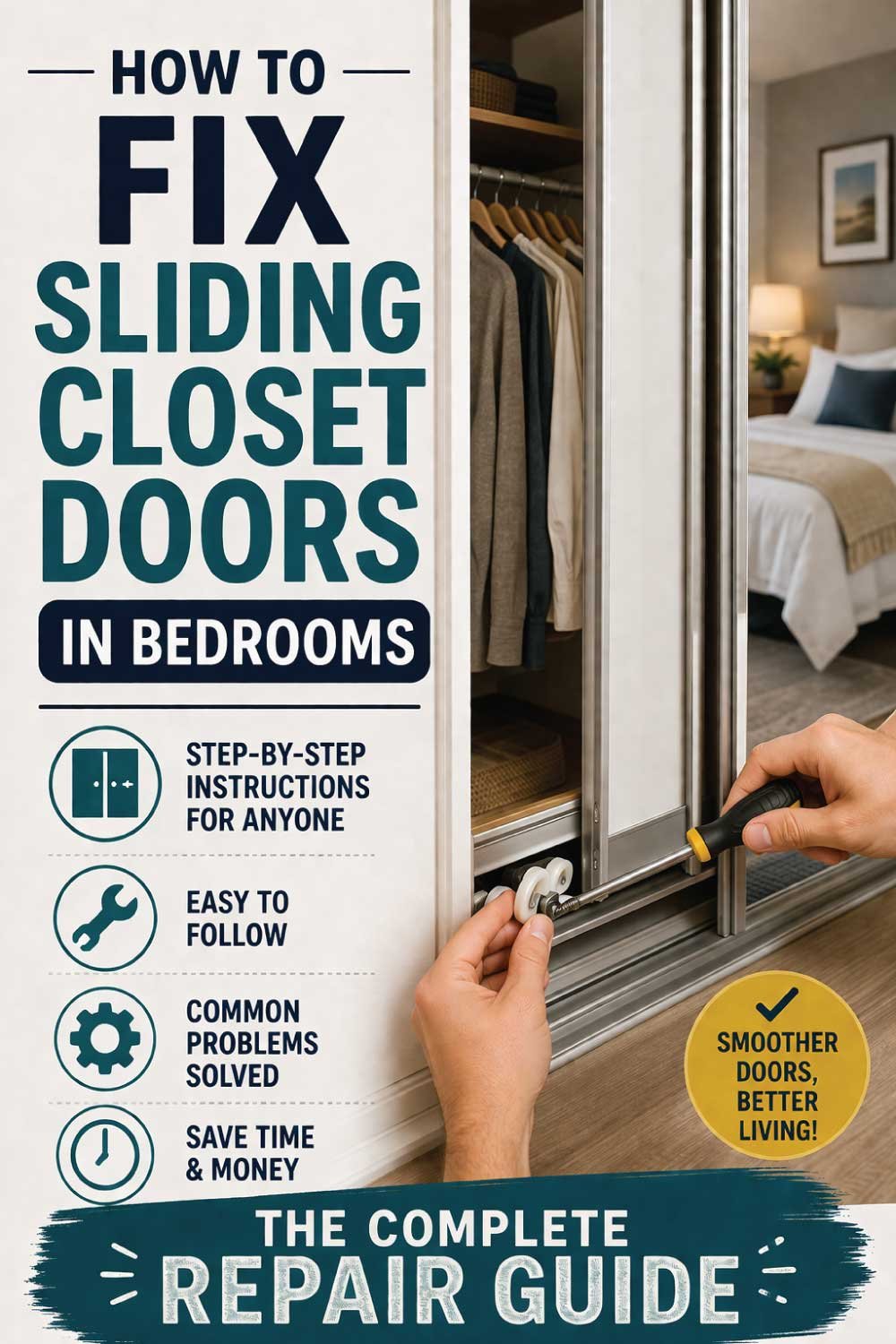
Sliding closet doors are one of those things you never think about, until they stop working. A door that jumps off its track, drags along the floor, refuses to slide smoothly, or sits crooked in the frame turns a simple task like grabbing a shirt into a daily frustration.
The aggravating part is that these problems almost never fix themselves, and they tend to get worse the longer you ignore them.
The good news: virtually every sliding closet door problem is fixable without calling a handyman, and most repairs take less than an hour.
This guide covers every common issue from doors off their tracks to broken rollers, misaligned panels, and damaged hardware and gives you clear, step-by-step instructions to get everything gliding smoothly again.
Understanding How Sliding Closet Doors Work
Before diagnosing problems, it helps to understand the basic mechanics. Most sliding closet door systems work on one of two setups:
Top-hung systems: The door hangs from rollers or carriers that ride inside a track mounted at the top of the door frame. The bottom of the door sits in a shallow guide channel that keeps it from swinging in or out, but carries no weight. This is the most common type in modern homes.
Bottom-rolling systems: The door rolls on wheels that ride along a track at the floor level. A top track or guide keeps the door upright but carries no weight. This system is common in older homes and with heavier mirror doors.
Bypass doors vs. bi-fold doors: Bypass doors are the classic two-panel sliding system where one panel slides in front of the other. Bi-fold doors fold in half as they open, using a pivot system at top and bottom. The repairs for each type differ significantly, and this guide covers both.
Knowing your system type helps you go directly to the right fix rather than guessing.
Tools and Materials You will Need
Most sliding door repairs require only basic tools. Gather these before you start:
- Flathead and Phillips screwdrivers
- Pliers and needle-nose pliers
- Hammer
- Rubber mallet
- Level
- Tape measure
- Drill with bits
- Utility knife
- Vacuum cleaner and stiff brush (for track cleaning)
- Lubricant: silicone spray or dry PTFE spray (not WD-40 or oil-based products)
- Replacement rollers or carriers (match your existing hardware)
- Replacement track (if damaged)
- Wood screws
- Adjustable wrench
Fix 1: Door Off the Track
This is the most common sliding door problem and the most alarming-looking but it’s usually the easiest to fix. A door that has jumped off its track looks like a major failure but often takes under ten minutes to resolve.
Why It Happens
Doors come off tracks because of worn rollers, a bent or dirty track, someone lifting and pulling the door at the wrong angle, or a track that was never properly secured to begin with.
Step-by-Step: Reinstalling a Top-Hung Bypass Door
Remove the door completely. Lift the door straight up, the bottom guide channel is shallow, so the bottom of the door will clear it, then angle the bottom of the door toward you and lower it free of the top track. Have a second person help with heavy mirror doors.
Inspect the rollers. Look at the wheels or carriers at the top of the door. Are they cracked, broken, or seized? If the rollers spin freely and look intact, the problem was simply the door coming loose rather than hardware failure. If rollers are damaged, replace them before reinstalling (see Fix 3).
Inspect and clean the track. Look inside the top track for debris, bent sections, or buildup. A clogged or bent track is often the reason the door came off in the first place. Clean it thoroughly (see Fix 2) and straighten any minor bends with needle-nose pliers.
Reinstall the door. Angle the top of the door into the track first, hooking the rollers onto the track rail. Once the top is secure, swing the bottom of the door toward the frame and drop it into the bottom guide channel. Slide the door back and forth to confirm it moves freely.
Adjust the roller height if needed. Most roller carriers have an adjustment screw that raises or lowers the door. If the door drags on the floor or has too much clearance at the bottom, adjust both rollers equally until the door hangs level and clears the floor by about 1/8 to 1/4 inch.
Step-by-Step: Reinstalling a Bottom-Rolling Door
Tilt the top of the door away from the frame to release it from the top guide.
Lift the door to free the bottom rollers from the floor track.
Clean the floor track and inspect the rollers.
Drop the bottom rollers back into the floor track, then tilt the top of the door back under the top guide until it clips or slides into place.
Also Read:
Fix 2: Dirty or Clogged Track
A sliding door that was once smooth but now drags, grinds, or stutters almost always has a dirty track. Dust, hair, debris, and old dried lubricant accumulate in the track channel and create friction that makes sliding feel like work.
Cleaning a Sliding Door Track
- Remove the door using the method described in Fix 1. Working with the door out of the way gives you full access to the track.
- Vacuum the track. Use a vacuum with a narrow attachment to pull out loose debris from the entire length of the track — both the top track and bottom guide.
- Scrub the track. Dip an old toothbrush or stiff-bristled brush in warm soapy water and scrub the inside of the track channel. For stubborn buildup, a butter knife wrapped in a cloth or a flat-head screwdriver with a rag works well to reach into the channel corners.
- Wipe clean. Use a damp cloth to wipe the track interior completely. Make sure no soap residue or grit remains.
- Dry thoroughly. Any moisture left in the track can accelerate corrosion on metal tracks or cause swelling in wooden tracks.
- Lubricate correctly. This step is critical and commonly done wrong. Do NOT use WD-40, petroleum jelly, or any oil-based lubricant on sliding door tracks. These attract dust and debris, making the problem worse within weeks. Instead, use a dry silicone spray or dry PTFE (Teflon) spray. These lubricate the track without leaving a sticky residue that collects dirt. Spray lightly along the full length of the track, then wipe away any excess.
- Reinstall the door and test. The improvement is usually immediate and dramatic.
How often to clean: Clean sliding door tracks every 6–12 months as routine maintenance, or any time the door starts feeling stiff. A two-minute cleaning session every few months prevents most sliding door problems from developing.
Fix 3: Worn or Broken Rollers
If your door jumps off the track repeatedly, makes grinding or clicking sounds, or simply won’t slide smoothly even after track cleaning, the rollers are likely worn, cracked, or seized. Rollers are the small wheels or carrier assemblies that the door hangs or rolls on, and they wear out over years of use.
Identifying Bad Rollers
Remove the door and flip it on its side (lay it on carpet or a padded surface to protect the finish). Look at the rollers:
- Do the wheels spin freely? Seized rollers that don’t spin will grind along the track rather than roll.
- Are the wheels cracked, chipped, or worn flat on one side?
- Is the roller assembly bent, broken, or pulling away from the door?
Any of these mean replacement is needed.
Finding Replacement Rollers
Take the old roller to a hardware store or home improvement center to match it. Key measurements are the wheel diameter, the wheel width, and how the carrier attaches to the door (most screw into the top edge or side of the door). Many sliding door rollers are standardized, but taking the old one for comparison eliminates guesswork.
If the door is older and parts are hard to find locally, search online using the brand name stamped on the track hardware or take measurements to find a compatible replacement.
Replacing Rollers on a Bypass Door
-
Remove the door and lay it flat on a protected surface.
-
Unscrew the old roller assembly from the top of the door. Note the position and angle before removing photograph it if needed.
-
Screw the new roller into the same position. Most rollers have an adjustment screw; set it to the middle of its range to start.
-
Reinstall the door on the track.
-
Adjust the roller height screws until the door hangs level, clears the floor by 1/8 inch, and slides without binding.
Replacing Rollers on a Bottom-Rolling Door
-
Remove the door. Bottom rollers are usually mounted in a bracket on the bottom edge of the door.
-
Unscrew or pry out the old roller bracket.
-
Snap or screw the new roller bracket into position.
-
Reinstall the door and test the slide.
Also Read:
Fix 4: Door That Drags on the Floor
A sliding closet door that scrapes along the floor is noisy, difficult to move, and will eventually damage both the door’s bottom edge and the flooring underneath. The cause is almost always one of three things: rollers that need adjusting, rollers that are worn down, or a floor track that has been pushed up or is no longer level.
Adjusting Roller Height (Top-Hung Doors)
Most top-hung door rollers have an adjustment screw usually accessible through a small hole in the door face near the top, or visible on the roller carrier itself when the door is removed.
-
Locate the adjustment screw on each roller (there’s one roller at each end of the door for bypass doors).
-
Turn the screw clockwise to raise the door, counter-clockwise to lower it. The adjustment is usually small, a quarter turn moves the door a few millimeters.
-
Adjust both rollers equally to keep the door level.
-
Test after each adjustment until the door clears the floor with a consistent 1/8-inch gap.
Fixing a Raised Floor Track (Bottom-Rolling Doors)
If the floor track has buckled, shifted, or a section has been pushed upward (common if something heavy was dropped on it), the rollers will catch on the high spot.
-
Try pressing the raised section back down with firm thumb pressure.
-
If it won’t stay flat, remove the track (usually held by small screws), flatten it on a hard surface using a rubber mallet, and reinstall.
-
If the track is too damaged to flatten properly, replacement track sections are inexpensive and sold at hardware stores.
Also Read:
Fix 5: Door That Won’t Stay in the Track (Keeps Popping Out)
If your door repeatedly jumps out of the bottom guide channel or pops out of the top track during normal use, the guide or track is likely damaged, improperly sized, or missing entirely.
Bottom Guide Replacement
The bottom guide is the small plastic or metal piece centered in the floor that keeps the door from swinging. These get cracked, broken, or simply lost when doors are removed and reinstalled.
-
Find the old guide (it may be partially broken and still in place, or completely gone).
-
Take it to a hardware store to find a matching replacement, or measure the door thickness to find a compatible guide.
-
The new guide usually screws into the floor at the center of the door opening. Position it so the door panel slides freely through the guide channel without binding.
Top Track Clip Repair
Some top-hung systems use a clip or retaining tab that keeps the roller in the track. If this clip is bent or broken, the door will repeatedly pop out of the track on that side.
Inspect the top track for bent or missing retaining tabs. These can sometimes be bent back into shape with needle-nose pliers. If broken, a section of replacement track may be necessary.
Fix 6: Bi-Fold Closet Door Repairs
Bi-fold doors fold rather than slide, using a different hardware system that has its own set of common problems.
Door Won’t Fold or Unfold Smoothly
Bi-fold doors pivot on a pin at the top and bottom of the door and are guided by a carrier that rides inside the top track. If the door feels stiff, binds at the fold, or won’t open fully:
- Check the pivot pins. The bottom pivot pin sits in a small bracket on the floor. The top pin fits into a bracket on the door frame. Both pins should be secure, straight, and in good condition. Bent or missing pins cause the door to sit crooked and bind.
- Lubricate the carrier. The top carrier that rides in the track is the most common source of stiffness. Spray dry silicone lubricant into the top track and work the door back and forth.
- Adjust the door alignment. Most bi-fold pivot brackets have adjustment screws that allow you to move the door left, right, up, or down slightly. If the door rubs against the frame or leaves a large uneven gap, adjust the pivot brackets until the door hangs evenly.
Bi-Fold Door Off the Track
Find the top carrier the wheeled piece that rides in the top track and check that it’s still seated in the track. If it has popped out, press it back in firmly.
Check the top pivot bracket. If the door has swung outward, the top pivot pin may have slipped out of its bracket. Lift the door at the top, realign the pin with the bracket, and press it back in.
If the bottom pivot pin has slipped out of its floor bracket, lift the door slightly and reseat the pin into the bracket cup.
Loose or Broken Bi-Fold Hinges
The hinges connecting the two panels of a bi-fold door get significant stress every time the door is used. Loose hinge screws cause the panels to sag and bind.
Tighten all hinge screws with a screwdriver. If the screw holes are stripped, use the toothpick-and-wood-glue method: dip wooden toothpicks in wood glue, pack them into the stripped hole, let dry, then redriving the screw. If hinges are bent or cracked, replace them with identical hardware.
Fix 7: Closet Door That Won’t Stay Closed
A sliding closet door that drifts open on its own is usually caused by a floor that isn’t perfectly level, or a missing/worn door bumper.
Door bumpers are small rubber or plastic stops that prevent the door from sliding past the closed position. Check both ends of the track there should be a bumper or stop at the closed position for each panel. If missing, purchase replacements at a hardware store and press or screw them into position.
Floor leveling issues: If the floor slopes slightly toward the closet opening, gravity will pull the door open. One solution is to adjust the roller height so the door hangs with a very slight lean toward the closed position. Another is to add a small magnetic door catch, a magnet mounted on the door frame that holds the door closed when it reaches the closed position.
Fix 8: Damaged or Bent Track
A track that is bent, corroded, or has sections pulling away from the wall or ceiling is beyond cleaning and lubricating — it needs repair or replacement.
Minor bends: Use needle-nose pliers to carefully straighten bent sections. Work slowly and check frequently over-bending in the other direction is easy to do.
Loose track: If the track is pulling away from the wall, ceiling, or floor, resecure it with screws. Make sure screws are driving into solid wood or wall studs for a secure hold. Pre-drill to avoid splitting.
Replacement track: If the track is severely bent, corroded, or broken, replacement is the right call. Bring the old track to a hardware store to match the profile, tracks come in different widths and depths. Full track replacement requires removing the doors, unscrewing the old track, cutting new track to length if needed, and installing with screws into solid backing.
Maintenance Tips to Prevent Future Problems
Once your sliding closet doors are working smoothly, a small amount of regular maintenance keeps them that way.
-
Clean tracks every 6 months. A quick vacuum and wipe-down takes five minutes and prevents debris buildup that causes most sliding door problems.
-
Lubricate twice a year. A light application of dry silicone spray on the tracks and roller wheels keeps everything moving freely.
-
Don’t force a sticking door. If a door starts to feel stiff, clean and lubricate before pushing harder. Forcing a sticking door bends tracks and damages rollers.
-
Check roller adjustment screws annually. Rollers can drift out of adjustment over time, especially if the door is used heavily. A quick check and minor adjustment keeps the door hanging correctly.
-
Inspect pivot pins on bi-fold doors. These work themselves loose slowly. A quick tightening once a year prevents the gradual lean that leads to binding.
When to Replace Instead of Repair
Most sliding closet door problems are absolutely worth repairing parts are inexpensive and the repairs are straightforward. But in some cases, replacement makes more sense:
- The door panels themselves are cracked, split, or severely warped
- Mirror panels are broken (a safety concern)
- The track system is completely corroded or the wrong type for your opening
- The doors are extremely outdated and you want to update the look of the bedroom
New sliding closet door systems are available as complete kits at home improvement stores, including track, hardware, and sometimes panels, making full replacement more accessible than most people expect.
Final Thoughts
Sliding closet doors have a reputation for being finicky, but the truth is that the vast majority of problems come down to a few simple issues: dirty tracks, worn rollers, and hardware that needs minor adjustment. Address these and the door that’s been annoying you for months will glide like new.
The most important habits are diagnosing carefully before grabbing tools, knowing whether you have a top-hung or bottom-rolling system, and whether you’re dealing with bypass or bi-fold doors, sends you directly to the right fix without wasted effort.
Work through the simplest solutions first: clean the track, lubricate properly, adjust the rollers. In most cases, that’s all it takes. When parts are truly worn out, replacements are inexpensive and widely available.
A smoothly operating sliding closet door is one of those small details that makes everyday life genuinely more pleasant — and getting there usually takes less time than you’d expect.