
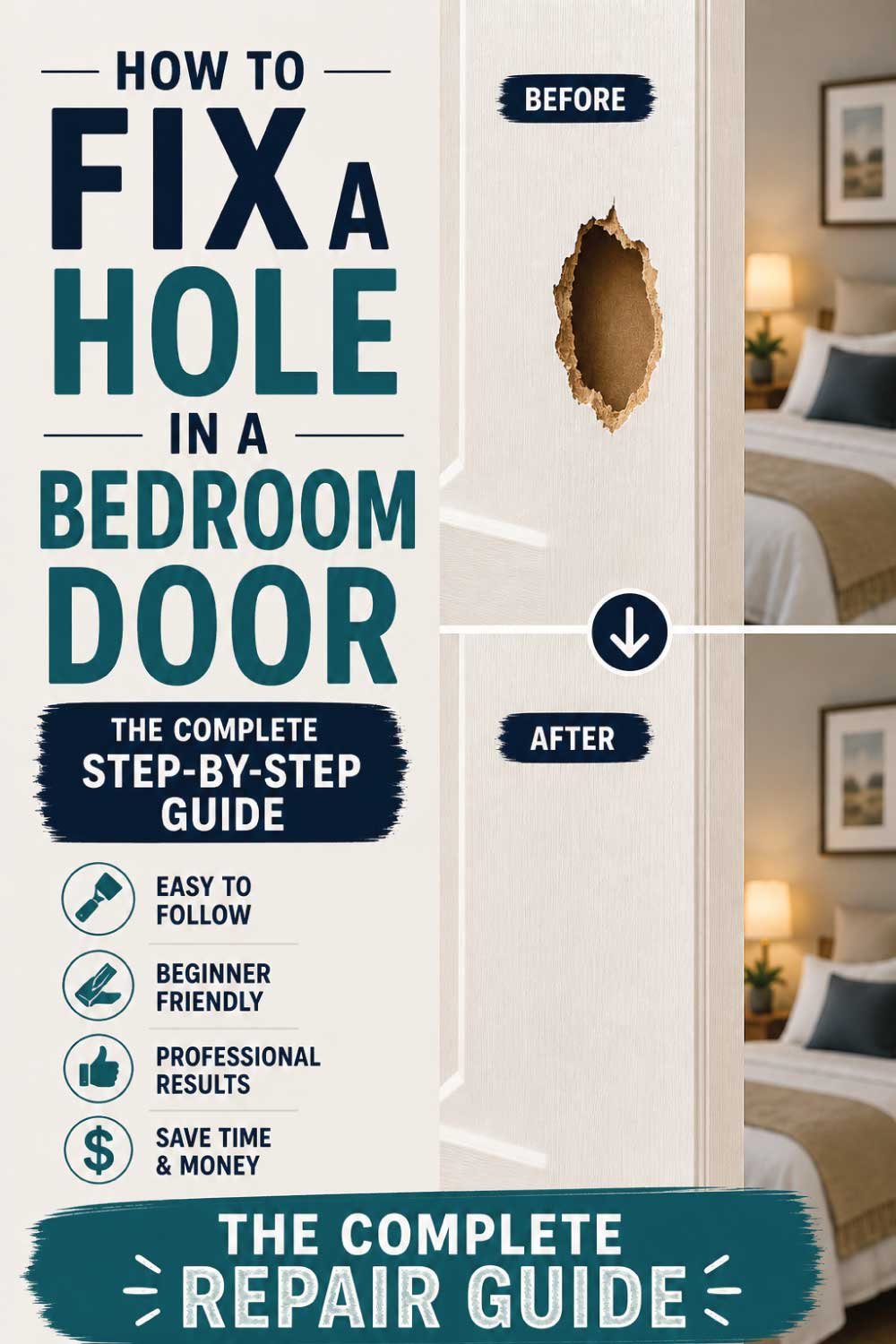
A hole in a bedroom door is one of those problems that’s hard to ignore. Whether it’s a small puncture from a doorknob, a fist-sized dent from a bad day, or a larger section of damage from an accident, a damaged door looks terrible and undermines the privacy and soundproofing you rely on every night.
The good news is that fixing a hole in a bedroom door is absolutely a DIY project, even for beginners and the materials cost a fraction of what a replacement door would run you.
This guide covers every type of hole, from tiny dents to large gaping damage, and walks you through exactly how to repair each one so that the finished result is clean, smooth, and nearly invisible once painted.
Before You Start: Understanding What Your Door Is Made Of
The single most important thing to know before attempting any repair is what kind of door you’re dealing with. Bedroom doors come in two very different constructions, and the repair method is completely different for each.
Hollow-Core Doors
The majority of interior bedroom doors installed in homes built after the 1960s are hollow-core. Despite the name, they aren’t completely hollow — they typically have a cardboard honeycomb or corrugated paper core surrounded by a thin wood veneer skin on each side. The edge is usually solid wood, but the large flat panels are just thin sheets of wood or hardboard over air.
How to identify a hollow-core door: Knock on it with your knuckle. If it sounds like knocking on a cardboard box — a light, resonant thud — it’s hollow-core. You can also check the weight when you open it: hollow-core doors are surprisingly light.
Why this matters: A hollow-core door has no backing material behind the surface skin. This means you can’t simply fill a hole with putty and call it done — the filler has nothing solid to rest against and will crack or fall through. Hollow-core repairs require creating internal support before applying any filler.
Solid-Core and Solid Wood Doors
Older homes, higher-end construction, and doors that were upgraded at some point may have solid-core or solid wood doors. Solid-core doors have a dense composite or particleboard interior; true solid wood doors are made from planks of lumber throughout.
How to identify: Knock — the sound is dull and dense, not resonant. These doors are also significantly heavier than hollow-core versions.
Why this matters: Solid doors are easier to repair because there’s material behind the damage for your filler to bond to. Many repairs on solid doors are as straightforward as filling, sanding, and painting.
Tools and Materials You will Need
Having everything ready before you start saves frustration mid-project. Here’s what you’ll likely need depending on your repair type:
For small holes (under 1 inch):
- Spackling compound or lightweight wood filler
- Putty knife
- Sandpaper (120-grit and 220-grit)
- Primer and paint
For medium holes (1–6 inches) in hollow-core doors:
- Spray foam insulation (minimal expanding type)
- Auto body filler (Bondo) or wood filler
- Putty knife and spreader
- Sandpaper (80-grit, 120-grit, 220-grit)
- Primer and paint
For large holes (over 6 inches) in hollow-core doors:
- Plywood or hardboard patch piece
- Wood screws or construction adhesive
- Auto body filler or joint compound
- Fiberglass mesh tape
- Sandpaper (80-grit, 120-grit, 220-grit)
- Primer and paint
For solid wood doors:
- Wood filler or epoxy wood filler
- Putty knife
- Sandpaper (80-grit, 120-grit, 220-grit)
- Stain or paint to match finish
General tools for all repairs:
- Pencil and ruler or straightedge
- Utility knife or jigsaw
- Drill (for larger repairs)
- Painter’s tape
- Drop cloth or newspaper
- Sanding block
Method 1: Fixing Small Holes (Under 1 Inch) in Any Door
Small holes — from nails, screws, hooks, or minor impact damage — are the simplest repairs you’ll ever do on a door. The process is the same whether your door is hollow-core or solid.
Step 1: Prepare the Hole
Use a utility knife to clean up the edges of the hole. Remove any splinters, loose veneer, or jagged pieces of wood. The goal is a clean, stable edge for the filler to bond to. If there’s any loose material around the hole, press it flat with your fingers or remove it entirely.
For hollow-core doors, be careful not to push material inward once it drops into the cavity, it can rattle around forever.
Step 2: Apply the Filler
For holes under half an inch, spackling compound or lightweight wood filler works perfectly. Load a small amount onto a putty knife and press it firmly into the hole, working it in with a slight overfill — the filler will shrink slightly as it dries, so you want a small mound above the surface rather than a flush application.
For holes between half an inch and one inch, use a slightly thicker filler — auto body filler or a two-part wood epoxy — because it shrinks less and sands more cleanly than lightweight spackling.
Step 3: Let It Dry Completely
This step is where most people rush and ruin the repair. Read the drying time on your filler’s packaging and respect it. Lightweight spackling typically dries in 2–4 hours; wood filler takes 4–8 hours; two-part epoxy may harden in as little as 20–30 minutes but needs a full cure before sanding.
Applying a second coat or sanding too soon traps moisture inside and leads to shrinkage cracks after painting.
Step 4: Sand Smooth
Once fully dry, sand with 120-grit sandpaper to bring the filler down to level with the surrounding surface. Use a sanding block (a small block of wood wrapped in sandpaper) rather than your fingers — a flat block keeps the surface even and prevents low spots. Finish with 220-grit for a surface smooth enough to paint.
Wipe away all dust with a slightly damp cloth and let the area dry.
Step 5: Prime and Paint
Never skip the primer step when painting over filler. Filler is porous and will absorb paint unevenly, leaving a visible patch even after two coats of paint. Apply one coat of primer, let it dry fully, then apply your topcoat paint in thin, even layers. Two thin coats always look better than one thick coat.
If the door is a natural wood finish (stain rather than paint), matching the repair is more challenging. Use a stainable wood filler that matches the wood species, and test your stain color on a scrap piece first.
Also Read:
Method 2: Fixing Medium Holes (1–6 Inches) in Hollow-Core Doors
This is the most common type of bedroom door damage, a fist-sized or doorknob-sized hole. It looks intimidating, but the repair is manageable with the right technique.
Step 1: Clean Up the Damage
Use a utility knife and a straightedge to cut the hole into a clean, regular shape — a square or rectangle. This might feel counterintuitive (making the hole bigger), but a clean geometric shape is far easier to patch than a ragged, irregular hole. The edges of the cut need to be firm and stable.
Remove all debris, loose cardboard, and paper honeycomb from around the interior edges. You need the inside walls of the hollow cavity to be clean for the next step to work.
Step 2: Fill the Cavity with Spray Foam
This is the key technique that makes hollow-core door repair possible. Buy minimal-expanding spray foam insulation (not the maximum-expanding type, which will push out and distort the door skin). Insert the straw applicator into the hole and spray a moderate amount into the cavity around the hole area.
The goal is to create a backing that fills the void and gives your surface filler something solid to bond to. Don’t overfill — spray foam expands significantly. A few seconds of application is usually enough for a medium hole. Wait 30 minutes for the foam to cure, then use a utility knife to trim any foam that has expanded beyond the surface of the door, cutting it flush.
Step 3: Apply Auto Body Filler
Auto body filler (sold under brand names like Bondo) is the professional’s choice for hollow-core door repairs because it’s strong, dries hard, sands easily, and doesn’t shrink like lightweight spackling. Mix it according to the package directions (it’s a two-part system with a hardener) and apply it over the hole with a wide putty knife or spreader.
Work quickly — Bondo begins to harden within 5–10 minutes of mixing. Apply it in a slightly over-filled layer, feathering the edges outward onto the surrounding door surface. Don’t try to get it perfect on the first coat; you’ll sand it smooth.
Step 4: Sand in Stages
Once hard (usually 20–30 minutes), begin sanding with 80-grit sandpaper to knock down the high spots and shape the repair. Move to 120-grit to refine the surface, and finish with 220-grit for a paint-ready smoothness. Check your work by holding a light source at a low angle to the door surface — raking light reveals any humps or low spots that aren’t visible head-on.
If you see low spots after your first sand, mix another small batch of Bondo and apply a skim coat. Sand again once cured. Good repairs often require two or three thin coats rather than one thick application.
Step 5: Apply Fiberglass Mesh Tape (Optional but Recommended)
For holes larger than 3 inches, apply self-adhesive fiberglass mesh tape over the filled area before your final coat of filler. This reinforces the repair and prevents cracking over time. Press the mesh flat into a thin layer of filler, then apply another thin layer over the top. Sand smooth when cured.
Step 6: Prime and Paint
Apply two coats of primer, sanding lightly between coats with 220-grit paper. This fills any remaining surface texture from the filler and ensures a uniform, sealed surface. Apply your paint in thin coats — patience here determines whether the repair is visible or invisible.
For best results, paint the entire door panel rather than just the repair area. This blends any subtle sheen differences that can reveal a patch even when the texture is perfect.
Also Read:
Method 3: Fixing Large Holes (Over 6 Inches) in Hollow-Core Doors
Large holes require a different approach — a structural patch that replaces the missing door skin rather than just filling the void.
Step 1: Square Up the Damage
Use a utility knife, jigsaw, or oscillating tool to cut the damaged area into a clean rectangle. Extend your cuts to the nearest solid internal supports — most hollow-core doors have solid wood internal ribs running horizontally, roughly every 12–16 inches. Cut to just inside these ribs so your patch has a solid edge to attach to.
If you’re not sure where the ribs are, probe gently with a thin nail or push pin — you’ll feel the resistance of solid wood when you hit a rib.
Step 2: Create a Backing Frame
Cut strips of thin plywood or solid wood to create a backing frame inside the hole. Slide these pieces into the cavity through the hole and position them just behind each edge of the cutout. Apply construction adhesive or use screws through the door skin to hold them in place. These strips give your patch panel something to screw or glue to.
Let adhesive dry fully before proceeding — rushing this step undermines the entire repair.
Step 3: Cut and Attach a Patch Panel
Cut a piece of thin plywood or hardboard (1/8 inch to 1/4 inch thick) to exactly match the rectangular hole. Screw or glue it to the backing frame. The goal is a flush, firm surface — press the patch firmly and check that it doesn’t flex or move.
Fill all edges and screw heads with auto body filler, let dry, and sand smooth.
Step 4: Apply Mesh Tape and Skim Coat
Apply fiberglass mesh tape over all four seams where the patch meets the original door skin. Apply a thin skim coat of filler over the tape and the entire patch area. This blends the patch into the surrounding surface. Sand progressively from 80-grit to 220-grit.
You may need two or three skim coats to get a truly smooth result. Take your time — the finish quality entirely depends on this step.
Step 5: Prime, Sand, and Paint
Apply two coats of primer, sanding between each coat. Finish with two coats of paint. As with the medium-hole repair, painting the entire door panel gives you the best chance of a seamless, invisible result.
Also Read:
Method 4: Fixing Holes in Solid Wood Doors
Solid wood and solid-core doors are significantly easier to repair because the material behind the damage is solid throughout.
Step 1: Clean the Damage
Remove all loose splinters and debris. For gouges or dents, use a utility knife to cut away any raised grain or splintered edges. For holes that go through completely, you may need to cut out the damaged section cleanly with a jigsaw.
Step 2: Fill with Epoxy Wood Filler
Two-part epoxy wood filler is the best choice for solid wood doors, it bonds powerfully, doesn’t shrink, accepts stain and paint, and can be drilled, sanded, and shaped just like real wood. Mix it per the instructions and pack it firmly into the hole, overfilling slightly.
For very large damage in solid doors, you can cut out the damaged section and glue in a wood patch (cut from the same species if the door is stained) using wood glue and clamps. Once dry, this is essentially invisible after sanding and refinishing.
Step 3: Sand, Stain or Paint
Sand from coarse to fine grit as described above. If the door is painted, prime and paint as normal. If it’s stained, test your stain on a hidden area first, matching stain colors is tricky, and different wood species absorb stain differently. A professional wood finish touch-up marker (available at hardware stores) can help blend minor repairs into a stained surface.
Common Mistakes to Avoid
Skipping primer: Filler absorbs paint unpredictably. Primer creates a uniform, sealed surface. Never skip it.
Rushing drying time: Every hour you save during drying costs you in finish quality. Let everything cure fully.
Using the wrong filler: Lightweight spackling is for small cosmetic repairs only. Medium and large holes need auto body filler or epoxy for durability.
Using expanding foam incorrectly: Maximum-expanding foam can bow the door skin outward as it cures. Always use minimal-expanding foam for door repairs.
Painting only the patch area: Painting just the repair almost always leaves a visible border. Paint the full door panel or the full door for a seamless result.
Not sanding between coats: Paint builds smoothly when each coat is lightly sanded. Skipping this creates a rough, uneven finish.
Also Read:
How to Fix Sliding Closet Doors in Bedrooms: The Complete Repair Guide
When to Replace Instead of Repair
Most holes in bedroom doors can and should be repaired — it’s cheaper, faster, and produces a great result. But there are situations where replacement makes more sense:
- The door has multiple large holes or is damaged across more than a third of its surface
- The door frame or surrounding structure is also damaged
- The door is severely warped or twisted (this can’t be repaired by patching)
- The door is hollow-core and very cheap — a new hollow-core door costs as little as $50–$80 at a home improvement store, which may be comparable to repair materials for extensive damage
Final Thoughts
A hole in a bedroom door is fixable, full stop. Whether it’s a small screw hole or a large impact hole, the right technique transforms visible damage into a clean, seamless surface. The key principles are simple: understand what type of door you’re working with, create solid backing before filling any void, build up filler in thin coats rather than one thick application, and never skip the primer.
Take your time with each step, especially the sanding and priming stages — those two steps determine whether your repair is invisible or obvious. Done well, a patched bedroom door looks indistinguishable from an undamaged one, and you’ll have saved the cost of a replacement with just a few hours of your own time.