
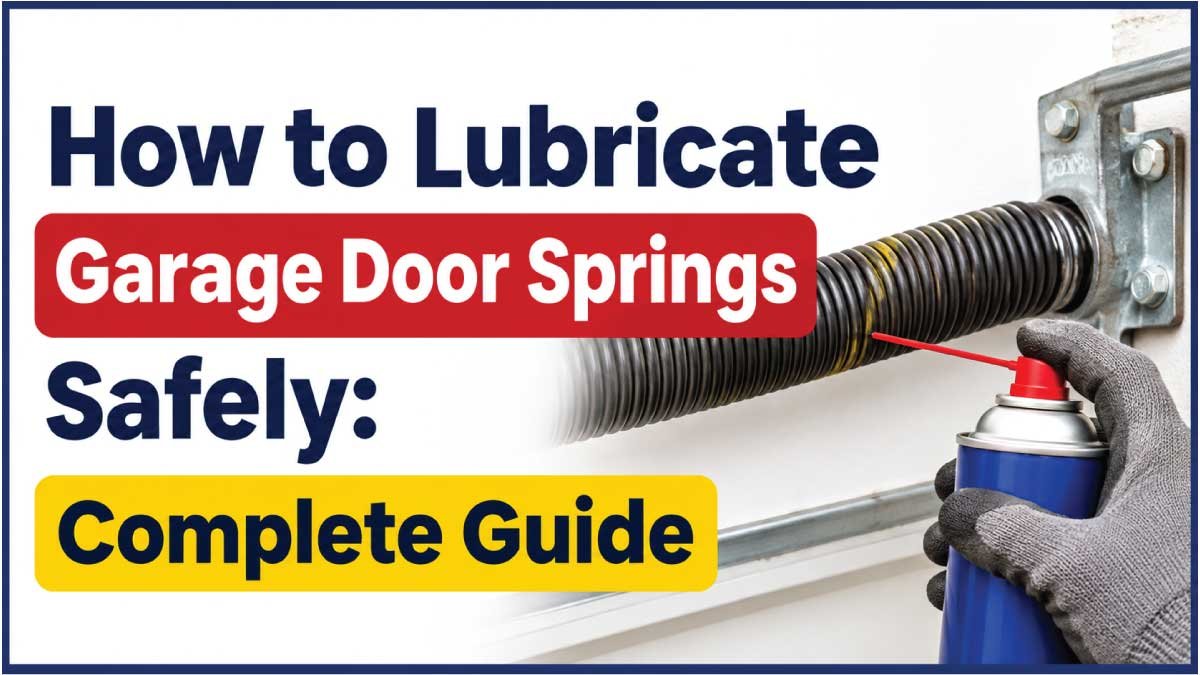
Garage door springs play an important role in lifting and lowering the door smoothly. They support much of the door’s weight and help the opener move it without excessive strain. Over time, these springs may develop surface rust, squeaking, or friction-related noises that make homeowners wonder whether lubrication is necessary.
Lubricating garage door springs can help reduce certain noises and protect exposed metal surfaces from moisture. However, springs are under significant tension, making them one of the most dangerous parts of a garage door system. Applying lubricant incorrectly, touching spring components, or attempting adjustments can cause serious injuries.
The safest approach is to understand which spring components may need lubrication, use a suitable product, and avoid touching or manipulating the spring mechanism. This guide explains how to approach garage door spring lubrication safely, what products to consider, which mistakes to avoid, and when to call a professional.
Why Garage Door Springs May Need Lubrication
Garage door springs operate repeatedly as the door opens and closes. Their movement can create friction, particularly around moving contact points and exposed metal surfaces.
Appropriate lubrication may help:
- Reduce squeaking and rubbing noises.
- Minimize friction at manufacturer-approved contact points.
- Protect exposed metal surfaces from moisture.
- Reduce surface corrosion when a suitable protective lubricant is used.
- Support smoother operation when the spring system is otherwise in good condition.
However, lubrication cannot repair a damaged spring, restore lost spring tension, or correct an unbalanced garage door. If a spring is broken, stretched, heavily corroded, or making unusual noises, it needs professional inspection rather than additional lubricant.
Understanding the Two Main Types of Garage Door Springs
Before considering lubrication, identify which spring system your garage door uses. The two common types are torsion springs and extension springs.
Torsion Springs
Torsion springs are usually installed horizontally above the garage door opening. They twist as the door moves, storing energy that helps lift the door.
These springs operate under substantial tension. Their coils, winding cones, cables, drums, and mounting hardware should not be handled by homeowners.
Some manufacturers permit a small amount of suitable lubricant on the spring coils, but the exact instructions vary by system. If lubrication is recommended, it should be applied without touching, gripping, loosening, or adjusting the spring.
Extension Springs
Extension springs are commonly installed along the horizontal tracks on either side of the garage door. They stretch as the door closes and contract as it opens.
These springs also store significant energy. Some models have safety cables running through them to reduce the risk of a spring flying across the garage if it breaks.
Do not pull, stretch, disconnect, or handle an extension spring to apply lubricant. Follow the manufacturer’s maintenance instructions and leave any work requiring contact with the spring mechanism to a qualified garage door technician.
Can You Lubricate Garage Door Springs Yourself?
Whether you can lubricate your springs yourself depends on the manufacturer’s instructions and the accessibility of the approved lubrication points.
Some garage door manufacturers recommend periodic lubrication of exposed spring coils. Others specify different maintenance procedures or products. There is no universal rule that every garage door spring should be lubricated by a homeowner.
A homeowner may be able to apply an approved lubricant from a safe position if the instructions permit it and the application does not require touching or manipulating the spring.
Do not attempt the task if:
- The spring is broken or visibly damaged.
- The spring has heavy rust or appears deformed.
- The door is crooked or unusually heavy.
- Cables appear loose, frayed, or damaged.
- The spring or its mounting hardware is difficult to access safely.
- You would need to climb near the spring or reach between moving components.
- The manufacturer’s instructions do not explain a safe lubrication method.
When in doubt, have a garage door technician perform the maintenance.
Choosing the Right Lubricant for Garage Door Springs
Using an appropriate lubricant is important because not every household oil or spray is suitable for garage door mechanisms.
The best choice is the product recommended by the garage door manufacturer.
Silicone-Based Garage Door Lubricant
A silicone-based lubricant designed for garage door components may be suitable for certain spring systems when the manufacturer permits it.
Potential benefits include:
- Smooth application.
- Protection against moisture.
- Reduced friction at approved contact points.
- Less tendency to attract dirt than some heavy oils or greases.
Check the product label to confirm that it is suitable for the intended metal components.
White Lithium Grease
White lithium grease is designed for certain metal-to-metal lubrication applications. However, it is not automatically suitable for every garage door spring.
Thick grease can collect dust and debris, and some manufacturers recommend a different product for their spring systems. Use it only when the garage door manufacturer’s instructions specifically allow it.
Garage Door-Specific Lubricant
A product labeled specifically for garage door maintenance may be a practical choice because its instructions identify the components it is designed to lubricate.
Before purchasing, check whether the label mentions springs or spring coils. A lubricant designed for hinges or rollers is not necessarily appropriate for every spring system.
Lubricants to Avoid
Avoid using the following unless the manufacturer specifically approves them:
- Cooking oil or household vegetable oil.
- Heavy automotive grease.
- Thick general-purpose oils.
- Products that leave a sticky coating.
- Unspecified penetrating oils as a long-term spring lubricant.
Standard WD-40 Multi-Use Product is primarily a water-displacing and cleaning product, not a substitute for a dedicated long-lasting lubricant. Different WD-40 Specialist products have different formulations, so always check the exact product label.
Tools and Materials You May Need
If the manufacturer permits homeowner-applied lubrication, prepare the following materials before starting.
| Tool or material | Purpose |
|---|---|
| Manufacturer-approved lubricant | Provides lubrication at approved points |
| Safety glasses | Protects eyes from accidental spray |
| Protective gloves | Helps prevent skin contact with lubricant |
| Clean cloth | Removes accidental overspray |
| Cardboard or protective sheet | Helps protect nearby surfaces |
| Flashlight | Allows visual inspection from a safe position |
| Manufacturer’s manual | Identifies approved maintenance instructions |
Do not use pliers, winding bars, wrenches, or other adjustment tools for spring lubrication. Lubrication is not a reason to loosen or adjust spring hardware.
How to Lubricate Garage Door Springs Safely
The following procedure is appropriate only when your garage door manufacturer allows homeowner lubrication and provides an accessible application method that does not require handling the spring.
Step 1: Read the Manufacturer’s Instructions
Start by checking the garage door manual or maintenance instructions. Look for specific guidance about spring lubrication, approved products, and application points.
Some manufacturers recommend lubricating spring coils, while others may specify different maintenance requirements.
Do not assume that instructions for one garage door model apply to another.
Step 2: Inspect the Spring Without Touching It
Look at the spring from a safe position. Check for obvious signs of damage, including:
- Visible breaks or separated coils.
- Heavy rust or corrosion.
- Unusual gaps between coils.
- Bent or distorted components.
- Loose or damaged cables.
- Signs that the spring has shifted from its normal position.
Do not touch the spring to check its tension or stability.
If you notice damage, stop and arrange a professional inspection. Lubricant cannot make a damaged spring safe.
Step 3: Secure the Garage Door Area
Keep children, pets, and other people away from the work area.
Do not stand underneath the door or place your hands near the tracks, cables, drums, or spring mechanism.
If the manufacturer’s procedure requires the door to remain stationary, follow its exact instructions. Do not attempt to secure the door by manipulating spring hardware or supporting it with improvised objects.
If the instructions require disconnecting the opener, but you are unsure how to do so safely, ask a technician.
Step 4: Prepare the Lubricant
Select a lubricant approved for your particular spring system.
Read the product label before use. Check the recommended application method, safety precautions, and whether the product is suitable for overhead garage door components.
If the lubricant comes in an aerosol can, use its extension straw only if the manufacturer’s instructions permit that application method.
Avoid using excessive lubricant. A light application is generally preferable when the product instructions call for it.
Step 5: Apply Lubricant Only at Approved Points
If the manufacturer specifically permits homeowner lubrication, apply the product from a safe position without touching or manipulating the spring.
Follow the manufacturer’s directions for the exact application points. Some instructions may identify the spring coils as the intended area.
Never:
- Grip or hold the spring while spraying.
- Put your fingers between the coils.
- Pull or stretch the spring.
- Loosen winding cones or mounting brackets.
- Adjust cables, drums, or spring tension.
- Stand directly beneath an exposed spring while working.
If you cannot reach an approved lubrication point without climbing into a hazardous position or reaching near moving components, stop and call a professional.
Step 6: Clean Accidental Overspray
After application, check nearby surfaces from a safe position.
Use a clean cloth to remove accidental lubricant from accessible surfaces, but never reach around the spring or into the track mechanism to wipe it.
Keep lubricant away from:
- Garage door tracks.
- Safety sensors.
- Rubber weather seals.
- Opener belts.
- Electrical components.
- Painted or finished surfaces not approved for the product.
Garage door tracks should generally remain clean and dry rather than coated with lubricant.
Also Read:
How to Fix a Garage Door That Does not Sit Flush: Complete Guide
Step 7: Follow the Manufacturer’s Operating Instructions
Once the application is complete, follow the manufacturer’s instructions for returning the garage door to normal operation.
Keep everyone clear of the door while checking its operation. Watch for unusual noises, jerky movement, or visible signs of imbalance.
If the door does not move smoothly, stop using it and arrange a professional inspection. Do not try to correct the problem by adding more lubricant.
Signs Your Garage Door Springs May Need Professional Attention
Not every spring-related noise indicates a lubrication problem. Some symptoms can point to mechanical damage or an unsafe spring system.
Loud Popping or Bangs
A sudden loud bang from the garage door may indicate that a spring has broken. A broken spring can leave the door extremely heavy and difficult for the opener to lift.
Do not attempt to operate the door or lubricate the damaged spring.
Visible Rust or Corrosion
Light surface discoloration is different from deep corrosion. Heavy rust can weaken spring material and increase the risk of failure.
A technician should inspect heavily corroded springs and determine whether replacement is necessary.
Uneven Garage Door Movement
If one side of the door rises faster than the other, or the door appears crooked, the spring system may have a balance or cable problem.
Lubrication will not correct uneven spring tension or damaged lifting components.
Also Read:
Why Is There a Gap Between Garage Door and Floor: Complete Guide
Door Feels Heavy
A properly functioning spring system helps counterbalance the door’s weight. If the door suddenly becomes difficult to lift, the spring may be damaged or losing its ability to support the door.
Do not test the spring by manually lifting a heavy door.
Repeated Squeaking Despite Lubrication
Persistent squeaking may come from hinges, rollers, bearings, or other moving parts rather than the springs.
A technician can identify the actual source of the noise and determine whether any component needs maintenance or replacement.
How Often Should Garage Door Springs Be Lubricated?
There is no single lubrication schedule that applies to every garage door. The correct interval depends on the spring design, manufacturer recommendations, environmental conditions, and how frequently the door is used.
For many residential garage doors, a general inspection every six months is a reasonable starting point. However, inspection frequency and lubrication frequency are not necessarily the same.
Consider these factors:
- Frequent use: Doors that open and close many times daily may need more regular maintenance inspections.
- Humid conditions: Moisture can increase the risk of corrosion on exposed metal components.
- Coastal environments: Salt in the air can accelerate corrosion.
- Dusty garages: Dust and debris can accumulate around moving components.
- Manufacturer guidance: The manufacturer’s recommended schedule should always take priority.
Do not apply lubricant repeatedly just because the calendar says it is time. Follow the product and garage door instructions.
Also Read:
Common Garage Door Spring Lubrication Mistakes
Avoiding common mistakes helps reduce the risk of damaging the garage door or creating an unsafe condition.
Using Too Much Lubricant
Applying excessive lubricant does not necessarily improve spring performance. It can create drips, overspray, and residue on surrounding surfaces.
Use only the amount recommended by the product manufacturer.
Using the Wrong Product
A lubricant suitable for door hinges may not be appropriate for spring coils. Always check the product label and garage door maintenance instructions.
Also Read:
How to Fix Uneven Gaps Between Garage Door and Frame: Complete Guide
Touching the Spring During Application
Never hold, turn, pull, or manipulate a garage door spring while applying lubricant. Springs store substantial mechanical energy and can cause severe injuries.
Attempting to Adjust Spring Tension
Some homeowners assume that a noisy spring needs tightening. This is dangerous.
Spring tension must be handled using the correct tools and professional procedures. Never loosen winding cones, turn adjustment hardware, or attempt to stretch a spring.
Lubricating a Broken Spring
A broken spring cannot be repaired with lubricant. Applying spray to a damaged spring may create a false impression that the problem has been addressed.
Have the spring inspected and replaced when necessary.
Ignoring Other Sources of Noise
Garage door noise can originate from hinges, rollers, bearings, tracks, or the opener.
Lubricating the springs without identifying the source may not solve the problem.
When to Call a Professional Garage Door Technician
Spring systems are among the most hazardous parts of a garage door. Professional assistance is the safest choice whenever a task requires contact with spring hardware or involves a suspected mechanical problem.
Contact a qualified technician if:
- A torsion or extension spring is broken.
- The spring has severe rust or visible damage.
- The garage door is crooked or unbalanced.
- The door suddenly becomes heavy.
- A cable is frayed, loose, or disconnected.
- The spring makes loud popping or grinding noises.
- Lubrication requires reaching into a dangerous area.
- The manufacturer does not provide a safe homeowner maintenance procedure.
A technician can inspect the complete spring system, identify damaged components, and perform any necessary adjustments or replacements.
Never attempt to repair or replace a garage door spring yourself. The stored energy can cause serious injury even when the door appears stationary.
Garage Door Spring Maintenance Checklist
Use this checklist as a general guide when visually inspecting your garage door.
-
Check for visible spring damage from a safe position.
-
Look for heavy rust or corrosion.
-
Watch for uneven door movement.
-
Listen for unusual popping or grinding sounds.
-
Check for visible cable damage without touching the cables.
-
Review the manufacturer’s lubrication instructions.
-
Use only an approved lubricant when homeowner application is permitted.
-
Keep lubricant away from tracks and electrical components.
-
Arrange professional service if any damage or abnormal operation is noticed.
Frequently Asked Questions
1. Should You Lubricate Garage Door Springs?
Some garage door springs benefit from lubrication, but not every system requires the same maintenance. Manufacturers may recommend a suitable lubricant for exposed spring coils or specify a different procedure. Check your garage door manual before applying anything. If the spring is damaged, heavily corroded, or difficult to access, arrange professional service instead of attempting lubrication.
2. What Is the Best Lubricant for Garage Door Springs?
The best lubricant is the product recommended by your garage door manufacturer. Depending on the spring design, this may be a garage door-specific lubricant or an approved silicone-based product. White lithium grease is suitable for some applications but not all. Always check the product label and manufacturer instructions before using any lubricant on spring components.
3. Can You Spray WD-40 on Garage Door Springs?
Standard WD-40 Multi-Use Product is mainly designed to displace moisture and help clean or loosen components. It is not a substitute for a dedicated long-lasting lubricant. Some products within the WD-40 Specialist range have different purposes and formulations. Check the exact label and use only a product approved for your garage door spring system.
4. How Often Should Garage Door Springs Be Lubricated?
Lubrication frequency depends on the spring system and manufacturer recommendations. Some garage doors may need periodic spring lubrication, while others may have different maintenance requirements. Inspecting the overall garage door system approximately every six months is a reasonable starting point for many homes. Do not assume that every inspection requires another application of lubricant.
5. Can Lubricating Garage Door Springs Stop Squeaking?
Lubrication may reduce squeaking when the noise comes from friction at an approved spring lubrication point. However, squeaking can also originate from hinges, rollers, bearings, or other components. If the noise continues after manufacturer-approved maintenance, arrange an inspection to identify the actual source instead of repeatedly spraying the spring.
6. Is It Safe to Lubricate Torsion Springs Yourself?
It depends on the manufacturer’s instructions and whether an approved lubrication point can be reached safely without touching or manipulating the spring. Torsion springs are under substantial tension, so homeowners should never adjust, loosen, or handle them. If the application requires reaching near hazardous hardware, leave the job to a qualified technician.
7. Do Extension Springs Need Lubrication?
Some extension spring systems may require lubrication, while others have different maintenance requirements. Follow the instructions for your specific garage door model. Never pull, stretch, disconnect, or handle an extension spring to apply lubricant. If the spring is damaged, rusty, or difficult to access, have a technician inspect it.
8. Can Lubricant Fix a Rusty Garage Door Spring?
Lubricant may help protect suitable exposed metal surfaces against moisture, but it cannot reverse corrosion or restore weakened spring material. Light surface discoloration and deep corrosion are not the same. If a spring has heavy rust, pitting, visible deformation, or other damage, a professional should inspect it and determine whether replacement is necessary.
9. Should Garage Door Springs Be Lubricated With the Door Open or Closed?
There is no universal position for every garage door spring lubrication procedure. The correct position depends on the manufacturer’s instructions and spring design. Do not move or secure a door in an unfamiliar position just to reach the springs. If the instructions are unclear or the task requires unsafe access, contact a professional.
10. Can You Use Grease Instead of Spray Lubricant on Garage Door Springs?
Not necessarily. Thick grease can collect dust and debris, and some garage door manufacturers recommend a specific spray lubricant instead. The appropriate product depends on the spring design and maintenance instructions. Do not substitute general-purpose grease for an approved product simply because it is available at home.
Conclusion
Lubricating garage door springs may help reduce friction and protect certain exposed metal surfaces, but safety must always come first. The correct lubricant, application points, and maintenance schedule depend on the garage door manufacturer’s instructions.
Never touch, stretch, loosen, or adjust a spring while attempting routine maintenance. If you notice heavy rust, broken coils, damaged cables, unusual noises, or uneven door movement, stop using the door and contact a qualified garage door technician.
Regular visual inspections and manufacturer-approved maintenance can help keep the garage door system operating smoothly while reducing the risk of preventable damage and injury.