
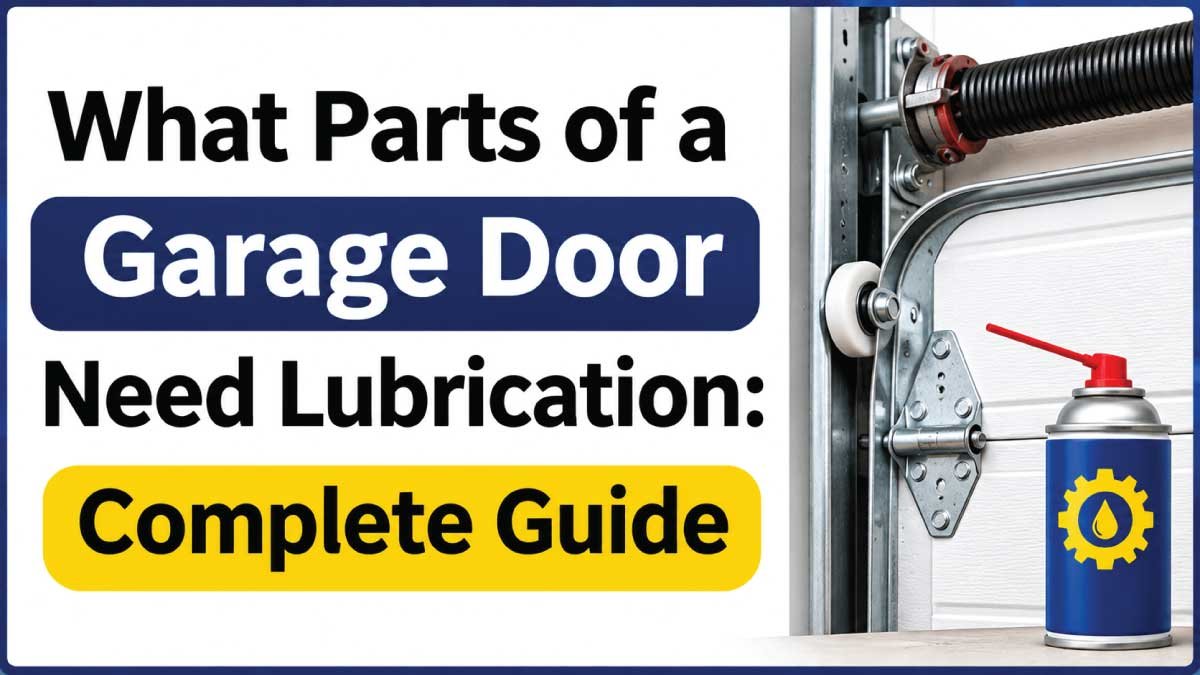
A garage door moves through several mechanical components every time it opens and closes. Hinges rotate, rollers travel along metal tracks, springs help lift the door, and the opener moves the entire system. Because these parts experience repeated movement and friction, proper lubrication is essential for smooth, quiet, and reliable operation.
However, not every part of a garage door should be lubricated. Applying lubricant to the wrong components can attract dust, collect dirt, interfere with the door’s movement, or create additional maintenance problems. Knowing which parts need lubrication and which should remain clean helps prevent unnecessary wear and extends the life of the garage door system.
The most important components that generally need lubrication include hinges, roller bearings, torsion spring coils, extension spring contact points, and certain moving parts of the garage door opener. The exact lubrication requirements depend on the door design and the manufacturer’s instructions.
This guide explains which garage door parts need lubrication, which products are suitable, how to apply lubricant correctly, and how often to perform maintenance.
Why Garage Door Lubrication Is Important
Garage doors are heavy mechanical systems with multiple moving components. Each time the door operates, these components experience friction, vibration, and repeated movement.
Without suitable lubrication, metal parts may rub against one another, creating squeaking, grinding, or rattling noises. Over time, excessive friction can contribute to premature wear and make the door less comfortable to operate.
Proper lubrication offers several benefits:
- Reduces friction: Lubricant creates a protective layer between moving metal surfaces, helping them move more smoothly.
- Reduces operating noise: Lubricating appropriate hinges, bearings, and spring coils can help eliminate squeaking and other friction-related sounds.
- Limits premature wear: Reducing metal-to-metal contact helps protect moving components from unnecessary damage.
- Supports smoother operation: Properly maintained mechanical parts can move more consistently during opening and closing.
- Helps protect against corrosion: Some garage door lubricants provide a light protective coating that helps reduce moisture-related corrosion.
- Reduces maintenance problems: Regular lubrication can help prevent certain noise and friction issues from developing into more expensive repairs.
Lubrication cannot correct every garage door problem. A door that is crooked, unusually heavy, unbalanced, or difficult to operate may have a mechanical or structural problem that requires professional inspection.
What Parts of a Garage Door Need Lubrication?
Several garage door components contain moving surfaces or bearings that benefit from suitable lubrication. Understanding the purpose of each component makes it easier to apply lubricant where it is actually needed.
1. Garage Door Hinges
Garage door hinges connect individual door panels and allow them to bend as the door travels around the curved section of the tracks. Most sectional garage doors have several hinges positioned between the panels.
These hinges experience repeated movement whenever the door opens and closes. Their pivot points can become dry over time, resulting in squeaking or creaking sounds.
Apply a small amount of garage door lubricant to the hinge pivot points where the moving sections rotate. Open and close the door after application to distribute the lubricant.
Avoid spraying excessive lubricant over the entire hinge or door panel. Focus on the moving joint rather than the surrounding metal surface.
2. Roller Bearings
Garage door rollers move along the vertical and horizontal tracks, allowing the door to travel smoothly between the open and closed positions.
Some rollers contain internal ball bearings that require lubrication. These bearings allow the roller to rotate around its axle with minimal friction.
Apply a small amount of suitable lubricant to the exposed bearing area if the roller design allows it. Rotate the roller gently by hand only when it is safely accessible and the door is secured against movement.
Do not assume every roller needs lubrication. Nylon rollers with sealed bearings are often designed to operate without additional lubrication. Follow the manufacturer’s maintenance instructions.
3. Torsion Spring Coils
Torsion springs are usually mounted horizontally above the garage door opening. They store mechanical energy and help counterbalance the weight of the door.
As the door operates, the spring coils expand and contract slightly against one another. This movement can create friction and produce squeaking or rubbing sounds.
A garage-door-specific lubricant may be applied lightly to the outside surface of the spring coils when permitted by the manufacturer. The lubricant helps reduce friction between the coils.
Important safety warning: Torsion springs are under extreme tension and can cause serious injuries. Never loosen, adjust, remove, or attempt to repair a torsion spring. Do not touch spring winding cones, set screws, or mounting hardware. If the spring appears damaged, separated, or excessively rusty, contact a qualified garage door technician.
4. Extension Spring Contact Points
Extension springs are commonly installed along the horizontal tracks on certain garage door systems. They stretch and contract as the door moves.
Depending on the design, some spring contact points and moving connections may benefit from lubrication. However, the springs themselves do not always require routine lubrication.
Follow the manufacturer’s recommendations for the particular spring system. Never disconnect, stretch, adjust, or handle a loaded extension spring. Extension springs can release dangerous energy if a component fails.
If an extension spring is noisy, damaged, or appears stretched unevenly, have the system inspected by a professional.
5. Roller Axles and Bearing Areas
The axle is the part that supports the roller and connects it to the roller bracket. Depending on the roller construction, the axle or bearing area may require suitable lubrication.
For rollers with exposed, serviceable bearings, apply lubricant according to the manufacturer’s instructions. Avoid coating the entire axle or allowing lubricant to run into the track.
Some modern roller assemblies use sealed bearings that should not be opened or lubricated. If the roller is worn, cracked, or no longer rotates properly, replacement may be more appropriate than additional lubrication.
6. Garage Door Opener Chain
Some garage door openers use a metal chain to move the trolley along the opener rail. The chain experiences repeated movement during operation and may require occasional lubrication.
Only lubricate the chain if the opener manufacturer recommends it. Use the product specified for that particular opener system and apply it sparingly.
Do not apply thick grease indiscriminately. Excess lubricant can collect dust and debris, making the chain dirty and potentially affecting its operation.
Belt-drive openers do not have a metal drive chain, so they should not be lubricated as though they were chain-drive systems.
7. Garage Door Opener Screw Drive
Some garage door openers use a long threaded screw to move the trolley. This screw drive requires a specific lubricant to reduce friction and maintain smooth movement.
Use only the lubricant recommended by the opener manufacturer. Certain screw-drive systems require periodic lubrication, while others use different maintenance arrangements.
Apply the product according to the manufacturer’s instructions rather than covering the entire rail with an arbitrary lubricant.
Never lubricate a belt-drive rail or other opener component unless the manufacturer specifically identifies it as a lubrication point.
8. Moving Pivot Points and Linkages
Some garage door systems include additional pivot points, connecting arms, and mechanical linkages. These components may move whenever the door or opener operates.
If a manufacturer identifies a pivot point as a lubrication location, apply a small amount of suitable lubricant to the moving joint.
Avoid lubricating electrical connections, sensors, plastic covers, or components that are not designed to receive lubricant.
Which Garage Door Parts Should Not Be Lubricated?
Although lubrication is useful for many moving components, certain areas should generally remain clean and dry.
Applying lubricant to these parts can cause dirt buildup, reduce traction, or interfere with normal operation.
Garage Door Tracks
Garage door tracks guide the rollers along the correct path. They are not normally designed to operate with a thick layer of grease or oil.
Lubricating the inside of the tracks can attract dust, dirt, and other debris. This buildup may interfere with roller movement and make the tracks harder to clean.
Instead of lubricating the tracks, wipe away dirt and inspect them for dents, loose mounting points, or obstructions.
Garage Door Panels
The exterior and interior surfaces of garage door panels do not require routine lubrication. Applying oil or grease to these surfaces provides no meaningful mechanical benefit.
Clean the panels using a suitable household cleaning method recommended for the door’s material and finish.
Safety Sensors
Photoelectric safety sensors are usually installed near the bottom of the garage door opening. They detect objects in the door’s path and help prevent accidental closing.
Never apply lubricant to sensor lenses, electrical connections, or wiring. Keep the lenses clean and free from dust or obstructions.
Rubber Weatherstripping
Bottom seals and perimeter weatherstripping help prevent rain, dust, insects, and outside air from entering the garage.
These rubber components generally do not require mechanical lubrication. Use cleaning and maintenance products only when approved for the specific seal material.
Belt-Drive Opener Belts
Belt-drive openers use reinforced rubber or similar belt materials to move the door. These belts should generally remain clean and dry.
Do not apply oil, grease, or general-purpose lubricant to the belt. If it becomes damaged, loose, or noisy, follow the opener manufacturer’s inspection and service recommendations.
Best Lubricant for Garage Door Parts
Choosing the correct lubricant is just as important as knowing where to apply it. Garage door systems contain different materials and mechanical designs, so one product may not be appropriate for every component.
Silicone-Based Garage Door Lubricant
Silicone-based lubricants are commonly used for suitable garage door moving components. They can provide a light lubricating film without the heavy residue associated with some greases.
They are useful for certain hinges, bearing areas, and other manufacturer-approved lubrication points.
Choose a product specifically labeled for garage door use and check that it is compatible with the materials involved.
Lithium-Based Garage Door Grease
White lithium grease is suitable for certain metal-to-metal applications where a longer-lasting lubricating layer is required.
Some manufacturers recommend it for particular screw-drive opener systems or mechanical components. However, it should not be applied everywhere.
Use it only where the garage door or opener manufacturer specifically permits it.
Garage Door-Specific Spray Lubricant
Garage door lubricants are designed for common maintenance needs involving hinges, rollers, and spring coils.
Many products include a spray nozzle that helps apply lubricant to small moving areas without coating surrounding surfaces.
A garage-door-specific formula is often a practical choice because its intended applications are clearly identified on the label.
What About WD-40?
Standard WD-40 Multi-Use Product is primarily a water-displacing and cleaning product rather than a long-lasting garage door lubricant.
It may help loosen certain contaminants or displace moisture, but it is not necessarily the best choice for routine lubrication.
For regular maintenance, use a lubricant specifically designed for garage door mechanisms or the product recommended by the manufacturer.
| Lubricant type | Suitable applications | Important consideration |
|---|---|---|
| Silicone-based lubricant | Approved hinges and bearing areas | Check material compatibility |
| White lithium grease | Manufacturer-approved metal components and screw drives | Avoid excessive application |
| Garage door spray lubricant | Hinges, spring coils, and suitable rollers | Follow product directions |
| Standard WD-40 | Limited cleaning or moisture-displacing tasks | Not a substitute for long-lasting lubrication |
| General-purpose heavy grease | Only where specifically approved | Can attract dirt and collect debris |
Tools and Materials Needed for Garage Door Lubrication
You do not need many tools to perform basic garage door lubrication. Having the right supplies makes the job cleaner and helps prevent accidental damage.
| Tool or material | Purpose |
|---|---|
| Garage door lubricant | Reduces friction at approved moving points |
| Microfiber cloth | Removes dirt and excess lubricant |
| Soft cleaning brush | Removes loose dust and debris |
| Safety glasses | Protects eyes from spray and falling dirt |
| Step ladder | Provides access to safely reachable components |
| Protective gloves | Helps keep hands clean |
| Manufacturer’s manual | Identifies approved lubrication points |
Use a stable ladder when necessary, and never climb onto the garage door or stand on the opener rail.
How to Lubricate Garage Door Parts Correctly
Lubricating a garage door is generally straightforward when you work only on accessible, manufacturer-approved lubrication points.
The following steps cover basic maintenance without requiring adjustments to springs, cables, tracks, or other high-tension components.
Step 1: Close the Garage Door
Start by closing the garage door completely. This provides access to many of the moving components while keeping the door in its normal resting position.
Disconnect the opener from its power source if you are working near moving opener components and the manufacturer’s instructions call for it.
Never work beneath a moving garage door.
Step 2: Inspect the Moving Components
Look at the hinges, rollers, spring coils, and opener mechanism for visible dirt, rust, wear, or damage.
Check whether the rollers appear cracked or worn and whether the hinges show signs of separation.
Do not touch springs, cables, bottom brackets, or other components that may be under tension.
If you notice broken hardware, a loose cable, or a damaged spring, stop and arrange professional service.
Step 3: Clean the Lubrication Areas
Use a dry microfiber cloth or soft brush to remove loose dust and dirt from accessible lubrication points.
Cleaning first prevents dirt from mixing with the lubricant and creating a sticky buildup.
Do not use excessive water or cleaning chemicals around bearings, electrical parts, or opener components.
Step 4: Lubricate the Hinges
Apply a small amount of garage door lubricant to the hinge pivot points.
Work along the accessible hinges, applying only enough product to coat the moving joints lightly.
Avoid spraying the door panels and surrounding surfaces.
Step 5: Lubricate Suitable Roller Bearings
If the rollers have exposed, serviceable bearings, apply lubricant to the bearing area according to the manufacturer’s directions.
Do not spray the tracks or lubricate sealed bearings that are designed to remain maintenance-free.
If a roller is cracked, loose, or visibly damaged, arrange replacement rather than relying on lubricant to restore it.
Also Read:
How to Replace Old Garage Door Perimeter Seals: Complete Guide
Step 6: Lubricate the Spring Coils if Recommended
If the manufacturer recommends lubrication, apply a light coating to the outside of the torsion spring coils from a safe position.
Do not touch the spring or its hardware. Never attempt to rotate, loosen, adjust, or remove the spring.
If the spring is damaged or you cannot safely reach the recommended lubrication area, leave the task to a professional.
Step 7: Maintain the Opener Mechanism
Check whether your opener uses a chain, screw drive, or belt drive.
Apply lubricant only to the specific parts that the manufacturer identifies as lubrication points.
Do not lubricate a belt, electrical components, or an entire opener rail without explicit manufacturer instructions.
Step 8: Remove Excess Lubricant
Use a clean microfiber cloth to wipe away drips and excess product from nearby surfaces.
Excess lubricant can attract dust and create unnecessary residue around the door mechanism.
Make sure the tracks, safety sensors, panels, and floor remain clean.
Step 9: Test the Garage Door
Restore power if it was disconnected and operate the door using its normal controls.
Observe the movement from a safe position. The door should travel smoothly without unusual grinding, sticking, or excessive vibration.
If the door moves unevenly, becomes unusually heavy, or makes a new mechanical noise, stop using it and arrange a professional inspection.
Also Read:
How to Stop Water Coming Through Garage Door Side Gaps: Complete Guide
How Often Should You Lubricate Garage Door Parts?
The correct lubrication schedule depends on how frequently the door is used, the surrounding environment, and the manufacturer’s recommendations.
For many residential garage doors, inspecting the system and lubricating approved components approximately every six months is a reasonable starting point. Some systems require more frequent maintenance, while others have sealed or maintenance-free components.
| Garage door component | General maintenance frequency |
|---|---|
| Hinges | Inspect every 6 months |
| Roller bearings | Inspect every 6 months |
| Torsion spring coils | Lubricate only when recommended |
| Extension spring contact points | Follow manufacturer instructions |
| Opener chain | Follow the opener maintenance schedule |
| Screw-drive opener | Follow the specified lubrication schedule |
| Tracks | Clean and inspect every 6 months |
| Safety sensors | Check and clean regularly |
Garage doors used several times a day may require more frequent inspections than doors operated occasionally.
Dusty, humid, or coastal environments can also increase the need for cleaning and corrosion inspections.
Do not apply lubricant repeatedly just because the door makes noise. Identify the source of the noise first, since excessive lubrication will not correct worn bearings, loose hardware, or alignment problems.
Also Read:
How to Fix a Garage Door That Does not Sit Flush: Complete Guide
Signs Your Garage Door Needs Lubrication
A garage door may show several signs when its moving components are dry or experiencing friction.
Common warning signs include:
- Squeaking hinges: Dry hinge pivot points may produce a high-pitched squeaking sound.
- Noisy roller movement: Worn or dry roller bearings can create squealing or grinding noises.
- Spring squeaking: Spring coils may produce rubbing sounds during operation.
- Increased mechanical noise: Several dry moving parts can make the entire door system louder.
- Rough movement: Certain friction-related problems may make the door sound or feel less smooth.
These symptoms do not always indicate a lubrication problem. A damaged roller, bent track, loose bracket, failing bearing, or unbalanced door can produce similar sounds.
If lubrication does not improve the problem, avoid applying more product without identifying the underlying cause.
Common Garage Door Lubrication Mistakes to Avoid
Incorrect lubrication can create problems instead of preventing them. Avoid these common mistakes during routine maintenance.
Lubricating the Entire Track
One of the most common mistakes is spraying lubricant along the inside of the garage door tracks.
The tracks should generally remain clean and free from grease. Lubricant can collect dust and interfere with roller movement.
Clean the tracks instead of coating them with oil.
Using Too Much Lubricant
Applying excessive lubricant does not necessarily improve performance.
Large amounts can drip onto the floor, collect dust, and leave sticky residue around moving parts.
Use a light application at the specific lubrication points.
Lubricating Every Type of Roller
Not all garage door rollers have the same construction.
Some have exposed bearings, while others use sealed bearing assemblies that do not require additional lubricant.
Check the roller manufacturer’s instructions before applying anything.
Also Read:
Why Is There a Gap Between Garage Door and Floor: Complete Guide
Using the Wrong Product
Household oils, heavy grease, and general-purpose sprays may not be suitable for every garage door component.
Some products can attract dirt, damage certain materials, or interfere with the intended operation of the mechanism.
Choose a product recommended for the specific component.
Ignoring Worn or Damaged Parts
Lubricant cannot repair a cracked roller, damaged hinge, broken spring, or worn bearing.
If a component is physically damaged, it may need professional repair or replacement.
Attempting Spring Adjustments
A noisy spring does not mean that it needs tightening or adjustment.
Garage door springs store substantial mechanical energy. Attempting to adjust them without proper training and tools can cause severe injury.
Leave all spring adjustments and repairs to qualified technicians.
When Should You Call a Garage Door Professional?
Basic lubrication is a normal maintenance task, but some garage door problems require professional attention.
Contact a qualified technician if you notice:
- A broken or visibly damaged torsion or extension spring.
- A loose, frayed, or displaced lifting cable.
- A garage door that appears crooked or uneven.
- Rollers that repeatedly come out of their tracks.
- A door that becomes unusually heavy or difficult to lift.
- Grinding noises that continue after appropriate lubrication.
- Bent tracks or loose structural mounting hardware.
- An opener that strains, stops unexpectedly, or struggles to move the door.
Do not attempt to correct these problems by adjusting spring tension, moving cables, tightening loaded brackets, or bending tracks.
A professional can inspect the door’s balance, alignment, hardware, and opener operation to identify the actual cause.
Garage Door Lubrication Maintenance Checklist
A simple maintenance checklist helps you keep track of the components that need attention without applying lubricant unnecessarily.
| Maintenance task | Recommended action |
|---|---|
| Inspect hinges | Check for wear, rust, and unusual movement |
| Check roller bearings | Look for damaged or noisy rollers |
| Inspect spring coils | Look for visible damage or corrosion without touching them |
| Check opener mechanism | Identify whether it uses a chain, belt, or screw drive |
| Clean tracks | Remove dust and loose debris |
| Inspect weatherstripping | Check for cracks, gaps, or deterioration |
| Clean safety sensors | Remove dust from sensor lenses |
| Test door operation | Observe smooth and consistent movement |
Keep a record of maintenance dates and any unusual noises or changes in operation. This makes it easier to recognize recurring problems and explain them to a technician if professional service becomes necessary.
Frequently Asked Questions
1. What parts of a garage door should be lubricated?
The main parts that may require lubrication include hinge pivot points, serviceable roller bearings, torsion spring coils, certain extension spring contact points, and approved opener components. The exact lubrication points depend on the garage door design. Always follow the manufacturer’s instructions and avoid applying lubricant to tracks, safety sensors, belts, or other components that should remain clean.
2. Should I lubricate garage door tracks?
No, garage door tracks generally should not be lubricated. Their purpose is to guide the rollers, and a coating of oil or grease can attract dust and dirt. This buildup may interfere with smooth roller movement. Instead, clean the tracks using a dry cloth or suitable brush and check for visible obstructions or damage.
3. What is the best lubricant for garage doors?
A garage-door-specific spray lubricant is a practical option for many approved lubrication points, including suitable hinges and roller bearings. Some opener systems require white lithium grease or another manufacturer-specified product. The best choice depends on the component being serviced, so check the product label and your garage door manufacturer’s maintenance instructions.
4. Can I use WD-40 on my garage door?
Standard WD-40 Multi-Use Product is not generally the best choice for routine garage door lubrication because it is primarily designed for water displacement and related cleaning tasks. A dedicated garage door lubricant is usually more suitable for long-term lubrication of approved moving components. Avoid assuming that every WD-40-branded product has the same formula or application.
5. How often should I lubricate my garage door?
Many residential garage doors benefit from an inspection approximately every six months, with lubrication performed as needed at manufacturer-approved points. Doors used frequently or exposed to dusty and humid conditions may require more frequent attention. However, some rollers and other components have sealed bearings and do not require additional lubricant.
6. Should garage door rollers be lubricated?
Rollers with exposed, serviceable bearings may require occasional lubrication if the manufacturer permits it. However, sealed-bearing rollers are often designed to operate without additional lubricant. Applying spray to the outside of every roller will not necessarily improve performance. Inspect the rollers for cracks, wear, and unusual noise before deciding whether maintenance or replacement is needed.
7. Should I lubricate garage door springs?
Some garage door manufacturers recommend applying a light coating of suitable lubricant to torsion spring coils to reduce friction and noise. Other spring systems may have different maintenance requirements. Never adjust, loosen, remove, or handle a loaded spring. If a spring is damaged, excessively corroded, or making unusual noises, arrange professional inspection.
8. Why does my garage door still squeak after lubrication?
A garage door may continue squeaking if the actual problem involves worn roller bearings, damaged hinges, loose hardware, track alignment, or a failing mechanical component. Applying additional lubricant will not correct these issues. Inspect only accessible components and contact a qualified technician if the noise continues or the door moves unevenly.
9. Can too much garage door lubricant cause problems?
Yes. Excess lubricant can drip onto the floor, collect dust, and create sticky residue around moving components. It may also spread onto tracks or other surfaces that should remain clean. Apply a small amount only to approved lubrication points and wipe away excess product with a clean cloth.
10. Do belt-drive garage door openers need lubrication?
Belt-drive openers generally do not require lubrication on the belt itself. Applying oil or grease can contaminate the belt and interfere with its operation. Other parts of the opener may have specific maintenance requirements, so consult the manufacturer’s manual. Do not lubricate the entire rail or belt unless the manufacturer explicitly recommends it.
Final Thoughts
Knowing what parts of a garage door need lubrication helps maintain smooth movement, reduce unnecessary friction, and prevent certain noise-related problems. Hinges, suitable roller bearings, spring coils, and selected opener components are among the parts that may require lubrication, depending on the system’s design.
The most important rule is to lubricate only manufacturer-approved moving points. Keep tracks, safety sensors, door panels, rubber seals, and belt-drive components clean unless specific instructions say otherwise.
Regular inspection and careful lubrication can help extend the service life of a garage door system. However, damaged springs, cables, rollers, and alignment problems should always be handled by a qualified garage door professional.