
Have you ever read the poetry and wondered, What the hell does this mean? — you are not alone. Majority of the people are not aware that poetry is not supposed to be mystic or obscure. Poetry is, in its most basic form, just a creative means of express the emotions, experiences and ideas in words. When you write rhythmically, imaginatively, and heartedly, you will be amazed at the strength of the few lines. Now it is time to explore just what poetry is and why people write it, the typical forms, and how you can start to comprehend and even write your own.
Understand What Poetry Really Is
The thing is, poetry does not consist of fancy words and hidden meanings. It has got something to do with experiencing something and expressing it in beautiful and meaningful words. The essence of poetry is that it is a literary expression that in some way communicates ideas through rhythm, imagery and emotion. It is similar to painting, except that the poets do not employ brushes and colors, but rather use words to paint the pictures in your head.
A simple definition?
👉 Poetry is the art of express the emotions and ideas in imaginative and rhythmic words.
You will find that poems tend to violate the normal grammar rules. It may be shortened, punctuations may be omitted and words may be used repetitively. All that is the magic, poetry just makes you feel something, not just to understand it.
Why Do People Write Poetry?
The majority of people are unaware of the fact that poetry has existed in human life, thousands of years ago, when there were neither books nor movies. It was used by people to tell stories, share wisdom, express love or even pray.
Here are a few common reasons people still write poetry today:
To express emotions: Whether it’s joy, heartbreak, loss, or hope, poems help release feelings words can not usually express.
To reflect on life: Poets often explore questions about meaning, time, or human nature.
To inspire others: A few lines of verse can lift someone’s mood or give them strength during hard times.
To connect: Poetry builds an emotional bridge between writer and reader, both can feel seen and understood.
Think about it, a song lyric that makes you tear up or a quote that stays in your mind for days… that’s poetry in motion.
How Poetry Differs From Regular Writing
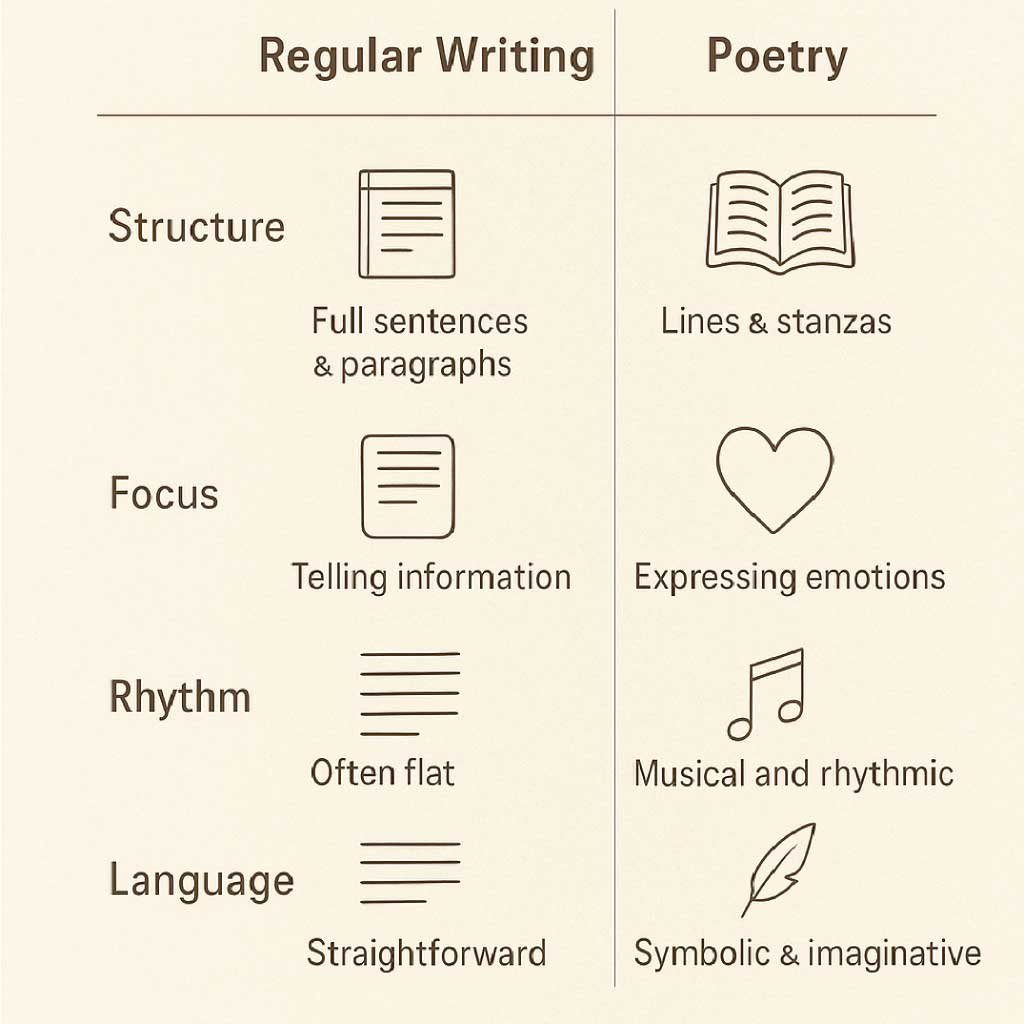
You may ask, “Then can not I just write about my thoughts in sentences? But poetry is something which makes the ordinary thought memorable.
Here is the quick comparison to make it clear:
| Feature | Regular Writing | Poetry |
|---|---|---|
| Structure | Full sentences & paragraphs | Lines & stanzas |
| Focus | Telling information | Expressing emotions |
| Rhythm | Often flat | Musical and rhythmic |
| Language | Straightforward | Symbolic and imaginative |
Even silence is important in poetry. Some silence or break of the line may transform the tone or the meaning entirely. You will notice it as soon as you begin reading the poems slowly, not in a hurry.
Common Types of Poetry
There are hundreds of poetic forms out there, but let’s start with a few simple ones you’ll easily recognize:
1. Free Verse
Free verse poems do not adhere to either rhyme or rhythm. They are more natural and almost heart-throbbing. With this kind, writers are completely free in their creativity to use emotions without the structure. It can be used to present personal thoughts or day-to-day observations or deep thoughts in a conversational form.
Example: Most modern poets use free verse because it feels honest and unrestricted.
2. Rhymed Poetry
That is what one usually thinks of when he or she thinks of poetry lines that rhyme. Rhyme pattern gives it a beat of music that is easy to memorize and easy to read. Rhymed poems have a tendency of being spirited and classic, hence they are common in folksongs, nursery rhymes, and classic literature. It is ideal in the declaration of joy, rhythm and telling a story through melody.
Example:
“The sky is blue, the grass is green,
The world is brighter than it’s ever been.”
3. Haiku
A Japanese verse consisting of three lines (5-7-5 syllables). It normally records nature. Haiku poems resemble paintings, although they are rather short. Every word is meticulously used to depict simplicity, mindfulness and balance. Most haiku used by poets portray a sense of serenity, seasons, or the short-lived beauty in little things in life.
Example:
“Autumn leaves falling,
Whispers of a fading sun,
Silence fills the air.”
4. Sonnet
The 14 lines are vintage poem and usually on the subject of love or philosophy. This form became famous due to Shakespeare. Sonnets are based on certain rhyme patterns and are developed around one thought or feeling. It is both structured and expressive with every section leading to a final conclusion or twist. It takes practice, musicality and knowledge of the emotive power of language to make a sonnet.
5. Narrative Poetry
These poems narrate a story they do contain characters, conflict and plot, just as a short story. Narrative poems can be either long or short and sometimes they combine both emotion and storytelling. They can talk about adventures, history or experience. This kind assists the readers in imagining the scenes and relating the events as though they were happening at the moment. Such well-known examples as The Odyssey and The Raven are also epic tales.
Elements That Make Poetry Special
You will be surprised how many small things make a poem stand out. Let’s look at a few important poetic elements you will notice again and again.
1. Rhythm and Sound
Poetry is commonly beat-like, not always very noticeable, but it is. This cadence renders it pleasurable to read aloud. Read slowly your favorite poem–you’ll hear the music. The rhythm, repetition and flow of the words make it sound musical a feature that makes poetry stand out among the normal writing. The poets employ devices such as alliteration, rhyming, and meter to provide their lines with a heartbeat. Although the poem lacks rhyme, the inherent up and down movement of phrases can give a poem a lifelike sound, full of vitality and energy.
2. Imagery
Poets are good painters with words. When a poem talks of a lonely moon talking to the sea, it comes to mind immediately. Imagery appeals to your senses sight, sound, touch, taste and smell and transforms words into action. It enables the reader to get into the world of the poet and experience what they are writing about. Even the most basic scenes such as rain falling or leaves moving can be emotional and memorable due to strong imagery. It is among the strongest means by which a poet links feeling and fantasy.
3. Metaphors and Similes
Poets love comparisons. One thing is a metaphor (e.g. time is a thief). A simile is that something is like something else (e.g. Her smile is like sunshine). Such literary devices make poems rich in color. Poets do not say something, but these comparisons can be used to allude to hidden meanings and emotions. Similes and metaphors are that which render writing more expressive and multifaceted by enabling their readers to perceive the familiar objects in completely new light. They transform the common concepts into something enchanted and memorable.
4. Emotion
There is a heartbeat in every poem–a feeling that moves that poem. It is sad, it is hopeful, it is marvelous, but the emotion is the part that makes it memorable. Poetry is all about emotion; it is what puts life into mere words to something meaningful. Without emotion a poem is an empty thing, however perfect the structure. Readers feel that when poets write with a sincere soul it comes out at first sight. This is why some touching lines could touch the hearts more than the pages of the commentaries. Feeling makes poetry the language which all people can understand.
Who Poetry Is For (Hint: Everyone)
Poetry has always been believed to be a preserve of literature enthusiasts or students, yet that is not the case. Poetry belongs to anyone who had ever felt something in your heart and wanted to say it.
It’s ideal for:
- Students learning creative expression
- Writers wanting to improve language flow
- Readers who enjoy short but powerful words
- Anyone going through emotional moments in life
It may sound paradoxical, but even a non-reader can find short poems a pleasant relief after long and dense material. It takes only a second to complete one and continue to ponder about it all day.
Benefits of Reading and Writing Poetry
Reading poetry is not just an art, it’s a therapy. Here is why it’s good for you:
✨ Pros of Engaging with Poetry
- Boosts creativity and imagination
- Improves emotional awareness
- Helps with stress relief and mindfulness
- Strengthens vocabulary and writing skills
- Encourages empathy and deeper thinking
⚠️ A Few Cons (If You are Not Careful)
- Some poems can feel too abstract to understand
- Over analyzing can kill the emotional experience
- Certain forms might seem old-fashioned or complex
But truth to tell the advantages far exceed the disadvantages. When you have gotten into the habit of reading poetry you will start to see beauty even in the simplest of things the sunset, the sound or the memory.
Common Mistakes People Make with Poetry
Here, an item of speedy realty check-up, there are two mistakes most frequently committed by the inexperienced in attempting to read or write poetry. It is better to know them early because this will save you frustration.
Overthinking every line: Don not treat poetry like a puzzle to solve. Just feel it first, then think about meaning later.
Forcing rhymes: Good poems don’t always need rhymes. If it feels unnatural, skip it.
Copying styles too closely: Learning from great poets is fine, but let your own voice come through.
Ignoring rhythm: Even free verse has a flow. Read your poem aloud to check how it sounds.
Writing without emotion: A technically perfect poem means nothing if it lacks heart.
How to Start Writing Poetry (Even If You’re a Beginner)
You do not require special training or degrees in order to write poetry. All you have to do is be honest and show some curiosity. Here’s how to begin:
1. Start Small
Start with the little verses, two or three lines. Focus on one image or feeling.
2. Observe Your Surroundings
Poetry begins with noticing. Pay attention to the world, sounds, smells, emotions, people. This is the inspiration in the daily things.
3. Play with Words
Practice rhyme, rhythm or repetition. Be not too perfect in what you write.
4. Read Poems Often
You will learn through the process of reading the work of other people. Attempt to read such poets as Robert Frost, Emily Dickinson or Langston Hughes.
5. Revise Thoughtfully
Poetry is rewriting. When you perfect your words and emotions, the greatest lines will be found on subsequent editions.
💡 Tip: Keep a small notebook or phone notes app just for poetic thoughts. Sometimes a single word or image can later grow into a beautiful poem.
Simple Comparison: Poetry vs. Prose
| Aspect | Poetry | Prose (Normal Writing) |
|---|---|---|
| Expression | Emotional and rhythmic | Straightforward and detailed |
| Structure | Lines and stanzas | Sentences and paragraphs |
| Purpose | To move or inspire | To inform or explain |
| Examples | Songs, Haikus, Sonnets | Novels, Articles, Essays |
When you know this difference you will begin to appreciate the reason why poetry seems so different, it is not intended to inform but to touch.
Why Poetry Still Matters in the Modern World
You may believe that poetry is out of date, but have a closer look, it is all around. The words of songs, lines of movies, advertising slogans, even brief captions on the Internet, all are borrowed rhythm and feeling of poetry. Poetry makes us stop and feel and think in a fast moving world. It transforms commonplace language into a healing, comforting, and inspirational one. This is why even nowadays, when the world is digitalized, poetry is able to unite people of different cultures, generations and feelings.
Helpful Takeaway and Final Thoughts
Poetry does not consist in knowing all the words, it is in sensing them. Reading a poem, you are entering into the heart of another person, and see the world through his eyes. Unless you are familiar with poetry, you should begin with short contemporary poems or even song lyrics. There is no need to analyze too much. Close your eyes and feel the flow. You will find in due time that you begin to sound more poetical upon yourself, a lovely thing.
You are not going to read, write or just enjoy poetry, but keep in mind: it is not about being perfect. It’s about connection. But take a few minutes, find some quiet place, and read a poem to-day. You can always find something of you between the lines.