
If you have ever read a poem that made you pause and say, Wonder, that came to me hard, then it was not only the words, but the devices of poetry lurking over there somewhere. It is these minute implements which give poetry its rhythm, its feeling, and its indelible impressiveness. Poetic devices are also ubiquitous and most people are not aware of the fact that they are not confined to poets alone.
They are used in song lyrics, commercials, speeches, even movie scripts, all of them are there to make your heart ache or get a message in your head. Then, to jump into a deeper water, what poetic devices actually are, why they are important and how you can apply them to make your writing even more alive.
What Are Poetic Devices?
Poetic device is, in plain language, a method, employed by a writer, to render his or her language more expressive, musical or meaningful. Imagine them as the spices in cooking, you can get a good meal with simple ingredients but once you get the proper mix of spices you will never forget the meal. This is what poetic devices do to words.
The point is that, poems are not about saying anything, it is the way you say it. A poet may not say, It rains on the quiet streets, but may also write, The sky wept down the silent streets. That is descriptive contents or imagery, one of numerous poetic devices.
Why Poetic Devices Matter
Rhyme or rhythm is the battle of most new writers, but the center of the poetry is much deeper. Poetic devices help you:
Create emotion – Whether it’s joy, sadness, or nostalgia, the right device stirs the reader’s feelings.
Build rhythm and flow – Sound devices like alliteration and assonance make words feel musical.
Make ideas memorable – Repetition and metaphor can carve words into a reader’s memory.
Paint vivid pictures – Imagery and symbolism turn plain thoughts into art.
You will be amazed by the fact that one metaphor can make a simple line a force.
For example:
“She was as bright as the morning sun.”
versus
“She was the morning sun.”
The second line hits harder, does not it? That’s the beauty of poetic devices, they say more with fewer words.

The Main Types of Poetic Devices
Poetic devices are of very many shapes and forms, yet all these devices are usually grouped into a few major categories. We will examine the most frequent ones and the way they can be applied in practice.
📝 1. Sound Devices (Music of the Words)
Poetry usually has a life of its own rhythm. Sound devices experience the words sing – literally.
Alliteration
This is when several words start with the same sound.
“Peter Piper picked a peck of pickled peppers.”
It is catchy, has a beat, and it is easy to pronounce. The alliteration provides the lines with a flow that draws readers forward.
Assonance
The repetition of vowel sounds inside words.
“The mellow wedding bells.”
Notice the repeating “e” sound? It creates a soft, echoing tone.
Consonance
When consonant sounds repeat, usually at the end or middle of words.
“Blank and think” or “strong and string.”
Consonance adds harmony and balance to lines.
Onomatopoeia
These are words that are phonemically similar to their meanings, e.g. buzz, crash, or whisper. They make the poems come alive and they do this with the appeal to the ear.
Quick tip: In case your poem is too dull or one-dimensional, insert some sound devices. They are able to make your writing interesting at a stroke, without altering the meaning.
🎨 2. Figurative Devices (Painting with Words)
Figurative devices are all figurative, that is, are saying something but meaning something deeper.
Metaphor
A direct comparison between two unrelated things.
“Time is a thief.”
It does not steal literally but it deprives of moments. That is the strength of metaphors they form emotional shortcuts.
Simile
A comparison using “like” or “as.”
“Her smile was like sunshine.”
Similes are easy yet efficient – ideal to those who are just starting because they still have to work on brightening their language.
Personification
Giving human qualities to non-human things.
“The wind whispered through the trees.”
This device helps readers feel what’s happening rather than just see it.
Symbolism
Objects or images that represent deeper meanings.
A rose might symbolize love,
A storm might symbolize conflict or inner turmoil.
Writers often use symbols to hide emotional layers in plain sight.
Pro tip: Do not impose metaphors or symbols – have them come naturally as a result of the feeling or the subject of your poem.
💓 3. Structural Devices (Building the Poem’s Framework)
How you structure the poem can be completely changed how it feels. Structural devices are like the blueprint of your poem.
Repetition
Repeating a word or phrase to emphasize an idea.
“Let it go, let it go, let it go.”
It’s memorable and emotionally strong. But be careful- too much repetition can sound forced.
Enjambment
When one line runs into the next without a pause.
“I think I could
see the stars breathing.”
It creates flow and surprise, readers are pulled from one line to the next.
Anaphora
Repetition at the beginning of multiple lines.
“I dream of peace.
I dream of love.
I dream of home.”
Anaphora builds rhythm and intensity, often used in speeches and powerful poetry.
Rhyme and Rhythm
Rhyme This is the repetition of sounds that are similar to each other; rhythm is the beat that leads the poem. The poem does not always have to rhyme but has to have some sort of a rhythm to keep the readers glued.
🌿 4. Imagery and Sensory Devices
Read a poem that gave you the impression that you were there? That’s imagery doing its job. Through imagery, the sensory language which is sight, sound, touch, taste, and smell is used to paint vivid images in the mind of the reader.
Example:
“The scent of rain clung to the air,
while puddles mirrored the dying light.”
You can see and smell the scene. That’s the power of imagery.
Common mistake: Most amateurs visualize everything and lose track of hearing or feeling. Combine the senses – that is how you make the writing come alive.
🧠 5. Rhetorical Devices (Power of Persuasion)
These devices do not only sound good they make you think. In speeches or in emotional poetry.
Hyperbole
An intentional exaggeration.
“I’ve told you a million times!”
It is not literally a million — it is about intensity and frustration.
Oxymoron
Combining opposite ideas for contrast.
“Bittersweet memories.”
It creates emotional depth by showing that feelings can coexist.
Irony
When the opposite of what you expect happens.
A fire station burns down.
Irony adds surprise and layers of meaning to your writing.
Parallelism
Balancing phrases or clauses to create symmetry.
“Easy come, easy go.”
It makes writing smoother and easier to remember.
How to Use Poetic Devices Effectively
The thing is this is knowing poetic devices, and another thing is knowing how to use them well. Most of the new writers have lost their heads and they fill each line with rhyme or metaphor to the extent that it becomes a fake poem.
Let’s go through a few simple tips for using poetic devices wisely:
✅ Keep It Natural: Don not force rhymes or comparisons. Let your emotion guide your language. If a metaphor doesn’t feel right, drop it.
✅ Less Is More: One well-placed metaphor is worth more than five average ones. Choose devices that fit your theme naturally.
✅ Match the Mood: Use sound devices for fun or lively poems, imagery for emotional ones, and structural devices when you want rhythm or drama.
✅ Read Aloud: Poetry is meant to be heard. Reading aloud helps you catch awkward lines or misplaced rhythms.
✅ Revise Smartly: Many poets write with emotion first, then revise with structure. That’s often when poetic devices truly shine.
Common Mistakes People Make When Using Poetic Devices
Oh, it is all right– everybody is wrong at first. However, they can all be repaired easily once they are noticed.
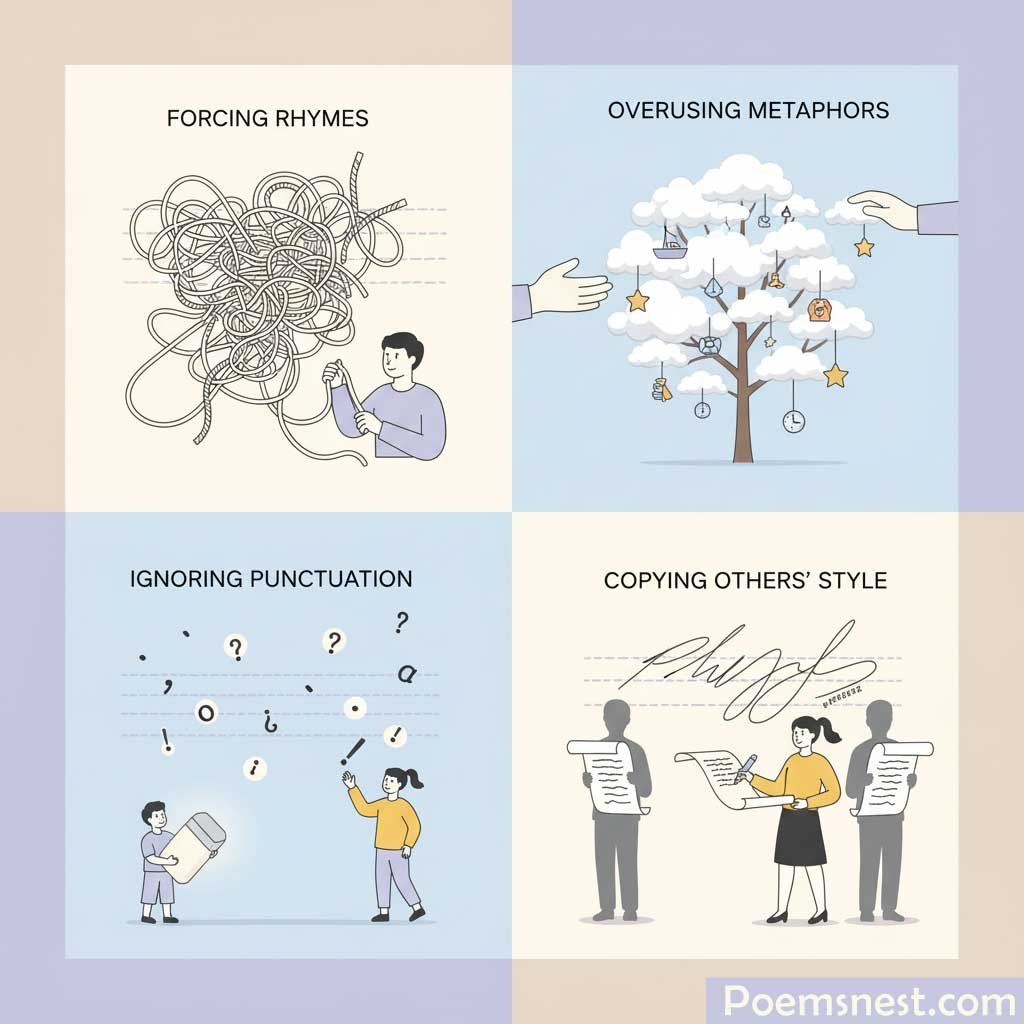
Forcing rhymes: Do not bend sentences just to make words rhyme. It kills the natural flow.
Overusing metaphors: Too many comparisons can confuse readers. Keep it simple.
Ignoring punctuation: Line breaks and commas matter more in poetry than you think.
Copying others’ style: Inspiration is fine, but your best poetry comes from your own experiences.
Remember, poetic devices are there to enhance meaning — not to hide behind.
Who Should Learn Poetic Devices?
Honestly? Anyone who loves words. Being a student, writing a song, or being a blogger, or being a person, who only wants to write a better caption or a better speech, knowing poetic devices provides your writing with a taste.
-
Students can analyze literature more easily.
-
Writers can craft stronger emotional connections.
-
Speakers can sound more persuasive.
-
Even content creators can use rhythm and metaphor to grab attention.
You will also start to notice poetic devices everywhere once you get used to it in song, in advertisements, in movies, and even in memes!
Pros and Cons of Using Poetic Devices
Pros:
-
Makes writing more expressive and memorable
-
Helps evoke emotion and imagery
-
Builds rhythm and structure
-
Engages readers through beauty and creativity
Cons:
-
Overuse can make writing sound unnatural
-
Some devices (like irony or symbolism) can confuse readers if not used clearly
-
Takes practice to balance creativity with clarity
But, the rewards far outshine the harms, you see, once you know to make due use of them.
Real Example: Turning Simple Lines into Art
Let’s look at a quick transformation.
Plain line:
“She walked through the rain.”
With poetic devices:
“She danced through the silver rain,
each drop a whisper against her skin.”
See the difference? We added imagery (silver rain), personification (whisper), and rhythm (danced through).
That is how poetic devices breathe life into ordinary sentences.
A Simple Comparison: Poetry vs. Plain Writing
| Element | Plain Writing | Poetic Writing |
|---|---|---|
| Language | Straightforward | Expressive, emotional |
| Rhythm | Often neutral | Musical, flowing |
| Devices | Minimal | Heavy use of sound and imagery |
| Emotion | Subtle | Deeply felt and layered |
Poetry is not better — it’s just a different flavor of expression. Poetic devices make that flavor stronger.
Final Thoughts: Making Your Words Come Alive
Here the truth is, you need not be a professional poet to employ the devices of poetry. You only need to speak to your words. Feel their rhythm. Listen to the way they sound. Learning this is every great writer in his time, that the beauty of poetry is not only in the saying of it, but in the saying it. The next time that you write, a poem or brief note, or even a Facebook post, attempt to employ one or two poetic devices. You would be amazed at the strength of your message. However, writing is not merely a communication. It’s connection. And it is poetic devices that make words experiences to be remembered.
📜 Discover the beauty of words — 👉 ✍️ What Is a Poem explains the essence of poetry, its emotions, rhythm, and purpose. Learn how poems capture feelings, tell stories, and express the soul through language and imagination!