
The first thing that comes to your mind when you read the term of poetic devices is that it can be used only by poets who write sonnets and ballads. However, this is the point here, these tools are not exclusively poetry. They are the hidden ingredient to some of the most involving, emotionally loaded, and memorable works of writing – novels and speeches, as well as the storytelling we use in our daily lives.
Poetic devices are not as common in the eyes of most people. They creep into the lines of movies, advertisement slogans, the words in a song, and even in the jokes that you share with your friends. Therefore, when you are a creative writer (or even aspire to be one), poetic devices are like breaking the code of rhythm and emotion language possesses.
What Are Poetic Devices, Really?
Poetic devices are in simple terms, the methods that writers employ to create rhythm, depth, as well as meaning in words. Take them as instruments of expression. They make writing more living and more emotional.
Imagine two sentences:
- “The day was hot and quiet.”
- “The sun blazed above like an angry god, and the air held its breath.”
The first is plain. The second breathes. That is what poetic devices are decided to do, to make common lines touchable.
Why Writers Use Poetic Devices
- To evoke emotions rather than just state facts.
- To make their writing memorable and rhythmic.
- To connect ideas creatively and draw readers in.
- To show personality in their writing voice.
The truth is that, whether you are planning to write poetry or not, learning the devices of poetry can significantly enhance your storytelling, blogging and even your business writing.
Types of Poetic Devices You’ll Actually Use
There exist dozens of poetic devices, not all of them are useful in creative writing. We can dissect the strongest ones and examine how they are used in reality.
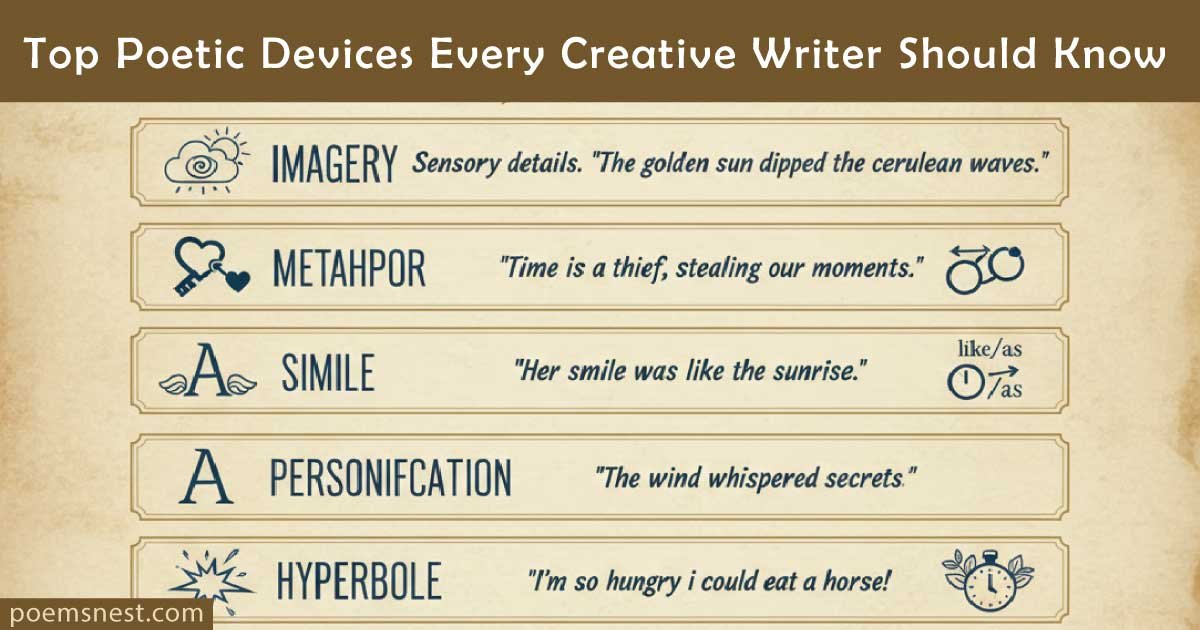
1. Imagery — Painting with Words
You are likely to have heard of imagery. It is an art of making your readers see, hear, taste, smell, and feel what is occurring.
“The coffee steamed, wrap the room in the smell of roasted comfort.”
That single line does more than tell — it pulls the reader inside the moment. You can almost smell it, right?
Quick Tip: Only one or two powerful senses per scene should be stressed through imagery. It is easy to overload all the five.
Common Mistake to Avoid: Do not describe everything. Select the information that has an emotional or visual impact.
2. Metaphor — The Heart of Creative Writing
A metaphor is used to compare two unrelated things without the use of the words like and as. e.g.: Her smile was sunshine. You are not saying she’s literally the sun but the image warms your mind instantly.
Why It Works: Metaphors provide the readers with a feeling shortcut. They transform abstract concepts (such as sadness or hope) into something that you can imagine.
Example: You could say in your everyday writing, My mind was a battlefield, to mean that you are stressed or confused. Your reader, suddenly, understands clearly the intensity of your thoughts.
Who Should Use It: Everybody who writes stories, poems and even personal essays. Metaphors provide an emotional texture which otherwise plain sentences lack.
3. Simile — Comparisons Made Easy
Similes are close relatives to metaphors -Similes compare two things with the help of the words like or as. Examples: “It was as quiet as the breath of a held breath at night. Similes come so easily to creative writing that you will be surprised. They also describe them in a graphic way without sounding too dramatic.
Pro Tip: Keep similes short and fresh. That is, worn is “as cold as ice or as fast as lightning, attempt original ones such as as cold as a forgotten cup of tea.
4. Alliteration — That Catchy Sound
Alliteration happens when words close together start with the same sound:
“Whispering winds washed over the water.”
Tastes good on the tongue? Alliteration renders phrases catchy and musical – just like in poems, brand slogans or even fantasy writing.
Why Writers Love It:
- Adds rhythm to your sentences.
- Makes lines easier to remember.
- Creates a sense of motion or mood.
Common Mistake: Excessive confidence may also render writing sing-song or childish. Apply it lightly, as spice in a plate.
5. Personification — Giving Life to the Lifeless
That is fun, that one – personification makes things which are inanimate appear human.
“The clouds marched across the sky.”
“The city never sleeps; it dreams in neon.”
By personify, you breathe emotion and motion into your scenes.
Why It Matters in Creative Writing: Readers identify with human aspects. When you cause the wind to whisper or the moon to smile, your setting begins to take on a vital quality.
Writing Tip: Personification should be used only in important situations, such as atmosphere creation or focus on the emotion.
6. Hyperbole — The Art of Exaggeration
Hyperbole is exaggeration used for emphasis or humor.
“I’ve told you a million times.”
“My backpack weighs a ton.”
Not a count of literal millions being but hyperbole expresses emotion. It is able to make conversation more humorous, feelings more intense or descriptions more dramatic.
Pros:
- Adds humor or drama.
- Emphasizes strong emotion.
- Makes writing energetic.
Cons:
- Overuse can make writing sound unrealistic.
Use it when you want to make a point, not when describe reality.
7. Onomatopoeia — When Words Sound Like What They Mean
You are already familiar with the sounds of buzz, bang, crash or sizzle. That is onomatopoeia – sound imitation.
Why It’s Powerful: It brings scenes to life, especially in action writing or poetry.
“The door creaked open.”
“Raindrops pattered on the tin roof.”
Creative Tip: Be sparing of it, a word or two of sound will turn a hopeless description into a kind of sense.
8. Symbolism — Hidden Meaning Beneath the Surface
Symbolism A symbolism is the representation of objects or the actions by other underlying ideas. An example of this is, a broken mirror may be used to represent bad luck, lost identity or change.
Example: In creative writing, an author may talk of a dying flower not only to indicate rotting, but also to allude to a loss of hope.
Why It Works: Readers adore reading to get meaning. Symbolism is an emotional, intellectual enhancement – your story stays in their minds.
Tip for Beginners: Do not force symbols. Allow them to develop out of your narrative or theme.
9. Repetition — Rhythm and Emphasis
Repetition is not about laziness, it’s a deliberate way to highlight emotion or rhythm.
“I waited. I waited till my heart grew tired of waiting.”
That echo strengthens the feeling.
Best Uses:
- In speeches or poems to build rhythm.
- In emotional writing to emphasize longing, pain, or passion.
Common Mistake: It is clumsy when it is repeated with no meaning. Every time repeat with a purpose, to get the reader to feel something.
10. Assonance and Consonance — The Music Within Words
These two are sound-based devices often overlooked by beginners.
- Assonance: repetition of vowel sounds
“The early bird heard the word.”
- Consonance: repetition of consonant sounds
“The black rock cracked and clicked.”
Why They Matter: They add a rhythm to your writing- the reader may never know it consciously, but he or she will feel the flow.
Pro Tip: Use them in key lines or endings for a musical finish.
Common Mistakes Writers Make with Poetic Devices
These tools are not always used correctly by even experienced writers. Here’s what to watch for:
Over-decorated sentences: Too many metaphors or adjectives make writing feel heavy.
Using clichés: “Cold as ice” or “light as a feather” these dull your originality.
Forcing rhythm: If your line does not flow naturally when read aloud, simplify it.
Ignoring context: A poetic line might sound beautiful but make no sense in your story’s tone or setting.
Remember — poetic devices are meant to enhance meaning, not distract from it.
Quick Comparison: Poetry vs. Creative Writing Use
| Device | Common in Poetry | Common in Creative Writing | Notes |
|---|---|---|---|
| Imagery | ✅✅✅ | ✅✅ | Universal tool for vividness |
| Metaphor | ✅✅✅ | ✅✅✅ | Emotional depth builder |
| Alliteration | ✅✅ | ✅ | Works best in subtle doses |
| Personification | ✅✅ | ✅✅ | Perfect for mood setting |
| Symbolism | ✅✅✅ | ✅✅✅ | Deepens theme and emotion |
You need not make use of them all at a single time. Only two or three, which you use wisely, can enhance your writing.
Who Should Learn and Use Poetic Devices?
Honestly — anyone who writes. But here’s a quick breakdown:
Creative Writers: To add depth, rhythm, and style.
Bloggers: To make storytelling more engage.
Students: To enhance essays and literary analysis.
Content Creators: To craft memorable taglines or captions.
Speakers: To make speeches flow smoothly and stick in people’s minds.
You will be amazed at how poetic structures are commonly used in contemporary life, in the marketing slogans such as Snap, Crackle, Pop! or speeches such as I have a dream.
Practical Tips for Using Poetic Devices Naturally
Read your work aloud. If it sounds flat, add rhythm through repetition, alliteration, or varied sentence length.
Mix devices wisely. A metaphor + a dash of imagery often works better than five different techniques at once.
Study song lyrics and speeches. They are goldmines of poetic devices used with purpose.
Focus on feeling. The goal isn’t to sound poetic, it’s to make your reader feel something.
Common Myths About Poetic Devices
- ❌ “They’ are only for poetry: Nope. They power everything from novels to ads.
- ❌ “They make writing complicated: Actually, they make writing clearer and more emotional.
- ❌ “Only professionals can use them: Anyone can, you just need awareness and practice.
Example: Poetic Devices in Everyday Writing
Let’s take a simple idea — a rainy morning.
Plain:
“It rained all morning, and the streets were wet.”
Now, let’s add poetic devices:
“Rain whispered against the window, painting silver rivers down the glass as the city yawned awake.”
See the difference? The second line does not simply inform you that it is raining but rather allows you to experience the rain, hear it and even its drowsy bareness of the city. Such is the force of poetic devices.
Buyer Tips for Creative Writers (If You’re Choosing Courses or Tools)
When you are purchasing writing classes, books, or programs to polish your creative writing:
- Look for programs that focus on expressive writing, not just grammar.
- Do not use writing templates that are generic as they usually kill the creativity.
- Select the materials that stimulate reading actual literature and language analysis.
- Write plain paragraphs with poetic devices — there you will see improvement.
Final Thoughts: Why Poetic Devices Matter More Than You Think
The vast majority of people do not know that the purpose of poetic devices lies not in sounding beautiful, but in connection. They leave readers to pause, reflect and get emotional. In the era of underpayment of attention, that is priceless.
When used well, poetic devices turn average writing into something unforgettable. They give your words music, shape, and life. Whether you are a blogger, novelist, or storyteller, these tools help you move beyond “telling” and start showing.
So, start small. Play with metaphors. Notice rhythm. Hear the sound of your sentences. It will not take long before you will realize that your writing does not only inform but sings. 🎵
👉 Dive into the magic of poetry! Learn how poets use poetic devices like imagery, rhythm, and symbolism to express deep emotions and connect with readers. Each tool adds power and beauty to their words — read the full post to uncover how feelings turn into art.