
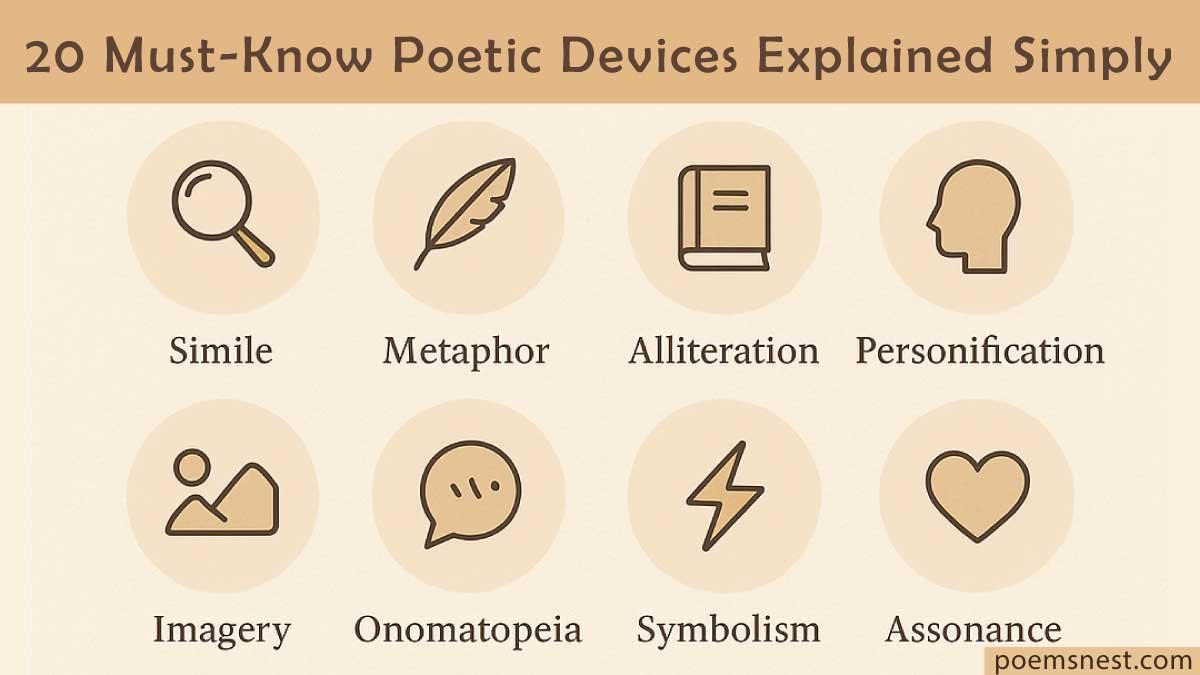
The majority of the population is not aware of the strength of poetical devices. They are not merely the fancies of poets to make themselves sound clever, but the life blood of every line that is memorable. Be it the rhythm that causes the flow of words or some hidden sense hidden within a metaphor, poetic devices transform ordinary words into what ultimately feels.
Wondered how poets are able to bring out feelings so bright? Here you have the clue. Now let us get into some of the most popular poetic devices and it will be done in simple terms with illustrative examples and literal sense.
1. Simile
A simile involves the comparison of two things using like or as. It creates a visual image in the mind of the reader and makes him relate images with emotions. An example is: Her smile was as white as the sun. You are immediately made to feel warm and happy.
Similes are easier to relate to in writing and can be used to describe nature, emotions, human behavior, etc. They do not make things too complicated.
Tip: Do not overuse them — one strong simile can do more than ten weak ones.
Common mistake: Using forced or unrealistic comparisons (“as fast as lightning” for a turtle). Keep it natural and fitting.
2. Metaphor
You see, there is a step further than a simile. It does not merely compare but is. When one says that Time is a thief, it does not imply that time will steal, but rather show that time will steal away moments. Metaphors render writing to be strong since they combine imagination and truth. They are met in all places, in songs, advertisements, even in normal conversation (He is a rock in difficult times).
Who it’s for: Writers who want emotional depth without being too wordy.
Pros: Makes writing memorable and layered.
Cons: Can confuse readers if the metaphor is too abstract or mixed.
3. Alliteration
Alliteration occurs where two words that come close to one another are similar in sound at the beginning of the words – such as Peter Piper picked a peck of pickled peppers. It is entertaining, rhythmic, and it puts music into the line. Alliteration is a feature used by poets to make lines catchy or highlight some words. As an example, when it is stated that it is whispering winds, it creates an atmosphere of stillness or secrecy immediately.
Quick tip: Use it sparingly. Too much alliteration can sound tongue-twisty or forced.
Real-world use: You will find it in slogans, nursery rhymes, and poetry titles because it’s easy to remember.
4. Personification
The majority of people are not aware of how much life you can give to a poem by personification. It is when inanimate objects are attributed human qualities, as of the wind whistling in the trees, or of the stars playing. It makes the readers experience what is being narrated rather than observe it. Nature and emotions and objects are alive.
Common mistake: Overdoing it. Not every leaf needs to “sing.” Use personification to emphasize mood, not just decoration.
Best for: Emotional poetry or descriptive writing that aims to build atmosphere.
5. Imagery
Imagery deals with all senses: hearing, seeing, feeling, tasting, and smelling. It is the poetic device that enables the readers to feel the poem and not merely read it. For example: “The scent of wet earth lingered after the rain.” You can smell it, right? That is imagery working.
Pro tip: Mix sensory types. Do not just describe what you see — describe how it feels or sounds.
Who benefits: Anyone writing nature poems, emotional reflections, or descriptive lines.
Common issue: Overloading descriptions until it feels cluttered. Keep it vivid but focused.
6. Onomatopoeia
This is a little humorous, such words which imply the thing they mean, buzz, splash, bang, whisper. They bring motion and liveliness particularly in the scenes of action or children poems. “Raindrops plopped on the rooftop” sounds more alive than “Rain fell.” You can almost hear it.
Pros: Makes poems immersive.
Cons: Can sound childish if used carelessly.
Quick tip: Choose subtle sounds that fit the tone of your poem — “hum” is gentler than “crash.”
7. Hyperbole
Hyperbole refers to exaggeration, not lying, emphasis. I have told you a million times, not that I have really told you a million times. It’s just strong expression. Poets use it to dramatize feelings, humor, or frustration. Think “Her heart broke into a thousand pieces.” It’s emotional, not factual.
Who it’s for: Writers who want to amplify emotions.
Mistake to avoid: Using it where realism matters — it can make a serious moment feel fake.
Buyer tip (for readers): Look for hyperbole when you sense a poet is stretching reality for feeling’s sake.
8. Symbolism
Symbolism conceals the meaning within the image. A rose may be love, a storm may be conflict and a light is frequently hope. You will be surprised at the number of times that poets use symbols to convey deep thoughts without writing them down. It allows the reader to make up his/her understanding of poems.
Pros: Adds layers and mystery.
Cons: Can be misunderstood if the symbol isn’t clear.
Practical example: “The broken clock” might symbolize lost time or regret.
9. Assonance
Assonance is the repetition of vowels sounds such as slow road home. It is not loud, musical and it adds rhythm without complete rhyme. Many poets prefer it because it feels natural in speech. “The mellow bell tolls” — see how it flows smoothly? That is the charm of assonance.
Tip: Read your lines out loud. If they sound smooth, you have probably nailed it.
Common error: Forcing too many vowel sounds in one line. Let it sound effortless, not rehearsed.
10. Consonance
Whereas assonance is concerned with the vowels, consonance is concerned with repeating consonant. As an example, blank and think, strong and string. It provides poetry with a satisfying touch and beat. In many cases, it is combined with rhyme or alliteration to create a compound sound.
Quick example: “The lumpy, bumpy road.”
Pro tip: Use it in lines that describe movement or tension — it enhances the mood subtly.
Mistake to avoid: Using it where it clashes with the poem’s rhythm or tone.
11. Enjambment
Ever noticed when the line in the poem continues without pause into the next one? That is enjambment. It breaks the sentence but keeps the thought flowing. It adds suspense, rhythm, and a sense of continuity. For example:
“The night was cold
but her heart was burning still.”
Why it matters: It guides how the reader breathes and feels while reading.
Tip: Do not force breaks — use them where the pause enhances emotion or tension.
12. Rhyme
Rhyme is known to everyone, words which sound the same, as “sky” and “high.” Not every rhyme is innocent or childish. These are slang rhymes (rhymes similar to each other such as worm and swarm) and internal rhymes (rhymes in a line).
Who it’s for: Poets who enjoy rhythm and flow.
Pros: Makes poems musical and easy to remember.
Cons: Can feel sing-songy if overdone.
Tip: Use rhyme where it feels natural — not where it cages creativity.
13. Repetition
Repetition underlines emotion or an important idea through repetition of words or phrases. Remember the speech of Martin Luther King Jr. “I have a dream” – repetition is power. In poetry, repetition of lines can be used to establish a rhythm or to emphasize the most important things.
Example:
“I will rise,
I will rise again.”
Use it for: Motivation, reflection, or emotional poems.
Common mistake: Over-repeated to fill space — it weakens the message.
14. Anaphora
This tool is comparable to repetition but more organized. Anaphora is the repetition of a word or phrase at the beginning of several lines or sentences.
Example:
“Every night I pray,
Every night I hope,
Every night I dream.”
It builds rhythm and emotional intensity. Many poets and speakers use it for emphasis.
Tip: Keep the repeated phrase short and strong.
Pros: Creates unity and focus.
Cons: Can sound dramatic if used too often.
15. Irony
Irony occurs when the words are used to indicate the opposing scenario of the expected one commonly to create humor or surprise. “What lovely weather!” said in a storm, as an example.
In poetry, irony creates tension or highlights contrast. It makes readers think deeper about meaning.
Example: A poem about “freedom” written from inside a prison cell.
Best for: Poets exploring social issues or emotions.
Common trap: Being too subtle — readers might miss the irony entirely.
16. Oxymoron
An oxymoron is a combination of two opposing words to disclose some hidden truth such as sweet sorrow or deafening silence. It is full of contradictions of life in a brief poetic hit. You will be amazed to know that oxymoron’s are so common in daily conversation (pretty ugly).
Pros: Makes readers pause and think.
Cons: Easy to overuse in emotional poetry.
Tip: Use when expressing complex feelings — love, grief, or nostalgia.
17. Tone
Tone is not what you say it is how you say it. It is the attitude of the poet to the subject: happy, enraged, optimistic or melancholy. For example, “The morning sun rose softly” feels peaceful, while “The sun screamed across the sky” feels harsh. Same event, different tone.
Practical tip: Read your poem aloud, does it sound how you want readers to feel?
Who it’s for: Every poet. Without tone, even good words feel flat.
18. Mood
Mood refers to the emotion that the reader develops due to tone, imagery and rhythm. A poem on rain may be quiet or lonely – using words like that.
Example: “Raindrops tapped gently on the glass” creates calm. “Rain crashed on broken windows” creates tension. See the difference? That’s mood.
Tip: Choose adjectives carefully. Even one word can shift mood entirely.
Mistake to avoid: Mixing conflicting moods — it confuses readers.
19. Theme
The theme- the idea behind the words- the heart of the words. It might be love, time, faith, struggle or hope. All the other things, tone, imagery, rhythm, all that, support that theme.
Example: A poem about rain might seem about weather but actually explore renewal or sadness.
Who it’s for: Writers wanting emotional depth.
Pro tip: Ask yourself, “What truth am I trying to show?”
Common error: Losing focus — keep all lines tied to the main idea.
20. Rhythm
The poetry dances with rhythm. It is the range of accented and unaccented sounds it is the rhythm. You can listen to it in nursery rhymes, rap or Shakespeare.
Example:
“Shall I compare thee to a summer’s day?”
The flow makes it musical.
Pros: Engages readers and gives poems movement.
Cons: Too rigid rhythm can feel mechanical.
Tip: Read aloud; if it flows naturally, your rhythm’s right.
Final Thoughts
The thing is that it is not only poets who can play with words. They are instruments of any person who desires his words to breathe. These devices do not help you to be clearer in expressing emotion, whether you are writing a poem, a speech or even a song. Experiment, combine a metaphor with some imagery, or combine repetition with rhythm. See what happens. You will find your voice is strengthened, your writing more vivid and your readers closer. The next time you write, do not say what you think, paint it. Sing, whisper, echo, dance, your words. That is the actual magic of poetry.
Dive into the magic of 👉 poetic devices and see how writers turn simple words into emotion-filled art! Learn their definition, explore unique types, and understand their uses. Read the full post to enhance your love for poetry!