
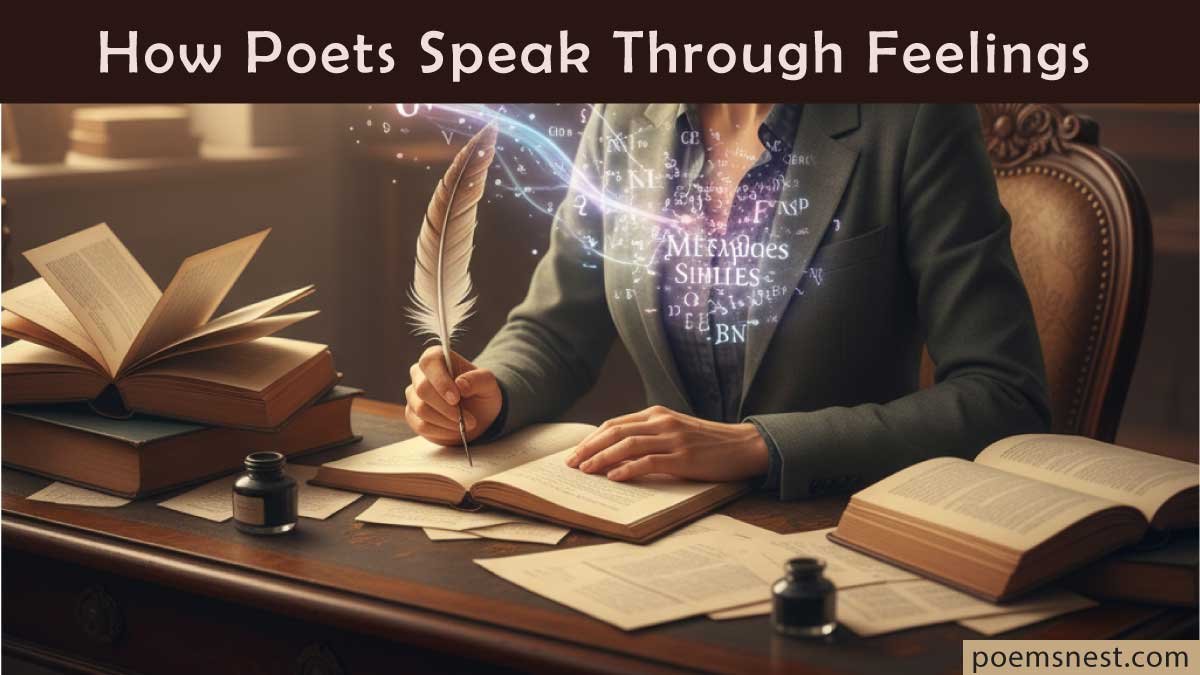
You were in that situation with some poem when you felt that your heart was being pulled a bit or when you were caught up in the beat of those few brief lines, you have already encountered the magic of poetic devices. The point is in the fact that poetry is not only about rhymes or sounding something fancy. It is about changing emotions to feel them by means of words. What most people are unaware of is that there are certain methods poets employ to create that emotional connection between themselves and the reader the so-called poetic devices.
These devices assist them in creating images, evoking memories and telling the truths that cannot always be told in simple sentences. So here we go, and we will look at how the authors invoke the devices of poetry to talk about their feelings, and how these simple instruments transform mundane words into the unforgettable feelings.
🎭 What Are Poetic Devices, Really?
Before we go into deep, it would be prudent to clarify on what poetic devices are. The tools of poetic devices represent the toolbox of a poet, including tricks of rhythm, sound, and structure, the tricks that assist in making the writing more expressive. They can be as basic as repeating a word or as complicated as intertwining metaphors between human feelings and the world or life. The thing is that not all poems involve all of them and not all devices are applicable to all moods.
Depending on the feeling that the poet wants the readers of his work, the poet decides what tool to employ. When they are writing about one of the heartbreaks, say, then they may apply repetition to reverberate pain. To be happy, perhaps, a witty beat or rhyme makes that livelier.
In short: poetic devices are not decoration — they are emotional instruments.
🌧️ Imagery — Painting Feelings with Words
Imagery is the device that makes poetry come alive at a stroke. Imagery helps the reader to visualize what the poet is describing by visual, hearing, smelling, tasting or feeling. It is the distinction between saying that one is sad and writing that the rain put its face against my window last night. You feel something about that second line, don’t you?
That’s imagery doing its job. The majority of poets use powerful imagery to convey feelings without telling them. They may not say they are lonely, but may tell them that there is a bench in the sunset, or it is a clock that is going on in a room full of silence. The readers automatically grasp the mood and this is the strength of imagery.
Quick tip: Whenever you are writing poetry, think in images, not emotions. Let your words show, not tell.
❤️ Metaphors and Similes — Turning Emotions into Images
It will be surprising how much metaphors and similes can change the perception of the way we perceive feelings. Metaphors assert that something is something else – such as Her voice was a soft wind. A simile is a statement that it is something like that something is like a soft wind. They are both instruments that poets employ to relate abstract feelings to the real. When you say that grief is a heavy coat that you cannot do away with, you do not need to elaborate on sadness.
The analogy has the emotional load on your behalf. These comparisons are not what many readers are even aware of, but they experience them. It is what makes them so potent. They do not follow logic and appeal to emotion.
Common mistake to avoid: Do not use too many metaphors simultaneously it will confuse the readers. Always use a single powerful comparison that describes your feeling.
🎵 Rhythm and Rhyme — The Music of Emotion
Have you ever wondered how a poem seems almost a song when it is read aloud? Such is rhythm and rhyme. The rhythm is the blood of poetry, that is, the stress and unstressed of syllables forming flow. The use of rhyme gives something to listen to, make the feelings sink deeper. However, this is the point here – not every poem has to rhyme. Other of the most emotional poems do not rhyme at all but maintain the rhythm such that it makes you feel like being drawn into it.
As an illustration, a poet may reduce the rhythm and use more long pauses and soft sounds when he or she is writing about grief. The rhythm could be fast and punchy to bring joy or excitement.
Pros of rhythm & rhyme:
- Easier to memorize and recite
- Engages readers through musicality
- Enhances mood and emotional tone
Cons:
- Overuse can feel forced or childish
- Sometimes distracts from meaning
Buyer tip (for beginner poets): When you are young, you have nothing to rhyme, you have something to feel. Allow the feeling to set the rhythm.
🔁 Repetition — When Feelings Echo
Repetition can be considered a very easy and simple technique but it is one of the most powerful tools of emotion in poetry. Just imagine songs–chorus because that is the one that makes a memory. The same is applicable in poetry. Repeating a phrase, word or form produces emphasis and rhythm when a poet does this.
Take this line:
“I waited, and waited, and waited.”
The emotion builds with every repetition — you can almost feel the patience turning into pain.
Poets use repetition to echo emotions like longing, anger, or even hope. It makes feelings tangible and memorable.
Quick comparison:
| Without Repetition | With Repetition |
|---|---|
| “I’m lonely tonight.” | “Lonely tonight, lonely again tomorrow.” |
See the difference? One tells, the other echoes.
🔥 Symbolism — Feelings Hidden Behind Things
Poetry that becomes profound and somewhat obscure. A symbol is that which represents something. A rose may symbolize love, storm may symbolize anger and light may symbolize hope. The reason is that poets use symbols since not all emotions are always good to express. Through concealed emotions behind the objects, they provoke the readers to interpolate meaning themselves.
For example:
- A burning candle could symbolize faith that never fades.
- A broken mirror could reflect shattered identity or regret.
- A locked door might represent emotional barriers.
Symbols ensure that the readers experience emotions in cases where the words do not convey the same. And that is the art of poetic story telling, of saying much by saying little.
Common mistake to avoid: Using random symbols without connection. Every symbol should fit the emotion and theme naturally.
🗣️ Personification — Giving Feelings a Voice
Poets are sometimes known to give life to inanimate things- that is known as personification. The wind whispered secrets through the trees, and as you read it you cannot see but wonder and be quiet. This is because we know what it is like to whisper so attributing that to wind makes nature sound human. Personification assists the poets to convey emotions in a roundabout manner.
They may not say I feel trapped, but instead write The walls closed in, silent and cold. It was not the movement of the walls but the feeling of being trapped is evident.
Why it works:
- Builds empathy — we relate to human-like traits
- Creates vivid, emotional imagery
- Adds personality and depth to simple scenes
Who this is ideal for: The authors, who prefer to bring nature, time, or any objects to light to express human feelings.
🌙 Tone and Mood — The Emotional Atmosphere
There are two invisible forces in every poem; mood and tone. Tone is the emotion which the poet has when writing. Mood refers to the disposition at reading.
Here is a simple example:
If a poet writes, “The stars laughed above the empty field,” the tone feels bittersweet, while the mood feels lonely yet beautiful. The poets have control of tone and mood through word choice, punctuation and rhythm. Hard, fast words bring about tension, long, soft words bring about calm.
Buyer tip: When writing or analyzing poetry, read it aloud. You will instantly sense the tone — your voice will naturally follow the emotion built into the words.
💫 Alliteration and Assonance — The Subtle Sound Tricks
You know not these, and yet your ear. Alliteration refers to words beginning with a similar sound of the consonant, i.e. whispering winds wandered wildly. Assonance is the repetition of vowel sounds e.g. the mellow bell tolls slowly. Poets employ these sound effects to produce a rhythm and underline some emotions. Hard consonants (such as k or t) may be angry or strong whereas soft ones (such as s or m) may be calming or friendly.
Simple comparison:
- Harsh tone: “Clashing cold cuts through the crowd.”
- Gentle tone: “Soft songs settled the night.”
Each sound pattern carries emotion, without the poet ever mention it.
✨ Enjambment — Flowing Emotions Without Pause
Here is a nice trick that poets play: enjambment- in other words the line does not end with a period but goes on in the following one. It keeps thoughts and feelings flowing causing tension or urgency. For instance:
“I held the letter
until the ink blurred
into my tears.”
The lack of full stops keeps the emotion moving, just like grief itself. Enjambment mirrors real emotions, which rarely pause neatly.
Common problem: Other new poets disregard rhythm by chopping lines. Always cut at a point of natural transition of emotion or meaning.
🌤️ Irony — When Emotion Hides Beneath Opposites
Irony in poetry is a disguise of emotions. It speaks one thing yet results in another, usually giving the impression of a sweet-sour or sarcastic sound. The example is a poet who writes using the lines, sunshine on the day of my loss. The juxtaposition of light imagery and shadow mood is struck more vividly than ever by sadness by itself. The irony is effective since emotions are hardly straightforward. It demonstrates how even when we are suffering, there is beauty and when we are happy, there is delicacy.
🧩 How Poets Mix Devices Together
The best poems are not based on a single device most powerful poems are a combination of a few but blended together. Consider Maya Angelo, “Still I Rise.” It combines rhythm, repetition, metaphor and tone simultaneously in order to construct defiance and hope. Or the imagery, symbolism and rhythm of Robert Frost in The Road Not Taken where he pays tribute to what life may offer by choice.
It is all about balance, having too many devices can make one feel pushed but when they are applied wisely, there is a unity between emotion and expression.
Pro tip: There are layers to find when one reads or writes poetry, sound, imagery, and structure tend to be in a partnership below the surface.
💡 Common Mistakes Beginners Make
Here are a few traps many new poets fall into:
Overusing rhyme: Not every poem needs to rhyme; focus on emotion first.
Telling instead of showing: Use images to express feelings instead of naming them.
Forgetting rhythm: Even free verse has flow, read it aloud to check.
Forced metaphors: Let comparisons come naturally; don’t stretch them too far.
No emotional honesty: Readers can sense when words do not come from a real place.
Small tip: Talk the way you write to someone you can trust. And that is when the real feeling comes out.
💬 Who This Topic Is Ideal For
Poetry beginners who want to understand how emotion connects to structure.
Students learning to analyze poems for meaning.
Writers and lyricists aiming to deepen emotional impact.
Anyone who wants to appreciate poetry on a deeper, more personal level.
🌿 Final Thoughts: The Heart Behind the Craft
Poetic devices are not gimmicks at the end of the day, they are bridges. They relate emotion to expression, making it a form of art. Poets do not employ devices, they touch them. Pictures depict what is not visible. Where hearts throb rhythm doth beat. The same thing repeats what the soul will not remember. And here is the fact, you do not need to be a poet to know poetry. All you have to do is listen hard.
Behind all the metaphors, all the gentle rhymes, all the pauses in a line, there is a heartbeat. When you read a poem, that is why you should not hurry this time. Let them echo a bit. Give them a place somewhere in you. It was part of the poetry business to make the unsaid sound so lovely.
🎭 Step into the art of 👉 poetic devices and see how poets weave emotions through words! Discover their definition, explore key types, and learn their uses in powerful writing. Read the full post to elevate your poetic skills!