
Poetry has been a powerful form of expression for centuries, allowing writers to convey emotions, tell stories, and explore the human experience in unique and creative ways. Unlike prose, poetry relies on rhythm, structure, and literary devices to create meaning beyond the literal words. If you are a beginner, an aspiring poet, or just someone who loves literature, this complete guide will help you understand the key elements of poetry—from basic terms to complex structures, meters, and literary devices.
What Is Poetry?
Poetry is a literary art form that uses carefully chosen words, rhythm, and imagery to express emotions, ideas, or stories. Unlike regular writing, poetry often relies on concise language, symbolic meaning, and musicality. Every word in a poem is intentional, and every line contributes to the overall effect.
Poetry is not just about rhyming or having a flow; it’s about connecting with the reader, evoking emotions, and painting vivid pictures in their minds. From sonnets and haikus to free verse and epic poems, poetry comes in many forms, each with its unique characteristics.
Poetry Definition:
Poetry is a form of literary expression that uses carefully chosen words, rhythm, and imagery to convey emotions, ideas, or stories. Unlike prose, poetry often emphasizes musicality, structure, and figurative language to evoke feelings and create vivid mental images. It can take many forms, from structured patterns like sonnets and haikus to free-flowing free verse, and is designed to connect deeply with readers through its expressive and symbolic language.
Poetry Meaning:
Poetry is the art of expressing thoughts, emotions, and ideas through rhythmic and imaginative language. It goes beyond ordinary speech or writing, using figurative language, imagery, and sound devices to convey meaning in a deeper, more emotional way. The meaning of poetry is not just in the words themselves but in the feelings, images, and reflections they evoke in the reader.
In simpler terms: poetry is a way to capture experiences, emotions, or ideas in a beautiful, creative, and often memorable form.
Types of Poetry: Exploring Different Forms, Styles, and Expressions
Poetry exists in a wide variety of forms, each offering unique ways to convey ideas, emotions, and stories. Understanding the different types allows readers to appreciate poetic diversity and helps writers choose the most suitable style to express their creativity and feelings effectively.
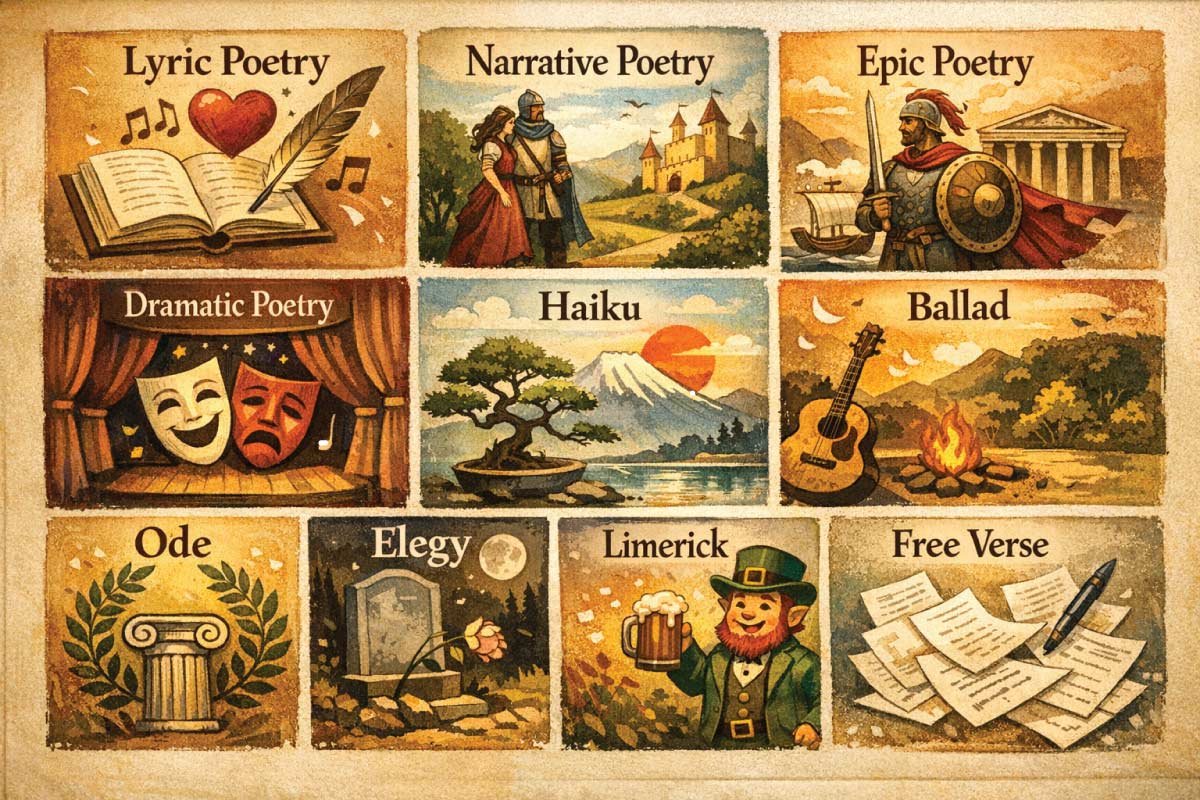
1- Lyric Poetry:
Lyric poetry expresses personal emotions, thoughts, or reflections, often in a musical and highly expressive way. It focuses on individual feelings rather than storytelling. Common examples include sonnets, odes, and elegies, where rhythm, rhyme, and imagery emphasize the poet’s emotional state and inner experience.
2- Narrative Poetry:
Narrative poetry tells a story with characters, events, and a sequence of actions. It can be short or long and often includes a plot, conflict, and resolution. Examples include ballads and epics, where the narrative structure makes the poem both engaging and memorable.
3- Epic Poetry:
Epic poetry is a long, formal, and grand narrative poem that recounts the heroic deeds of legendary figures or significant historical events. Epics often involve gods, supernatural beings, or cultural ideals, as seen in Homer’s The Odyssey or The Iliad, reflecting the values and history of a civilization.
4- Ballad:
A ballad is a narrative poem often meant to be sung. It usually has simple rhyme and meter, making it rhythmic and memorable. Ballads often focus on dramatic, romantic, or adventurous stories, and they frequently employ repetition to emphasize key moments or emotions within the narrative.
5- Dramatic Poetry:
Dramatic poetry is written in the form of dialogue, monologue, or performance. It conveys characters’ emotions, thoughts, and conflicts directly to the audience. Many of Shakespeare’s plays, for example, contain dramatic poetry, blending storytelling with expressive language and verse to heighten emotional impact.
6- Haiku:
Haiku is a traditional Japanese poetry form composed of three lines with a 5-7-5 syllable pattern. Haikus often focus on nature, seasons, or fleeting moments, capturing deep insight and emotion in a very brief, highly structured form that emphasizes simplicity, imagery, and reflection.
7- Ode:
An ode is a formal, lyrical poem that praises a person, object, or idea. It often employs elevated language, elaborate structure, and rich imagery. Odes express admiration, reverence, or contemplation, making them ideal for celebrating virtues, achievements, or profound experiences.
8- Elegy:
Elegies are mournful poems written in reflection on death, loss, or grief. They offer tribute, consolation, or philosophical insight, exploring themes of mortality and remembrance. Elegies balance sorrow with reflection, often providing emotional depth and closure for both poet and reader.
9- Limerick:
A limerick is a short, humorous poem consisting of five lines with an AABBA rhyme scheme. Limericks are playful, often whimsical or absurd, and rely on clever wordplay or punchlines. They are easy to memorize and bring lightheartedness and amusement to poetry.
10- Free Verse:
Free verse poetry abandons traditional rules of rhyme, meter, and form. It relies on natural rhythms, line breaks, and imagery to convey meaning. Free verse offers poets complete creative freedom, allowing them to experiment with style, voice, and structure to evoke emotion and expression.
Key Poetry Terms Every Writer Should Know
Understanding basic poetry terms is essential before diving deeper. These terms form the foundation of reading, analyzing, and writing poetry. Knowing them helps you appreciate the beauty, rhythm, and meaning in poems, and allows you to create your own works more effectively.
1- Line
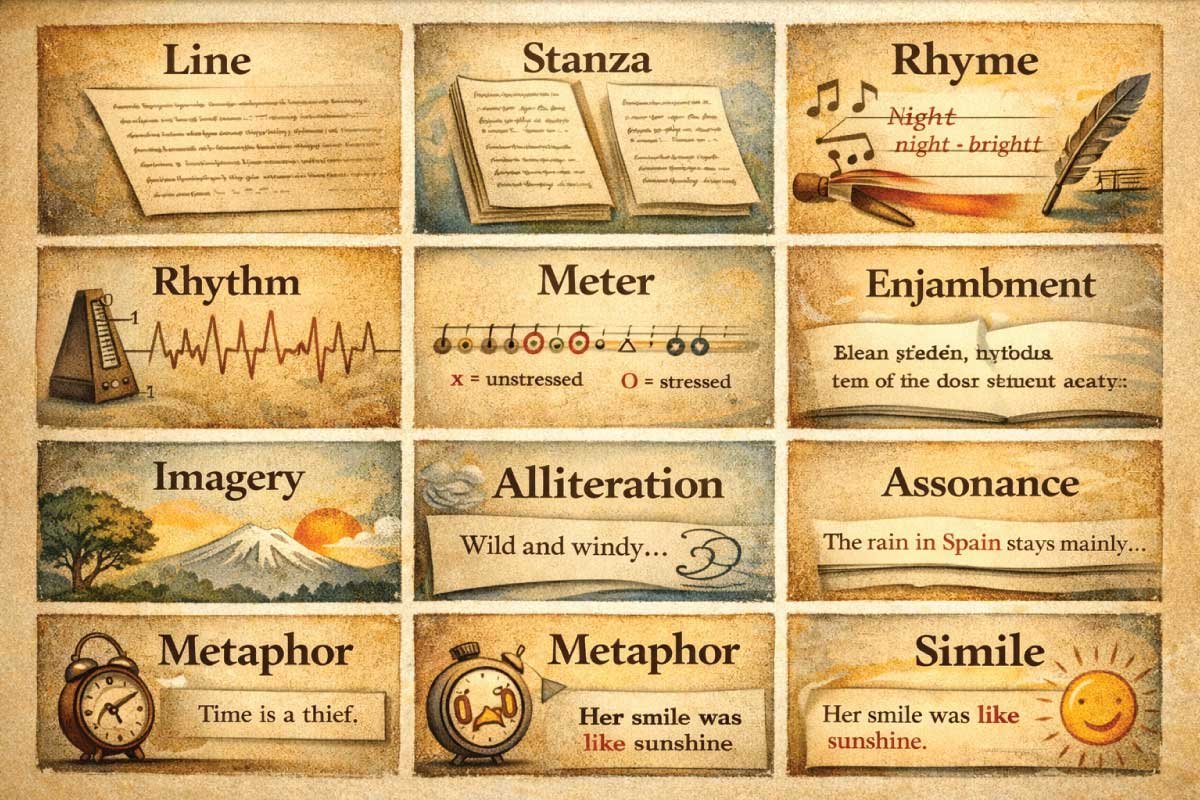
A line is a single row of words in a poem. Unlike sentences in prose, a line may or may not end with punctuation, and its length is determined by rhythm, rhyme, or emphasis rather than grammar. Lines can convey ideas, create pauses, or add musicality, giving poetry its distinctive flow and structure.
2- Stanza
A stanza is a group of lines that forms a unit within a poem, similar to a paragraph in prose. Stanzas organize ideas, create rhythm, and separate different thoughts or themes. They can have consistent line numbers, rhyme schemes, or syllable counts, or they can be irregular, depending on the poet’s style.
3- Rhyme
Rhyme is the repetition of similar sounds in two or more words, often at the ends of lines. Rhymes create musicality, make poems memorable, and emphasize important words or ideas. Common types include end rhyme, internal rhyme, slant rhyme, and eye rhyme, all contributing to the sound and structure of poetry.
3- Rhythm
Rhythm is the pattern of stressed and unstressed syllables in a line of poetry. It gives a poem its musical flow, influences how it is read aloud, and enhances emotional impact. Rhythm can be regular, as in metered poems, or irregular, as in free verse, allowing poets to control pacing and emphasis.
4- Meter
Meter is the structured pattern of rhythm in poetry, determined by the arrangement of stressed and unstressed syllables. Common meters include iambic, trochaic, anapestic, and dactylic. Meter adds musicality, structure, and predictability to a poem, guiding both the poet and the reader in understanding the intended flow and emphasis.
5- Enjambment
Enjambment occurs when a sentence or phrase continues beyond the end of a line without punctuation, carrying the meaning into the next line. It creates a sense of movement, surprise, or suspense, and can emphasize certain words or ideas. Enjambment allows poets to control pacing and enhance the poem’s natural rhythm.
6- Imagery
Imagery uses descriptive language to appeal to the senses—sight, sound, touch, taste, and smell. It paints vivid mental pictures, helping readers experience the poem more fully. By evoking emotions and creating strong sensory impressions, imagery makes poetry more engaging, memorable, and capable of expressing complex ideas and feelings.
7- Alliteration
Alliteration is the repetition of consonant sounds at the beginning of words close to each other. It adds musicality, emphasis, and rhythm to poetry. For example, “wild and windy” emphasizes motion and energy. Alliteration helps create mood, draw attention to key words, and make the poem more memorable.
8- Assonance
Assonance is the repetition of vowel sounds within words that are close together. Unlike rhyme, assonance focuses on internal sounds rather than line endings. For example, “the rain in Spain” creates harmony and flow. It enhances the poem’s musical quality and can evoke mood, emotion, or emphasis in subtle ways.
9- Metaphor
A metaphor is a figure of speech that compares two unlike things without using “like” or “as,” suggesting they are alike in some significant way. For example, “Time is a thief” conveys the fleeting nature of time. Metaphors add depth, symbolism, and layers of meaning to poetry.
10- Simile
A simile is a figure of speech that compares two unlike things using “like” or “as.” For example, “Her smile was like sunshine” draws a vivid connection between her smile and brightness. Similes make descriptions more relatable, create imagery, and help readers understand abstract or emotional ideas in tangible ways.
Also Read:
Understand Poetic Structure
Poetic structure is the deliberate arrangement of lines, stanzas, and rhyme patterns in a poem. It determines the flow, pacing, and rhythm, influencing how readers interpret meaning and emotion. A strong structure enhances clarity, impact, and musicality, guiding the reader through the poet’s vision.
1. Stanza Forms
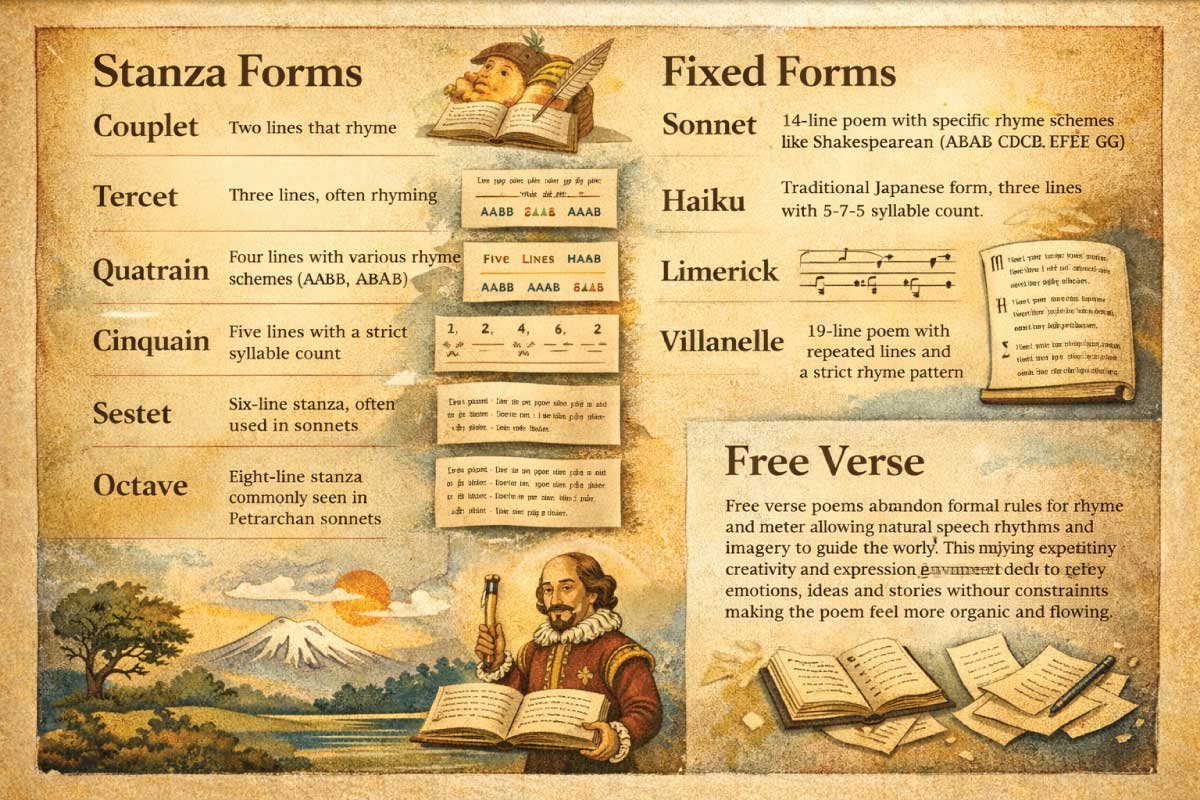
Stanzas are groups of lines forming a unit, similar to paragraphs in prose. They organize ideas, establish rhythm, and create visual breaks. Poets use stanzas to emphasize themes, control pacing, and guide readers, allowing a poem to feel structured, intentional, and aesthetically pleasing.
-
Couplet: Two lines that rhyme.
-
Tercet: Three lines, often rhyming.
-
Quatrain: Four lines with various rhyme schemes (AABB, ABAB).
-
Cinquain: Five lines with a strict syllable count.
-
Sestet: Six-line stanza, often used in sonnets.
-
Octave: Eight-line stanza, commonly seen in Petrarchan sonnets.
2. Fixed Forms
Fixed forms are poetic styles with strict rules for rhyme, line length, or meter. These forms challenge poets to express creativity within constraints. Classic examples include sonnets, haikus, and limericks, each offering a unique framework that shapes tone, rhythm, and meaning.
-
Sonnet: 14-line poem with specific rhyme schemes like Shakespearean (ABAB CDCD EFEF GG).
-
Haiku: Traditional Japanese form, three lines with 5-7-5 syllable count.
-
Limerick: Five-line humorous poem with AABBA rhyme scheme.
-
Villanelle: 19-line poem with repeated lines and a strict rhyme pattern.
3. Free Verse
Free verse poems abandon formal rules for rhyme and meter, allowing natural speech rhythms and imagery to guide the work. This style emphasizes creativity and expression, giving poets freedom to explore emotions, ideas, and stories without constraints, making the poem feel more organic and flowing.
Also Read:
What Is Meter in Poetry?
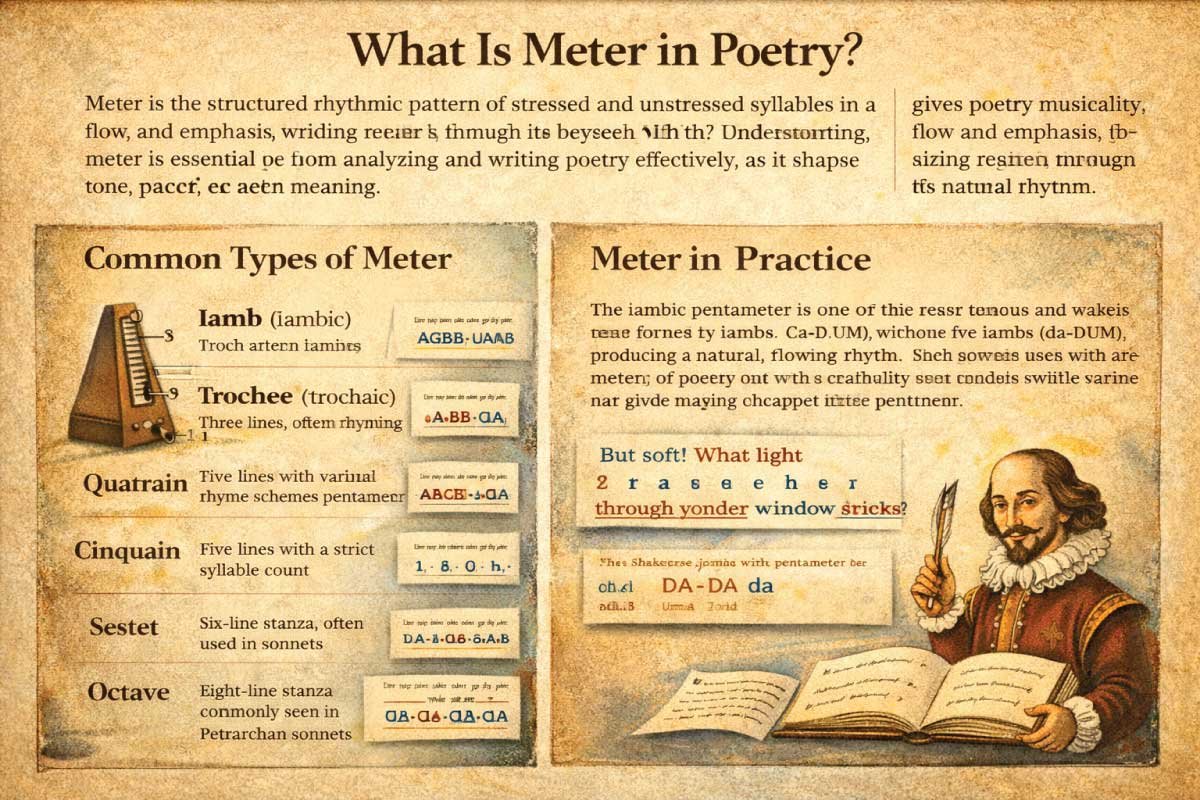
Meter is the structured rhythmic pattern of stressed and unstressed syllables in a poem. It gives poetry musicality, flow, and emphasis, guiding readers through its natural rhythm. Understanding meter is essential for both analyzing and writing poetry effectively, as it shapes tone, pace, and meaning.
1- Common Types of Meter
Poets use different meters to create rhythm, musicality, and emotional impact. Each type has its unique pattern of stressed and unstressed syllables, influencing the poem’s tone and pace. Learning these meters helps readers recognize patterns and writers craft intentional rhythm.
Iamb (iambic): Unstressed syllable followed by stressed (da-DUM).
Example: “I think I shall be somewhere”Trochee (trochaic): Stressed followed by unstressed (DA-dum).
Example: “Tyger Tyger, burning bright”Anapest (anapestic): Two unstressed followed by one stressed (da-da-DUM).
Dactyl (dactylic): One stressed followed by two unstressed (DA-da-da).
Spondee (spondaic): Two stressed syllables (DA-DA), used for emphasis.
2- Meter in Practice
The iambic pentameter is one of the most famous and widely used meters in poetry. Each line contains five iambs (da-DUM), producing a natural, flowing rhythm. Shakespeare used this extensively, giving his works musicality and elegance while reinforcing meaning through careful stress patterns.
Also Read:
Imagery and Symbolism in Poetry
Imagery and symbolism are central to poetry, helping readers visualize experiences and connect with abstract ideas. Imagery uses sensory details, while symbolism assigns deeper meaning to objects, colors, or events, enriching the emotional and intellectual depth of a poem.
Visual Imagery: Describes what we see.
Auditory Imagery: Appeals to hearing.
Tactile Imagery: Appeals to touch.
Gustatory Imagery: Appeals to taste.
Olfactory Imagery: Appeals to smell.
Symbolism uses objects, colors, or events to represent abstract concepts. For example, a rose may symbolize love, while a storm can represent turmoil or conflict. Symbolism adds layers of meaning, allowing readers to interpret poems on multiple levels.
Figurative Language: Adding Depth and Beauty to Poetry
Figurative language allows poets to express complex ideas and emotions in creative ways. By using comparisons, exaggerations, or human traits, figurative language enriches a poem’s meaning, makes it more memorable, and enhances its emotional and aesthetic impact.
Metaphor: Direct comparison without using “like” or “as.”
Example: “Time is a thief.”Simile: Comparison using “like” or “as.”
Example: “Her smile was like sunshine.”Personification: Giving human qualities to non-human things.
Example: “The wind whispered secrets.”Hyperbole: Exaggeration for effect.
Irony: Expressing meaning opposite to the literal words.
Using figurative language effectively makes poems resonate emotionally while conveying deeper meaning beyond literal words.
Also Read:
How to Write Poetry: A Step-by-Step Guide for Beginners and Aspiring Poets
Writing poetry is an art that combines creativity, observation, and emotion. Whether you are a beginner or an experienced writer, understanding techniques, structure, and language use can help you craft poems that resonate, evoke feeling, and express ideas with clarity and beauty.
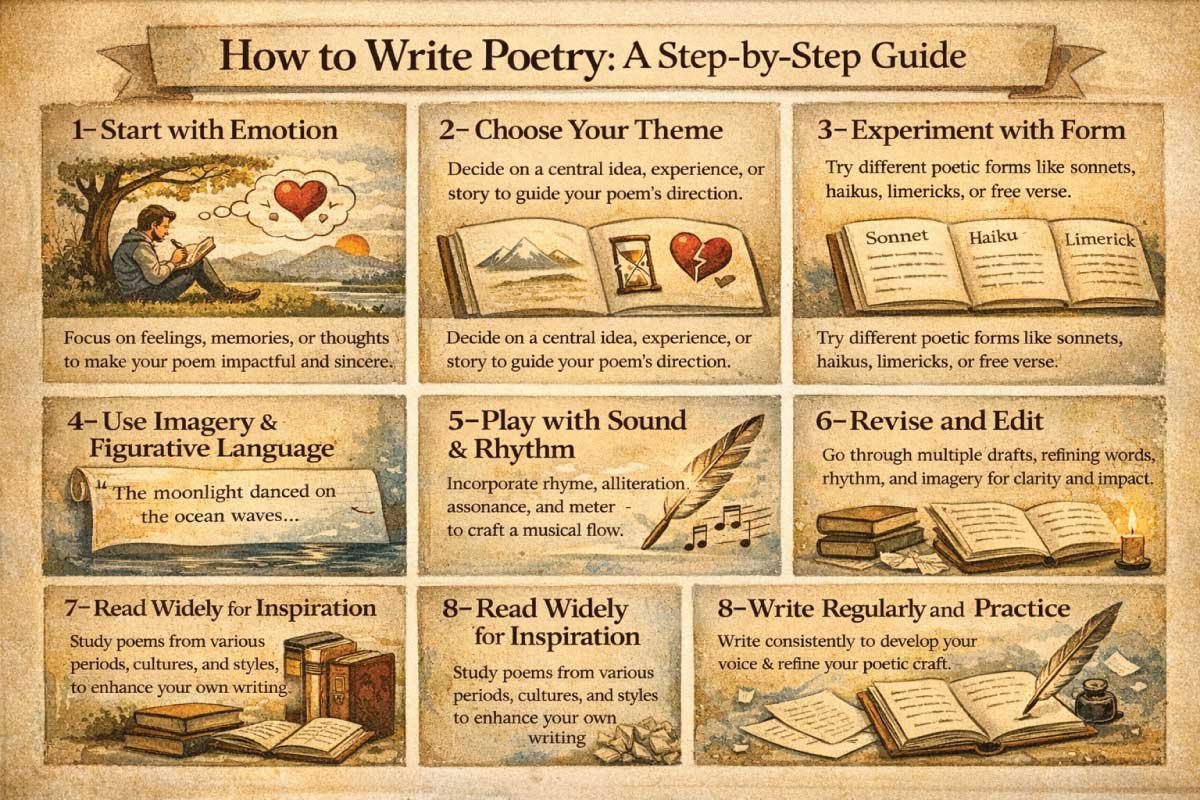
1- Start with Emotion:
Begin your poem by focusing on a feeling, memory, or thought. Poetry is strongest when rooted in genuine emotion, whether joy, sadness, love, or reflection. Expressing authentic emotion helps readers connect and makes your poem memorable and impactful.
2- Choose Your Theme:
Decide what central idea, experience, or story your poem will convey. Themes can range from love, nature, or grief to abstract concepts like freedom or time. A clear theme gives direction and purpose to your poem, guiding your language and imagery.
3- Experiment with Form:
Select a poetic form that fits your theme and style. Try structured forms like sonnets, haikus, limericks, or free verse. Experimenting with different forms allows you to explore rhythm, rhyme, and pacing, shaping how your poem sounds and feels.
4- Use Imagery and Figurative Language:
Paint vivid pictures with words by appealing to the senses and using metaphors, similes, and personification. Imagery helps readers experience your poem, while figurative language adds depth, creativity, and emotional resonance to your writing.
5- Play with Sound and Rhythm:
Incorporate rhyme, alliteration, assonance, or meter to create musicality and flow. The way a poem sounds aloud can enhance emotion and meaning, making your words memorable and engaging for readers.
6- Revise and Edit:
Poems often improve through multiple drafts. Review your work for clarity, rhythm, imagery, and word choice. Cut unnecessary words, refine lines, and ensure each element contributes to the overall meaning and emotional impact of the poem.
7- Read Widely for Inspiration:
Study poems from different periods, cultures, and styles to expand your knowledge and inspire creativity. Reading widely helps you understand techniques, forms, and vocabulary, improving your own writing and giving fresh ideas for expression.
8- Write Regularly and Practice:
Consistency is key to improving as a poet. Write daily or frequently, even in short bursts. Practicing helps develop your voice, refine technique, and discover new ways to express emotions, stories, and ideas through poetry.
Also Read:
Writing Techniques and Tips for Creating Powerful Poetry
Effective poetry writing combines emotion, imagery, sound, and structure. Whether you are a beginner or experienced, applying certain techniques can improve your poetry, helping you convey ideas clearly and engage readers more profoundly.
Start with Emotion: Decide what feeling you want to convey.
Use Strong Imagery: Paint vivid pictures to connect with readers.
Play with Sound: Experiment with rhyme, alliteration, and rhythm.
Experiment with Form: Try sonnets, haikus, free verse, or limericks.
Revise and Edit: Poems often improve through multiple drafts.
Read Widely: Study poems from different periods and styles to expand your skill.
Also Read:
The Role of Poetry in Literature
Poetry is more than an art form—it’s a reflection of culture, emotion, and history. From ancient epics like The Iliad to modern slam poetry, poetry captures the essence of human experience. It influences music, storytelling, and even public speeches.
Reading and writing poetry helps improve language skills, critical thinking, and empathy, making it a timeless and universal form of expression.
Also Read:
How to Analyze Poetry: Step-by-Step Guide for Readers and Writers
Analyzing poetry is the process of examining a poem’s structure, language, and meaning to fully understand its message, emotion, and artistry. Careful analysis helps readers interpret themes, literary devices, and symbolism while improving their own writing and appreciation of poetry.
Read Multiple Times: Poems often reveal new layers with each reading.
Identify the Theme: Determine the central idea or emotion the poem conveys.
Examine Structure and Form: Observe rhyme, meter, line breaks, and stanza patterns.
Look for Literary Devices: Identify metaphors, similes, imagery, and sound devices.
Consider Tone and Mood: Reflect on how the poem makes you feel.
Interpret Symbolism: Look for deeper meanings beyond the literal words.
Also Read:
Famous Poetry Forms and Their Examples
Poetry forms are defined by specific rules of structure, rhyme, or meter, guiding both the poet and reader. Each form serves a unique purpose, but all aim to convey human experience creatively, whether through emotion, humor, imagery, or storytelling.
Sonnet: Shakespeare’s Sonnet 18 (“Shall I compare thee to a summer’s day?”)
Haiku: Matsuo Basho’s seasonal three-line poem
Limerick: Edward Lear’s humorous five-line poems
Free Verse: Walt Whitman’s Leaves of Grass
Epic: Homer’s The Odyssey, narrating heroic adventures
These forms illustrate the diversity of poetry, showing how structure, sound, and style shape meaning. Understanding them allows writers to experiment confidently and readers to appreciate the rich traditions of poetry.
Also Read:
Conclusion
Poetry is a vast and fascinating art form that combines language, rhythm, and imagination to evoke emotion and meaning. By understanding terms, structure, meter, and literary devices, you can appreciate poetry more deeply and begin creating your own.
Whether you are drawn to traditional forms like sonnets and haikus or prefer the freedom of free verse, mastering the basics of poetry will enhance your reading, writing, and appreciation of this timeless art.
Start small, experiment with lines and stanzas, and let your words flow. With patience and practice, anyone can discover the beauty and power of poetry.
Also Read:
FAQs:
1. What is poetry?
Poetry is a literary art form that uses carefully chosen words, rhythm, and imagery to express emotions, ideas, or stories. Unlike prose, poetry often relies on symbolic language, musicality, and structure to create deeper meaning and evoke strong emotional responses from readers.
2. What is the meaning of poetry?
The meaning of poetry lies in expressing thoughts, feelings, and experiences through rhythmic and imaginative language. It goes beyond ordinary writing by using figurative language, imagery, and sound devices to convey emotions and ideas, making readers reflect on life, feelings, or human experiences.
3. What are the types of poetry?
Poetry comes in many forms, including lyric, narrative, epic, ballad, haiku, ode, elegy, limerick, and free verse. Each type has distinct characteristics, structures, and purposes, allowing writers to explore emotions, tell stories, or convey ideas creatively, and helping readers appreciate diverse poetic styles.
4. What are key poetry terms?
Key poetry terms include line, stanza, rhyme, rhythm, meter, enjambment, imagery, alliteration, assonance, metaphor, and simile. Understanding these terms helps readers analyze poems and gives writers tools to structure their work, enhance musicality, and express complex ideas with clarity and emotional impact.
5. How do you analyze poetry?
Analyzing poetry involves reading multiple times, identifying the theme, examining structure, and noticing literary devices like metaphors, similes, and symbolism. Consider the poem’s tone, mood, and imagery to interpret deeper meanings. Careful analysis reveals emotional layers and helps readers fully appreciate the poet’s craft.
6. How can I write my own poetry?
To write poetry, start with an emotion or theme, experiment with form and rhythm, use vivid imagery and figurative language, and revise carefully. Reading widely and practicing regularly develops your voice and style. Poetry is about expressing ideas creatively and connecting with readers on an emotional level.