
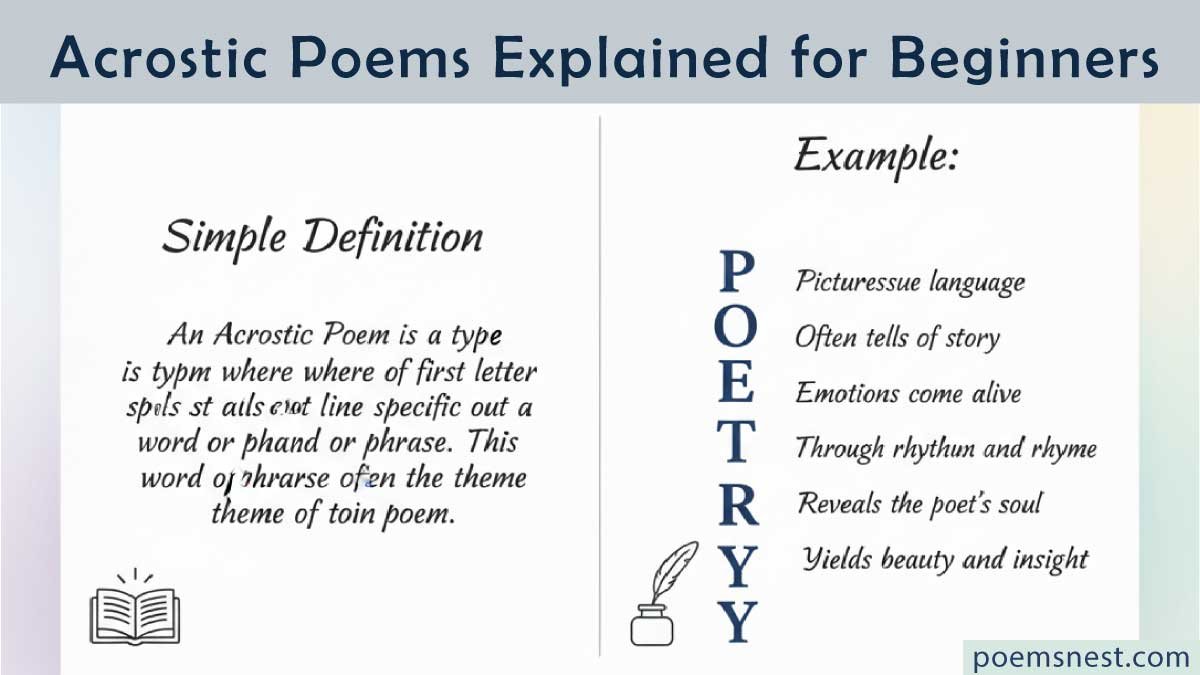
Not so many people know that acrostic poems can be creative and rather easy. They may appear easy on the surface but when you begin writing one, you will think there is a lot more behind the lines, literally! The thing is that an acrostic poem does not deal with rhyme or rhythm. It is structural and the way every line is related to a hidden message. Acrostics combine simplicity and imagination whether you are a student learning poetry a new thing or you are just interested in knowing more about creative writing.
Let’s break it down in a way that’s easy, fun, and full of examples.
🧩 What Exactly Is an Acrostic Poem?
An acrostic poem is a form of poem in which some letters, usually the first letter of every line, form the letters of a word or message when read in a vertical line. That’s the basic definition. What is interesting however is how poets apply this structure in conveying deeper feelings or thoughts. Imagine it as some puzzle within a poem. You may read it like a regular verse, however, when you read it down, you will find that there is another meaning out there.
Here’s a quick example:
HOPE
Hold on when things get tough,
Open your heart to new light,
Push past the fear and doubt,
Embrace tomorrow’s fight.
You see, the first letters in the lines give the word HOPE. It is very brief, strong and significant. And that is just what acrostic poems do best it says a lot in a very little.
💡 How Acrostic Poems Differ from Other Poetic Forms
You might wonder, “So, is an acrostic poem like the haiku or a sonnet?” Not really.
Here is the simple comparison to make it clearer:
| Feature | Acrostic Poem | Other Poems (like Haiku, Sonnet, etc.) |
|---|---|---|
| Structure | Based on letters of a word | Based on syllables, rhythm, or rhyme |
| Focus | Revealing a hidden message | Following a set form or pattern |
| Rhyme | Optional | Often required |
| Flexibility | Very high | Usually fixed rules |
Topical poems make you free. You may either keep them brief or long, humorous or grave, rhyme or free verse. Any one letter-directed creativity is good.
🎨 The Simple Structure of an Acrostic Poem
To write an acrostic Poem, you must first pick your key word. It may be anything, the name of a person, emotion, a place, or even an idea. And then all of the lines of your poem start with the letters of that word.
For example, if your word is “LOVE,” your poem might look like this:
Living moments that matter,
Open hearts with gentle care,
Voices soft but deeply felt,
Every heartbeat whispers, “share.”
You will be surprised how much emotion you can express in just four lines.
Quick Tip: When you are beginning with poetry, begin with shorter words. Smile, peace, dream, or faith are all the words that can be used by the beginners.
✏️ Step-by-Step: How to Write an Acrostic Poem
It is often believed that the writing of poetry involves the use of large diction or intense feelings but acrostic poems are wonderfully simple. The following are some tips on how to do one that really resonates:
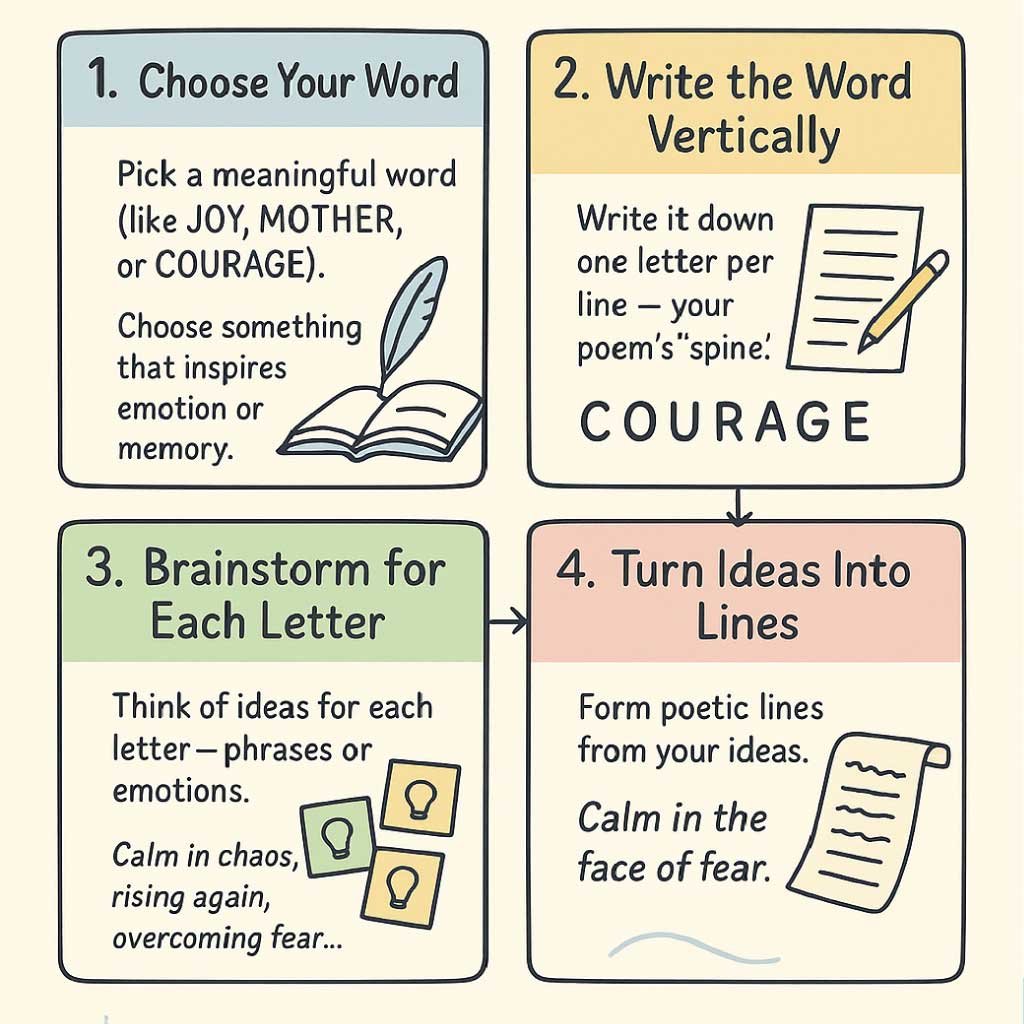
1. Choose Your Word
Pick a word that means something to you—maybe the feeling (JOY), a person (MOTHER), or an idea (COURAGE). The stronger your connection and the easier the lines will come.
2. Write the Word Vertically
Write it down one letter per line. That will serve as your poem’s “backbone.”
Example:
C
O
U
R
A
G
E
3. Brainstorm Ideas for Each Letter
Think: What does come to thee when thou thickest of that word? On the case of COURAGE, perhaps: calm in chaos, rising again, overcome the fear etc. Jot down phrases.
4. Turn Those Ideas Into Lines
Turn your brainstormed thoughts into full sentences or poetic lines.
Example:
Calm in the face of fear,
Overcoming what once seemed impossible,
Understanding that strength is quiet,
Rising again after every fall,
Allowing hope to guide your heart,
Giving your best even when unsure,
Ending each day proud you tried.
And there you have it, a heartfelt acrostic poem about courage!
🌿 Simple Real-Life Examples of Acrostic Poems
Here are some examples anyone can relate to:
Example 1: FRIEND
Forever listen when I need to talk,
Remind me who I am,
In the laughter and the silence,
Every moment feels lighter,
Never judge, always caring,
Days are better with you around.
Example 2: PEACE
Pause for a moment and breathe,
Every worry fades away,
Amid chaos, calm remains,
Choose the kindness every time,
Every day, a quiet gift.
See how simple and touch these can be? You do not need to rhyme or follow any rigid rule, just express a feeling through letters.
💭 Why Writers and Students Love Acrostic Poems
Acrostic poems are common in schools as they are not difficult to comprehend and promote the use of imagination. However, they are not only children favorites, a lot of adults like to have them.
Here is why they are so popular:
✅ Why It Works
- Easy to start: You only need one word to begin.
- Boosts creativity: It pushes you to think about words in new ways.
- Flexible format: Works for both short and long poems.
- Fun for all ages: Great for children, students, or hobby poets.
❌ Possible Drawbacks
- Limited theme space: You are tied to the letters in your chosen word.
- Can feel forced: Sometimes lines sound unnatural if the word’s tricky.
- Shorter emotional depth: Harder to build complex stories or emotions.
Acrostics are terrific, still, when it comes to expressing feelings.
⚡ Common Mistakes to Avoid When Writing an Acrostic Poem
Although acrostic poems are not very complicated, some traps that beginners can go through are few.
Here are some to watch out for:
Choosing awkward words: Pick a word that’s easy to build lines around. Words like “Xylophone” are just asking for trouble.
Focusing only on the letters: Do not forget the poem should still make sense overall.
Forcing rhymes: Acrostics do not have to rhyme! Focus on meaning, not sound.
Ignoring flow: Read your poem aloud, it should sound natural.
Over-explaining: Keep your lines short and expressive.
Quick Fix: Remember, a poem that sounds stiff can simply be read aloud and it can be cut. When it comes to poetry, it works better when it is simple.
👩🏫 Who Should Try Writing Acrostic Poems?
To be quite honest any one can write one. They are also good particularly at:
- Students — because they make learning fun and creative.
- New poets — to build confidence before tackling complex forms.
- Teachers — as classroom activities or holiday projects.
- Writers — to break creative blocks.
- Parents and kids — for personalized gifts (like spelling a name or feeling).
Use the name of your child to write an acrostic poem on a birthday card- it is meaningful, unique and simple to make.
🔍 Short Comparison: Acrostic vs. Other Simple Poetic Forms
| Type of Poem | Main Feature | Example Word | Difficulty |
|---|---|---|---|
| Acrostic | First letters spell a word | HOPE | ⭐ Easy |
| Haiku | 5-7-5 syllable count | Nature or moment | ⭐⭐ Moderate |
| Limerick | 5 lines with rhythm & rhyme | Humorous | ⭐⭐ Moderate |
| Free Verse | No fixed rule | Anything | ⭐⭐ Moderate |
| Sonnet | 14 lines with rhyme pattern | Love or emotion | ⭐⭐⭐ Challenging |
Acrostic poems is that you do not have to be concerned about syllables, rhyme or structure; just feel and be creative.
🌼 Acrostic Poems for Beginners: Tips and Tricks
In case you are willing to give it a chance, the following are some of the tips that can be applied quickly to make your poem flow naturally:
Pick emotional words. Words like “family,” “dream,” or “hope” create instant connection.
Use simple language. Don’t try to sound “poetic”—just honest.
Focus on meaning. Each line should reflect part of your theme.
Play with tone. Make it funny, serious, or inspirational—it’s your choice.
Try themes. Seasons, feelings, relationships, or memories work great.
And most importantly—enjoy it! Poetry is meant to feel, not force.
✨ A Few Creative Uses for Acrostic Poems
You will think how handy acrostic poems are out of the classrooms. The following are some of the ingenious applications by people:
Greeting cards: A personalized acrostic using the recipient’s name.
Art projects: Combine acrostic text with watercolor or digital art.
Social media posts: Short acrostics make great captions.
Daily journaling: Pick a word that reflects your day’s mood.
Teaching tools: Great for learning vocabulary or expressing feelings.
And they are also great to use in their mindfulness activities, writing one helps you to relax and ponder on feelings.
💬 Real Example: Acrostic Poem About “LIFE”
This is a good illustration which is simple and complex at the same time:
LIFE
Learning from moments, big and small,
Inside each failure, there’s a spark,
Finding strength to rise again,
Every ending starts a new mark.
Simple, right? But, by the way, how it gets so softly what “life” is–full of hope, thoughtfulness, and humanity.
🌟 Why Acrostic Poems Still Matter
In the world full of long, complex forms of writing, acrostic poems remind us that beauty can live in simplicity. You do not need to be any professional poet that to create something touching. All you need is one word and a bit of heart.
Most people do not realize that poetry is not about any fancy sound, It is about express truth in the way that others can feel. And acrostics do that perfectly. They are small, but they carry big messages.
🌻 Final Thoughts
If you have never written a poem before, start with an acrostic. It is easy, fun, and surprisingly deep once you get into it. Just pick the word that means something to you and let each line unfold naturally.
Do not worry about rules or rhyme—focus on emotion and flow. Whether it’s for a school project, for friend’s birthday, or your own quiet reflection, acrostic poems are also the kind of writing that stays with you.
So grab the notebook, choose your word, and see what words your heart creates. You will be amazed at what you can express—one letter at a time.
🌸 Step into the beauty of 👉 haiku poems, where few words paint deep emotions! Learn their definition, explore the simple structure, and enjoy classic examples. Read the full post to discover how haikus capture life’s quiet moments!