
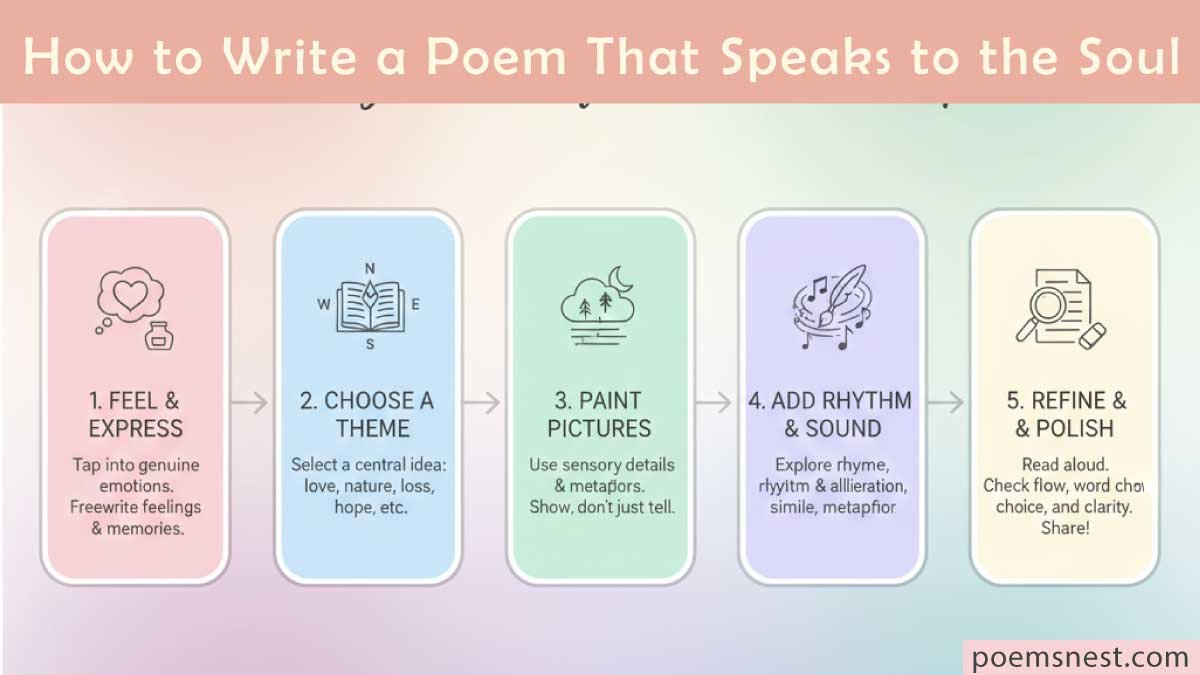
The vast majority of the populace is unaware of the fact that a truly moving poem is not made by the use of fancy wording or the correct rhyme- it is made by truth. You can write about love, loss, hope or a sunset, but what truly touches the hearts of people is the reality of a poem. The thing is that in poetry it is not about impressing people.
It is about something that is expressed so authentic that the reader experiences it. This is regardless of whether you are a beginner writer or have been penning down verses since childhood, this guide will enable you to mold your emotions into words that will remain in the minds of people long after they have finished reading them.
Let’s dive in and make your words come alive.
🧠 Step 1: Understand What Makes a Poem Emotional
Why do you want to write this poem? This is the question you must ask yourself before writing. Is it to say that you have never said some thing aloud? So that you can console a person in distress? Or perhaps just to know more about you?
Most heart touching poems come from one of these three places:
Personal experience – something you lived through or deeply felt.
Empathy – feeling someone else’s joy or pain as your own.
Observation – see something beautiful or tragic and want to give it meaning.
You will find to what power your words may sometimes tend when you speak them with genuine feeling. It is easy to feel when a poem is written to the heart and readers will always feel that it is almost a silent truth that one can never imitate.
Tip: Don not start with “What rhymes with love?” Start with what love felt like.
✍️ Step 2: Choose a Theme That Resonates
This is one of the main mistakes that most beginners make they want to write about everything in a single poem. Nevertheless, powerful poems tend to dwell on a single emotion or concept. Imagine, as though, that you did not paint all a sky, but only one bright star.
Common Themes That Touch Hearts
- Love that stays or fades
- Loss and healing
- Hope in dark times
- The beauty of small moments
- Faith, trust, or gratitude
- Letting go and moving on
Quick Tip: Pick a Real Feeling
Ask yourself: What happened in my life that I still remember in my heart? And that is where it normally begins. A heartfelt poem is a work usually created out of a still living memory.
💬 Step 3: Speak in Your Own Voice
One of the greatest errors human beings make is believe that they must go poetic. But guess what? One does not need flowery words to touch a person; he or she needs to be real. The point is here, the readers relate with reality, not with being perfect. Your poem will sound natural and relatable in case you write the way you talk.
Try This Exercise
Write a few lines as if you are talking to a close friend.
For example:
“I miss the way you used to laugh at things that weren’t funny.”
That single line already says more than a paragraph of fancy vocabulary ever could.
Quick Pros of Writing in Your Own Voice
✅ Easier to write and edit
✅ Sounds more genuine
✅ Builds emotional connection
✅ Timeless — your words won’t feel outdated
So, drop the “thee” and “thou.” Just write how you feel.
🎨 Step 4: Choose the Right Structure (But Don’t Overthink It)
The majority of individuals believe that they cannot write poetry as they are not aware of the rules. The thing is, though, that there is no rulebook. Admittedly, there are some poetic forms such as haikus, sonnets, or free verse. However, when you are writing to the heart, then it can be well done with free verse (poetry that has no rigid rhyme and rhythm). It leaves your feelings room to breathe.
Here is a Simple Comparison
| Type | Structure | Why It Works |
|---|---|---|
| Rhyming Poem | Follows rhyme patterns like ABAB | Sounds musical and catchy |
| Free Verse | No set rhyme or rhythm | Feels natural and emotional |
| Haiku | 5-7-5 syllable structure | Focuses on beauty and simplicity |
| Acrostic | First letters spell a word | Fun and meaningful |
If you are a beginner, go with free verse — just focus on rhythm and emotion, not strict patterns.
🌧️ Step 5: Use Strong Imagery and Emotion
A heart-touching poem does not explain to the readers how you feel but rather illustrates this. That’s where imagery comes in.
Instead of saying:
“I was sad.”
Try saying:
“Rain tapped on my window like it knew what I’d lost.”
See the difference? The second line creates a visual image and the reader experiences sadness without being told.
How to Use Imagery Effectively
- Use the five senses (sight, sound, touch, taste, smell).
- Replace abstract words like love, pain, beauty with sensory images.
- Don not overdo it — one vivid image can be enough.
Example:
“Your silence was louder than any goodbye.”
That’s the kind of line people remember.
💡 Step 6: Edit with Your Heart, Not Just Your Eyes
It is a little secret: the first paper you wrote your poem on was only you talking to your heart. It is at editing that your mind comes in to fashion it.
When editing, ask yourself:
- Does every line feel necessary?
- Is there a moment that feels forced?
- Does it sound like me?
Read your poem out loud. You will immediately detect rhythm, flow and tone. When one thinks something is wrong, it is likely. Trust that instinct.
Common Mistakes to Avoid
❌ Trying to rhyme every line
❌ Using clichés (“my heart is broken,” “tears like rain”)
❌ Overexplaining feelings
❌ Forcing emotion
Remember- emotion never comes in the form of words such as sad or beautiful. It comes from truth.
🧩 Step 7: Add a Twist or Deeper Meaning
A fine poem tends to make the readers think. It is not merely an expression of a feeling, but of a truth. An example is that a poem written about the loss of a person may silently become a lesson about the importance of living in the present. Or a poem of failure would be in fact a poem of endurance. The thing is that it is the reverse–the secret beat behind the words.
Try this:
After finishing your poem, ask: What truth does this reveal about me or life?
If you can answer that, your poem already carries depth.
👥 Step 8: Write for Someone (Even if It’s Yourself)
There are poems addressed to another person a friend, a beloved lost, even a self. That personal appeal is more cozy and friendly. Poems that are written as a conversation and not a speech are popular among readers.
For instance:
“Mom, I still see your smile in the morning light.”
It feels like we’re peeking into a private moment and that’s powerful.
Who This Is Ideal For
This kind of writing suits:
- People healing from something
- Those who want to express gratitude
- Beginners learning self-expression
- Anyone looking to connect emotionally through words
If you write from this space, you will touch hearts — guaranteed.
⚖️ Step 9: Pros and Cons of Emotional Poetry
To tell the truth, emotional poetry is a beautiful and difficult task.
Pros:
✅ Helps you release feelings
✅ Connects deeply with readers
✅ Can inspire and comfort others
✅ Feels timeless and honest
Cons:
❌ Can feel too raw or vulnerable at first
❌ Hard to balance emotion and clarity
❌ Sometimes misunderstood by readers
But do not let that stop you. Vulnerability is the very thing that makes poetry human.
Step 10: Learn From Real Life, Not Rules
Poets read and read about meters and metaphors but the most potent poems are usually written directly by actual life events, when your child is taking his first step, or when you are remember the voice of your grandmother.
Here is what you can do:
- Keep a small notebook for thoughts or emotions.
- Note down small, real moments.
- Don’t wait for inspiration — it’s usually hiding in everyday life.
You will discover that you often write poems out of the little things that meant the world to you.
💭 Step 11: A Quick Comparison — Writing With Emotion vs. Technique
| Approach | Focus | Result |
|---|---|---|
| Technique-first | Rhymes, structure, grammar | Sounds polished but may lack feeling |
| Emotion-first | Feeling, story, honesty | Connects deeply but may need editing |
The secret? Combine both. Write from emotion first, then edit with technique.
That is how you make poetry which not only is sometimes touching–but remains eternal.
🛠️ Step 12: Quick Tips to Make Your Poem Shine
Here are some tried and true tips most experienced poets use (but rarely talk about):
✨ Start with an image, not a title. Let the title come later — it should reflect the heart of your poem.
✨ End with impact. The last line should feel like a whisper that stays in the reader’s head.
✨ Read famous poems aloud. Notice their rhythm and tone, not just the words.
✨ Avoid forced rhymes. They can ruin the natural emotion.
✨ Trust silence. Sometimes, what’s not said speaks louder.
🌹 Step 13: Common Mistakes to Avoid
This is what mostly occurs when amateurs attempt to compose emotional poems:
❌ Trying too hard to sound deep — simplicity is more powerful.
❌ Overusing metaphors — one strong image is better than five weak ones.
❌ Copying other poets’ styles — your truth matters more than your technique.
❌ Skipping editing — even emotional poems need structure.
Avoid these, and you’re already ahead of most new poets.
💌 Step 14: How to Know If Your Poem Works
You do not have to have hundreds of likes or shares to realize that your poem is industrial. When it gives you a feeling, when it gives you a real feeling, then you know.
But you can also test it out:
- Share it with one trusted friend.
- Watch their reaction.
- If they pause, smile, or go quiet — your poem touched them.
That’s what poetry is meant to do.
🌷 Final Thoughts: Let Your Words Heal and Inspire
You have made this far, and you already have the most valuable part of it a heart that feels. The remaining is mere practice and time. Poetry will make you feel that you have done some healing. Each and every line you write is a little escape – a means of translating emotion into art. And keep in mind that you do not have to be a great poet to reach the hearts. You just need to be honest. It is sincerity, but not sophistication to which the readership can relate.
So, start small, Write couple of lines about your day, thoughts, or any memory that is still in your mind. Get your heart to rule. Your heart will have something to put across to you when you give it a voice. Write as you go on, keep on feeling, and get the words to where the voices cannot, to the heart.
🌼 Dive into the world of 👉 poems and uncover their hidden beauty! Learn about different types, explore poetic structure, and see inspiring examples that touch the heart. Read the full post to truly feel the rhythm of poetry!