
When the life steals something or someone dear, words can hardly suffice. But somehow, poetry is able to contain feelings that cannot be captured by simple sentences. That is what the elegy poems do, they make the grief into art. Majority of the populace fails to understand that an elegy is not a mere subject of sorrow, but also of contemplation, recovery and even silent hope. It is one of the oldest and the most potent types of poetry that were created as a result of human necessity to memorize and interpret the loss.
We shall discuss what makes the elegy poems so special, how they are written and why they still touch the hearts even today.
💭 What Is an Elegy Poem?
An elegy poem is a kind of poem that is written to convey grief or lamentation – usually over the death of a person, and occasionally over a past time, place or emotion. This is the point thing is that an elegy is not a sad poem. It goes through a definite process of emotions: grief and sadness, reflection and, ultimately, acceptance.
It is about seeking a calmness in the suffering. Just imagine it as the poetic version of remembering a person at a quiet moment not only crying about their departure, but also enjoying their presence and things they taught us.
Quick facts about elegy poems:
🕊️ Theme: Loss, reflection, remembrance, acceptance
📜 Tone: Sorrowful but thoughtful
🎵 Structure: Often free verse or traditional rhyming patterns
💡 Purpose: To express emotions and preserve memory through words
🌹 The Emotional Journey in an Elegy
You will feel that when you have ever read an elegy, the poem seems like a heart to the universe is talking to the poet. It typically passes through three emotional phases – and that is what makes it so compelling.
1. Grief and Sorrow
The poem is usually peaked with crude suffering. The poet laments the death of a person – he speaks about the blankness, the bewilderment, or disillusionment which comes. It’s deeply human.
“I cannot hold your hand again,
Yet every breeze still says your name.”
This opening stage helps readers feel the weight of absence.
2. Reflection and Tribute
Next comes reflection. The poet starts remembering the dead person, his or her character traits, or moments of his or her life. It takes a lesser focus on the hurt and more on the individual or thing that is lost. It is almost as much saying, Yes, they are gone–but how beautiful it is all they left behind.
3. Acceptance and Peace
Acceptance is another theme of the poem that usually comes at the end of it, not forgetting, but knowing how to go on living with the loss. Numerous of the elegies look in the direction of hope or eternity, implying that love or memory will live longer than death. And then the last change is very soothing. That is why, elegant never leave you, they always haunt like a low voice, saying you can get better.
🕯️ A Brief History of Elegy Poems
Elegy poems date back to thousands of years. Elegy is a Greek word, the Latin equivalent of which is elegies, which simply means a song of woe or sorrow. The Greek and Roman poets of ancient times, such as Tibullus, Propertius and Ovid, dedicated elegies to the death as well as the lost love, lost friendship and even a lost chance.
Next there were the English poets, whose works such as Thomas Gray, in his Elegy Written in a Country Churchyard (1751) made as classics. His poem did not lament an individual, but the lost lives of the common men. It made the elegy a world one. During the Romantic period, the elegy was turned into a very personal form of art by poets such as Percy Bysshe Shelley and Alfred Lord Tennyson.
The poem In Memoriam A.H.H. was composed by Tennyson following the loss of his good friend and it is regarded as one of the best manifestations of mourning in the English literature. Even in the current setting, modern poets still rely on elegies to convey loss, whether of people that they love or even love of a culture or even love of nature.
✍️ How to Write an Elegy Poem
It is not about rhyming and fancy words in order to write an elegy. It’s about honesty. You can write one, should you be able to feel.
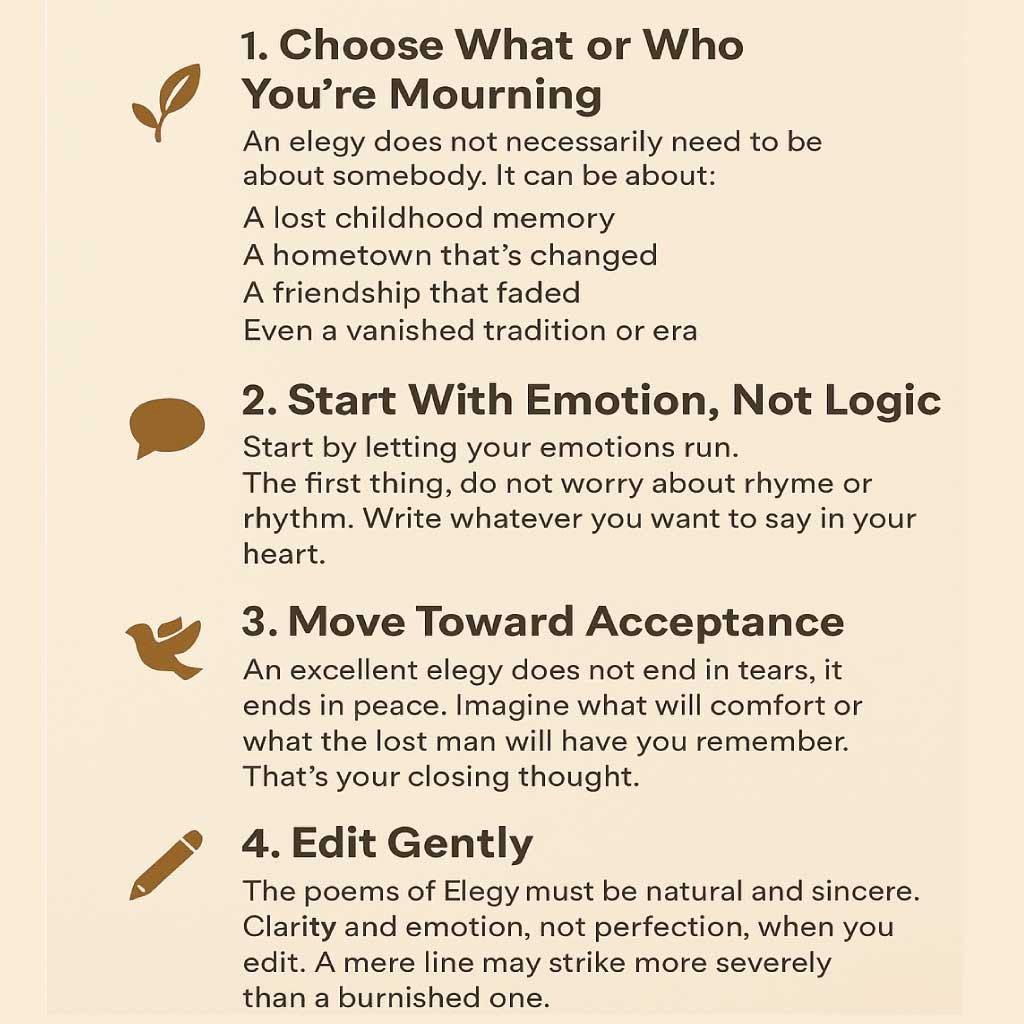
Here is the simple way to approach it:
🧩 Step 1: Choose What or Who You are Mourning
An elegy does not necessarily need to be about somebody. It can be about:
- A lost childhood memory
- A hometown that’s changed
- A friendship that faded
- Even a vanished tradition or era
The key is emotional truth — something that mattered to you.
🧠 Step 2: Start With Emotion, Not Logic
Start by letting your emotions run. The first thing, do not worry about rhyme or rhythm. Write whatever you want to say in your heart.
Ask yourself:
- What do I miss most?
- What moments do I keep replaying?
- What lesson or light did this loss leave behind?
🎭 Step 3: Move Toward Acceptance
An excellent elegy does not end in tears, it ends in peace. imagine what will comfort or what the lost man will have you remember. That’s your closing thought.
📝 Step 4: Edit Gently
The poems of Elegy must be natural and sincere. Clarity and emotionally, not perfection, when you edit. A mere line may strike more severely than a burnished one.
Example:
“You left quietly, without a sound,
But your laughter still fills the room.”
Common Mistakes to Avoid When Writing Elegy Poems
Even seasoned poets fall on their feet when such a theme is concerned. The following are some of the pitfalls to be avoided:
Over-dramatizing pain: It is tempted to make every line weep, but too much sadness can feel forced. Balance grief with gentle reflection.
Losing structure: A good elegy has flow, from sorrow to remembrance to calm. Jumping around emotionally can confuse readers.
Being too general: Specific memories make the poem real. Instead of saying “you were kind,” say “you always brought tea when I was tired.”
Forgetting hope: Elegies are about healing, not endless despair. Even one hopeful image, like sunlight breaking through, can transform the whole tone.
💖 Why Elegy Poems Still Matter Today
Our world is a fast-paced one, and you realize the sorrow is usually buried under the Instagram cheerful face. Elegy poems slow us down. They grant us the rights to feel. Here is the point, it is not only about lamenting a person in poetry but it is about knowing oneself. It assists you in working out feelings that cannot be expressed in words. Elegies are also secretly written by many individuals not to be published, but merely to survive. And that’s perfectly okay. Due to silence, writing is the only solution to peace with sometimes.
Modern uses of elegy poems:
- Writing tributes at funerals or memorials
- Sharing remembrance posts online
- Healing after personal loss or trauma
- Honoring heroes, mentors, or even cultural icons
🔍 Elegy vs Other Poem Types: A Simple Comparison
The majority of the people mix up elegies with other emotional poems, such as ode or epitaphs. In this brief comparison to clear that up:
| Feature | Elegy | Ode | Epitaph |
|---|---|---|---|
| Purpose | Mourning and reflection | Celebration or praise | Brief tombstone inscription |
| Tone | Sad but thoughtful | Joyful or admiring | Formal, concise |
| Length | Medium to long | Usually short | Very short |
| Example Theme | Death of a loved one | Beauty of nature | “Here lies a kind soul” |
So, while an ode celebrates life, an elegy mourns it, but both connect to deep human emotion.
🌤️ Who Elegy Poems Are Ideal For
To write and to appreciate an elegy you do not need to be a poet. Actually, they suit well every person who is full of emotions but is unable to share them with simple words.
Elegy poems are perfect for:
- Writers processing grief or heartbreak
- Students learning emotional poetry forms
- Artists who want to express remembrance
- Anyone seeking personal healing through writing
You know what it means to have something heavy in the breast, and be unable to describe it in words because, when you were a child, you had experienced the meaning of an elegy.
⚖️ Pros and Cons of Writing Elegy Poems
To tell the truth, it is not simple to write about loss. However, it also has its challenges and gifts just like most meaningful things.
✅ Pros:
- Deeply healing — helps you process emotions
- Builds empathy and emotional awareness
- Turns pain into something beautiful
- Connects readers through shared human experience
❌ Cons:
- Can be emotionally draining to write
- May reopen old wounds
- Hard to balance sadness and hope
And yet the majority of poets would say – the emotional release that follows the writing of an elegy is worth it. It is like one is shutting a door in a loving manner.
💡 Quick Tips for Writing a Meaningful Elegy
Here are some small but powerful tips that can elevate your poem:
✨ Use sensory language — sights, sounds, smells help readers feel the memory.
❤️ Keep it personal — even one real detail makes the poem alive.
🕊️ Don not rush the ending — let your tone shift naturally toward calm.
📖 Read classic elegies for inspiration — notice how they blend grief with grace.
☕ Write in a quiet moment — elegies need emotional stillness, not hurry.
A Gentle Example of a Modern Elegy
“For My Father’s Old Chair”
The wood still creaks where you used to sit,
A ghost of warmth beneath the dust.
I almost hear your Sunday hum,
A low tune about faith and trust.Years have gone — the paint has peeled,
But I can’t bring myself to mend.
Some things aren’t meant for fixing,
Just remembering, my old friend.
See? It’s simple, honest, and heartfelt. That’s the magic of an elegy, it speaks softly but deeply.
🌅 Why Elegy Poems Heal Both Writer and Reader
You will not believe the feeling of relief through writing or reading elegies. As soon as you read what you are grieving about, you will be able to confront it, not to become its victim. Readers also tend to be comforted that they are not alone through elegies. All human hearts are familiar with loss, elegies only provide it with words. Some even suggest poetry journaling as a gentle method of dealing with grief to many therapists. You do not need to demonstrate it to someone. The process of writing suffices at times.
🕊️ Final Thoughts: Finding Beauty in Loss
Grief is universal and our treatment of the loss is what makes us. The elegy poems help us to remember that all grief and love have the same place the heart that cared a lot.
If you ever feel words rise inside you after losing someone or something dear, don not hold them back. Write them down. That is your elegy form, your private bridge between grief and grace. Remember, an elegy is not about death, it is about life remembered.
And sometimes, remember is the most beautiful form of love there is.
So go ahead — open your notebook, breathe, and let your heart speak.
🍃 Curious about the charm of 👉 haiku poems? Learn their definition, explore the classic structure, and enjoy vivid examples that capture moments in just 17 syllables. Check out the full post to master the art of haiku!