
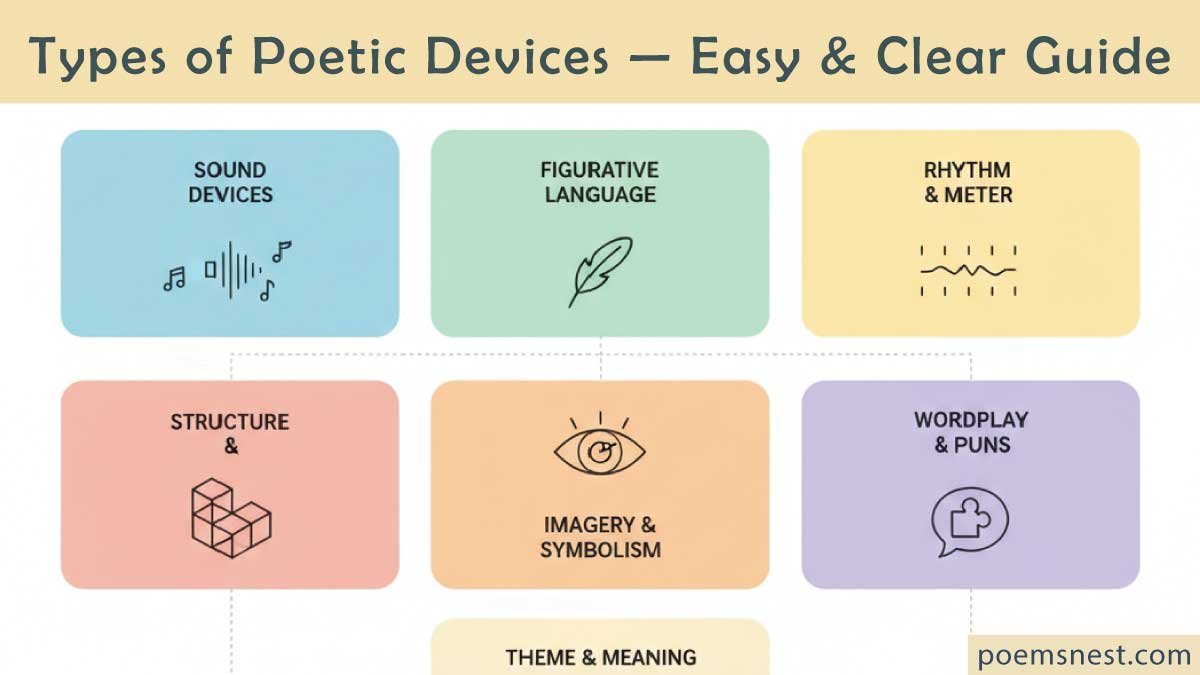
Have you ever read a poem and said to yourself, Wow, how did they get the words to sound that beautiful? you are not alone. What most individuals do not know is that behind each motile line or witty verse, their are some concealed tricks at play known as poetic devices. These are the little instruments of the poet they are instruments that make rhythm, arouse feeling and transform commonplace sentences into memorable poetry.
However, this is where the issue comes in: poetic devices do not belong only to poets. They are in songs, novels, speeches and even in the common language. Therefore, when you have always wanted to know how poetry works, this guide dissects the various forms of poetic devices in everyday simple language, without having to use the literary jargon, but rather giving the real life and simple instances of the same which you can relate to.
What Exactly Are Poetic Devices?
Let’s start simple. Poetic devices are devices employed by writers that help in making the words sound beautiful, emotional or even more powerful. They may be sound-playing, structure-playing (such as repetition) or semantic-playing (such as metaphors). You can imagine them like the spices that make a meal, you can write without them, but once you begin it with spices, then your writing will taste a lot better.
It will amaze you how poetic devices probably are used by you far more frequently than you usually think. Have you ever told someone that time flies or your heart skipped the beat? The thing is metaphor and personification!
Why Poetic Devices Matter
The thing is like this, not that poetry is all about what is said, but how it is said. Poetic devices help writers:
🎵 Add rhythm and flow so words feel musical.
🎨 Create vivid imagery so readers can see, hear, or feel what’s written.
💭 Express emotion in ways plain language never could.
🧠 Make messages memorable by using patterns or sound effects.
Poems would become one-dimensional and one-dimensional without the use of poetic devices. Yet in their presence, even the most basic concept such as describing rain, can be made magical.
For example:
“It’s raining outside.” (Plain)
“The sky wept over the quiet streets.” (Poetic)
Same meaning, completely different feeling.
Main Types of Poetic Devices (Explained Simply)
The number of big families of poetic devices is a few. We will examine each of them using examples (you will know them at a glance).
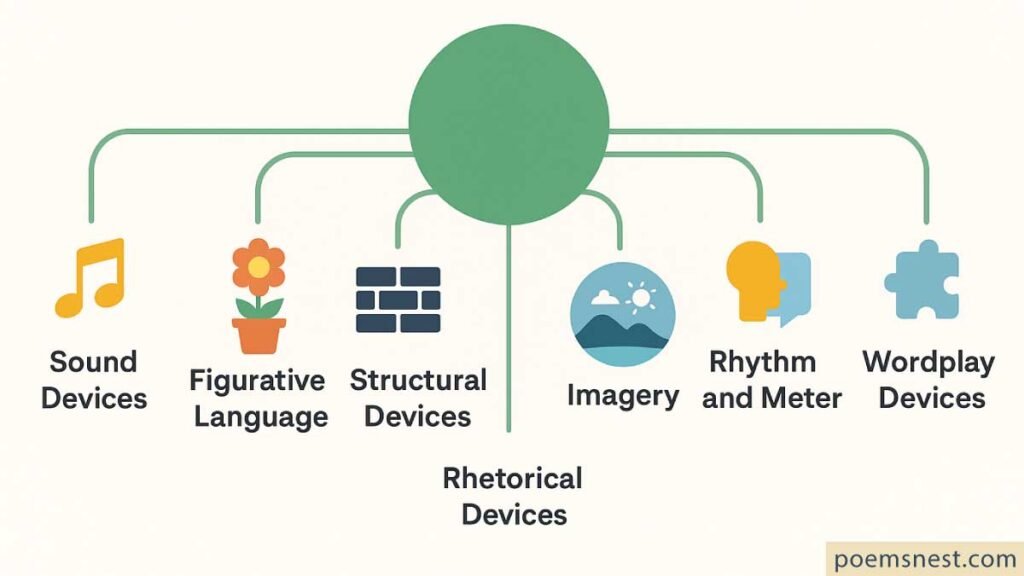
🎵 1. Sound Devices — The Music of Poetry
Sound devices render poetry good. They make rhythm, melody and musical flow – even by being read without sound.
Alliteration
This is when several words start with the same sound.
“Whispering winds wandered wildly.”
Alliteration gives a smooth, rhythmic feel and is often used in tongue twisters, slogans, and poems.
Quick tip: Too much alliteration can feel forced — keep it natural.
Assonance
Repeating vowel sounds inside words.
“The early bird catches the worm.”
The repeated “ir” sound creates a gentle echo that’s pleasing to the ear.
Consonance
Repeating consonant sounds within or at the end of words.
“The ship sailed to the shore.”
It’s subtle but adds harmony to lines.
Onomatopoeia
Words that sound like their meaning.
Buzz, crash, whisper, bang!
These bring poetry to life by appealing directly to the senses.
Common mistake: Many beginners mix up assonance and alliteration. Remember:
- Alliteration = same starting sound.
- Assonance = same vowel sound.
🌿 2. Figurative Language — Painting Pictures with Words
This group concerns itself with imaginings. Poets do not present things directly, they compare or symbolize things in order to make them more emotional or significant.
Metaphor
A direct comparison without using “like” or “as.”
“Time is a thief.”
It doesn’t literally steal, but it takes moments away — a powerful way to express passage.
Simile
A comparison using “like” or “as.”
“Her smile was like sunshine.”
Similes make complex emotions easy to picture.
Personification
Giving human traits to non-human things.
“The flowers danced in the breeze.”
This makes writing lively and relatable.
Symbolism
Using an object to represent something bigger.
A dove = peace.
A storm = conflict or struggle.
Symbolism adds layers of meaning beneath the surface.
Pro tip: Do not combine too many metaphors on a single piece of writing, this may bewilder the reader rather than impress him.
🧱 3. Structural Devices — How a Poem Is Built
The appearance and movement of a poem on the paper can have an influence on the way it is read and experienced. A poem has structure that is provided by the structural devices.
Rhyme
Probably the most famous device — words that sound alike.
“The moon above, the stars of love.”
Rhyme makes poetry musical, but not every poem needs it.
Repetition
Repeating words or phrases for emphasis.
“Never give up. Never give in.”
It reinforces emotion or theme and helps readers remember key ideas.
Enjambment
When a line continues without a pause onto the next.
“I think I could
see the stars breathing.”
This creates suspense and flow.
Anaphora
Repetition of words at the beginning of lines.
“I dream of peace,
I dream of home,
I dream of love.”
Used often in speeches and emotional writing to create power and rhythm.
🎨 4. Imagery — Showing, Not Just Telling
Imagery is among the most relevant poetic device. It attracts your senses, sight, sound, touch, taste and smell to make the readers experience what occurs.
Example:
“The scent of fresh rain clung to the soil as thunder rolled in the distance.”
You can almost smell the rain and hear the thunder. That’s imagery at work.
Common mistake: Visual images are their only aid to beginners. Make sure to use other senses, sound, taste and touch bring your writing to life.
🧠 5. Rhetorical Devices — The Art of Persuasion
Poetry is not always about beauty, sometimes it’s about impact. Rhetorical devices make your message stronger or more thought-provoking.
Hyperbole
Exaggeration for emphasis.
“I’ve told you a million times!”
We all know it’s not a million — but the point comes across loud and clear.
Irony
When what happens is the opposite of what you expect.
A fire station burns down.
Irony adds surprise or humor.
Oxymoron
Two opposite ideas side by side.
“Bittersweet memories.”
This creates emotional complexity — life isn’t always black and white.
Parallelism
Repeating a grammatical structure for rhythm or clarity.
“Easy come, easy go.”
Simple but very catchy.
💬 6. Rhythm and Meter — The Beat Behind the Words
Poems are not always consciously aware of having a heartbeat, a rhythm of stressed and unstressed syllables. That’s the meter.
Rhythm gives poetry movement and flow.
For example:
“Shall I compare thee to a summer’s day?”
(From Shakespeare’s Sonnet 18)
You can almost tap your fingers to its steady beat.
Tip: Read your poem aloud. When it sounds monotonous, change the rhythm – when speaking poetry, we should feel as though it is a song.
💡 7. Wordplay Devices — Clever Tricks of Language
Poetry can be based on wit, humor and surprise. These machines are more entertaining and provocative.
Pun
A humorous play on words with multiple meanings.
“Time flies like an arrow; fruit flies like a banana.”
Funny, clever, and memorable.
Allusion
A subtle reference to another text, person, or event.
“He met his Waterloo.” (referring to Napoleon’s defeat)
It lets writers say a lot with just a few words.
Euphemism
A softer way of saying something harsh.
“He passed away” instead of “He died.”
Poets tend to employ euphemism in a bid to deal with sensitive topics mildly.
Who Should Learn Poetic Devices?
Honestly — everyone who writes. Be it you are a student or a songwriter or content creator or you are simply someone who loves sharing your emotions through words, it is wiser to know poetic devices to make your writing better and more interesting.
Students can improve literature essays and analysis.
Writers can add depth and emotion to storytelling.
Public speakers can sound more persuasive.
Even everyday communicators can make their words more impactful.
When you want to be beautiful with feelings – you are best to start with poetic tools.
Common Mistakes People Make with Poetic Devices
You can be easily lost and this is most especially when you initially find out that these tools are so engaging. However there are some pitfalls to be avoided:
❌ Overloading your writing. Too many devices can feel unnatural.
❌ Forcing rhymes. Don not bend grammar or logic just to make things rhyme.
❌ Mixing metaphors. Keep your comparisons consistent.
❌ Ignoring clarity. Emotion is good, confusion isn’t.
❌ Copying tone. Don’t imitate famous poets, your voice is what makes poetry unique.
The trick is balance. The best poems feel effortless, not over-decorated.
Quick Comparison: Plain Writing vs. Poetic Writing
| Feature | Plain Writing | Poetic Writing |
|---|---|---|
| Style | Straightforward | Expressive & layered |
| Rhythm | Often flat | Musical flow |
| Language | Literal | Figurative & symbolic |
| Emotion | Subtle | Deep & personal |
You mean that the poetry writing is depth-giving and emotional? Though it is not about the use of fancy words, it is about building a connection.
Pros and Cons of Using Poetic Devices
Pros:
- Makes writing more expressive and emotional
- Builds rhythm and flow
- Engages the reader’s senses
- Enhances memorability and impact
Cons:
- Can feel exaggerated if overused
- Some readers may misinterpret complex imagery
- Takes practice to use naturally
Bottom line: Be poetic, employ such devices as seasoning,–only enough to make your writing flavor good, not to choke it.
Practical Tips for Beginners
You are just beginning, then here are just a few tips on how poetic devices can help you out:
Start small. Focus on one or two devices per poem or paragraph.
Read aloud. Poetry should sound good, not just look good.
Notice patterns in songs. Lyrics are full of poetic devices.
Edit slowly. Good poetry is written from the heart and refined with the mind.
Stay honest. Let your emotions lead — devices should enhance feeling, not replace it.
Final Thoughts: Poetry Is Closer Than You Think
The common belief about people is that Poetry is tough or outdated yet in reality, it is all around us, in the songs we sing, the quotes we give and even the jokes we make. When you begin to be mindful to poetic devices, you will look at the world in a different light. You will see the way words play, the way rhythm is talking and how one metaphor can do more than the thousand paragraphs could do. Then play with words to-day. Challenge yourself to a simile, rhyme or explain something mundane in an exciting manner. The better you practice the more poetic devices will come out on your pen (or keyboard) which is natural to you.
Your words already have power — poetic devices just help them shine brighter.
🌿 Unlock the secrets behind 👉 poetic devices — the tools poets use to turn simple words into art! Learn their definition, explore different types, and see how they’re used to create emotion. Read the full post to feel the poetry come alive!